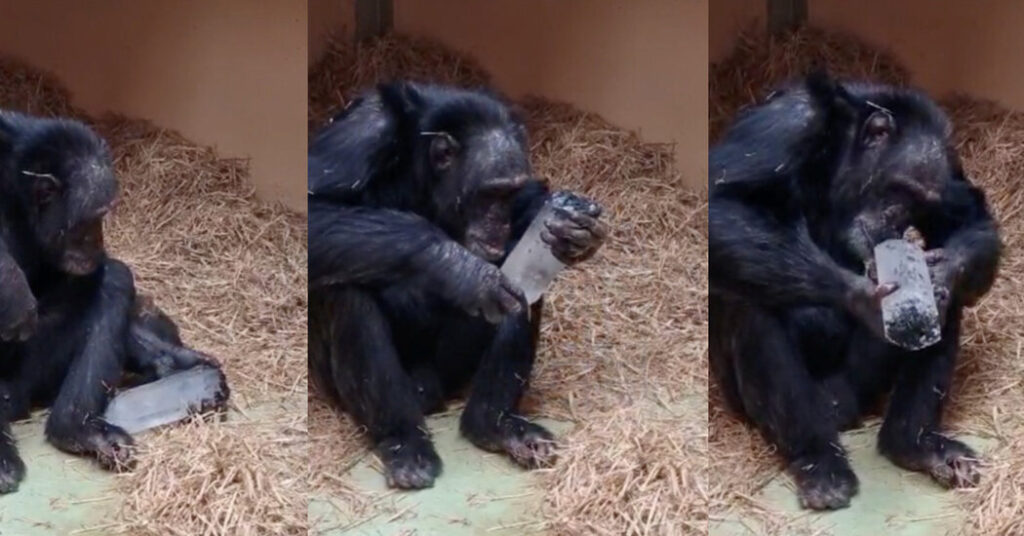
If you give a chimp a crystal, she might not give it back.
Researchers learned this the hard way. They gave quartz, calcite and other types of crystals to chimpanzees in a rehabilitation center. The apes responded with great interest, and the researchers ended up needing to trade large amounts of bananas and yogurt to get back the largest crystal. Others were never retrieved.
The crystal chimp study, published on Wednesday in the journal Frontiers in Psychology, was an attempt to understand what about the shimmering minerals is so attractive to the apes’ closest cousins, us. It was led by Juan Manuel García-Ruiz, a crystallographer at Donostia International Physics Center in Spain.
Dr. García-Ruiz has spent most of his career investigating the material properties of crystals, as well as their research applications. But he’s also very interested in “the impact of crystals on the history of art and the history of mind,” he said. Discoveries of quartz and other crystals at archaeological sites suggest that prehistoric predecessors of humans gathered these stones as far back as 700,000 years ago. Researchers haven’t found evidence that they were turned into tools, ornaments or anything else useful.
Contemporary humans also love crystals, and sometimes ascribe to them healing or other supernatural properties. “Some colleagues say, ‘We have to tell people that this is completely ridiculous,’” Dr. García-Ruiz said. “But for me, what’s important is to tell people why” this belief exists.
To discern what drew our ancestors to crystals, Dr. García-Ruiz decided to show some to chimpanzees. He and his team worked with two groups that were housed separately at Rainfer Fundación Chimpatía near Madrid, which helps chimps rescued from difficult situations.
For the first experiment, the researchers used two pedestals that were installed in the chimps’ yards. On one, they placed a multifaceted quartz crystal that stood about a foot tall, and on the other, a sandstone rock of similar dimensions. (Dr. García-Ruiz named this experiment “The Monolith” inspired by the world-changing object in Stanley Kubrick’s “2001: A Space Odyssey.”)
The chimps went crystal cuckoo.
In one yard, they repeatedly approached the monolith until the alpha female, Manuela, wrenched it off its pedestal. After that, the crystal rarely left the troop’s sight, while they largely ignored the sandstone rock. One video shows a 50-year-old male chimp named Yvan carrying it while he climbs and eats cabbage, passing it between his hands and feet with great panache.
In the other yard, the experiment was cut short after a chimpanzee named Sandy immediately grabbed both items from their pedestals and brought them into the dormitories, where human caretakers don’t generally go.
The other group also eventually brought the quartz to the dorm. Getting it back required the aforementioned prolonged negotiations with the chimps, which suggests that the animals “value the crystal,” Dr. García-Ruiz said.
For the second experiment, researchers set out piles of pebbles in the gardens, with a few small crystals incorporated into each. The chimpanzees immediately sorted the crystals out of the piles.
Then they carried them in their mouths, turned them in the light and held them up to their eyes like old-timey prospectors. When the researchers eventually set up cameras inside the chimp dorms, they saw that Yvan was still gripping one as he prepared to relax in his hay nest. (The research team has been unable to find or retrieve many of these smaller crystals, Dr. García-Ruiz said.)
Based on their data and observations, the researchers proposed that the chimps were attracted by the crystals’ transparency and shape.
They seemed to also be experiencing “something beyond curiosity,” Dr. García-Ruiz said. Watching them added heft to one of his more speculative theories: He believes that crystals, as “the only Euclidean object in nature,” may have helped humans invent geometry and unlock abstract thought.
Outside experts were more measured in their interpretation of the results.
The chimpanzees in the study “apparently share our own fascination with lustrous and translucent objects,” said Michael Haslam, an archaeologist at Historic Environment Scotland who studies how animals use tools. But the backgrounds of these particular chimpanzees as rescued animals, along with the small sample size of the study, make it difficult to generalize further.
And drawing broader conclusions about exactly why chimps like crystals — and whether these characteristics also appealed to the hominid ancestors of humans, or influenced our thought patterns — goes “a few steps too far,” Dr. Haslam said.
He added that other animals such as bowerbirds are also drawn to crystalline objects.
“While the attraction is clear, the underlying motivation is not,” he said.
Dr. García-Ruiz is hoping to perform similar experiments with wild chimpanzees. Unlike those raised among humans, “they have no idea about polyhedra and Euclidean geometry,” he said. “I think that will be even more interesting.”
The post Chimpanzees Are Really Into Crystals appeared first on New York Times.