Kevin R. Parker is a cyclist and writer in Prince William County, Virginia.
When I was 7 years old, I rode my bike beyond the end of the block for the first time to a shopping center a few streets away. Despite the short distance, it felt like a grand adventure. I remember riding along the shaded walkway in front of the stores, gliding across the smooth concrete with nobody else around, carrying the knowledge I had gotten myself to this seemingly exotic place on my own.
Decades later, I still remember that first feeling of freedom. Thanks to my bike, my world got bigger.
A bicycle doesn’t require a license, registration, insurance or fuel. You don’t need an app or a subscription. You just get on and go. In an era when your car can track where you drive and report it to your insurance company, the freedom a bicycle offers is appealing. It is a form of transportation available to children, grandparents, minimum-wage workers, and anyone with legs and a sense of balance. Bicycles offer genuine freedom of movement in a world that offers less of it every year.
E-bikes extend that freedom. Those who can’t manage hills anymore can ride again. Someone who lives a little too far from work for a regular bike suddenly has another option for the commute. E-bikes make the world bigger for more people. But policymakers are hard at work designing regulations that curtail this freedom.
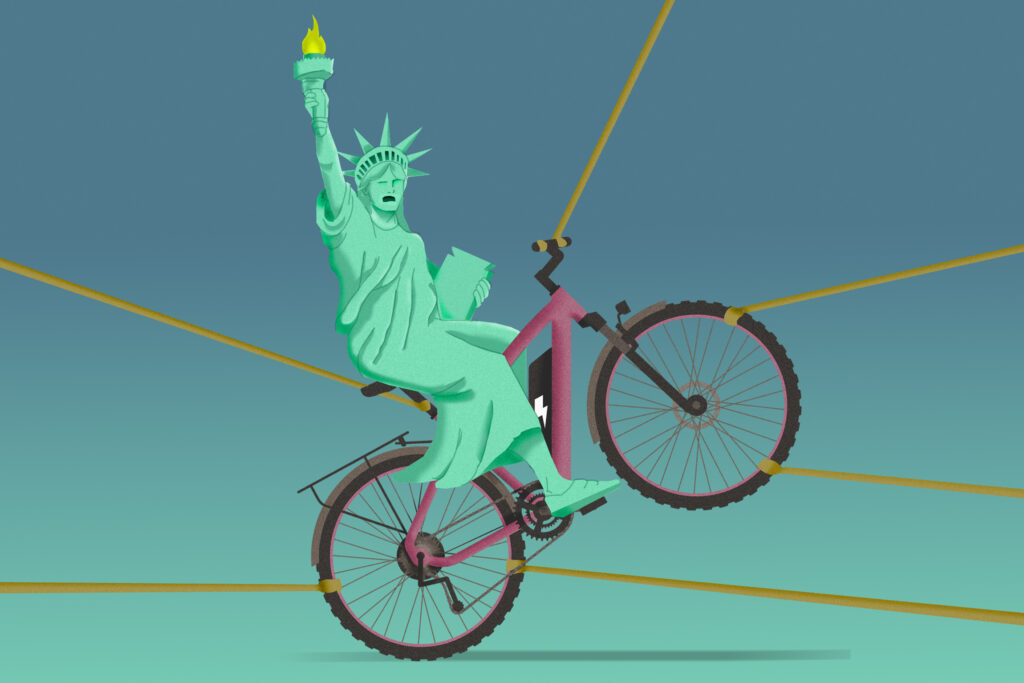
Last month, New Jersey Gov. Phil Murphy (D) signed the most restrictive e-bike bill in the country into law. Every e-bike rider in the Garden State — including those on pedal-assisted models — now needs a license, registration and insurance. Riders must be at least 15 years old. The law was rushed through the legislature and signed on Murphy’s last full day in office, over the objections of cycling and transportation groups.
The justification for New Jersey’s legislation is safety. A 13-year-old boy was killed on an e-bike when he collided with a landscaping truck in September, and there are real safety concerns for riders and pedestrians when it comes to faster and more powerful e-bikes. E-bikes that hit high speeds can be a problem. But the law doesn’t distinguish between different kinds of e-bikes when it comes to licenses, registration and age limits. A 70-year-old on a pedal-assist bike riding to the grocery store is treated identically to a teenager on a powerful e-bike doing 40 mph. The proposed regulations are a blunt instrument that restricts transportation options and increases cost for people.
New Jersey isn’t alone. Cities across the country are debating new regulations, and not just for e-bikes. After Murphy signed the bill into law, New Hampshire introduced a bill requiring a $50 annual registration fee on all bicycles that operate on paths, roads or trails funded by state or local government, including children’s bikes. In California, progressive Bay Area communities have moved to ban or restrict e-bikes on paths and in public parks — the same communities that spent years and millions promoting alternatives to cars, now cracking down on the most effective alternative.
When he signed the law, Murphy said the updated regulations were needed to “prevent tragedies from occurring.” Defending onerous regulations by citing a need to make citizens safer is not new. Midwestern cities started banning sledding on public hills — not because sledding had become more dangerous after generations but because of potential liability. The joy of flying down a hill was suddenly off-limits for children in these in towns and cities. The danger presented by e-bikes is greater than sledding, and accidents have been on the rise. But legislators shouldn’t respond with blanket regulation that doesn’t recognize different types of bikes and the risks they pose. There are other ways to address safety concerns without raising bureaucratic and financial barriers for bike riders who are following the rules. Florida — the most dangerous state for cycling in the country — just passed legislation introducing new speed limits on e-bikes and requiring local law enforcement to track crashes involving e-bikes.
In the name of reining in out-of-control e-bike riders flouting existing laws that are inadequately enforced, lawmakers are regulating 14-year-olds exploring their towns on their own for the first time and grandparents who need a little help to keep biking around their neighborhood. And yet, this issue seemingly has no political home.
Activists fighting e-bike restrictions frame it as climate policy or transportation equity. The political language focuses on progressive political priorities. There’s a stronger argument to be made based on personal liberty: State governments are restricting personal mobility and imposing licensing and registration on bike riders across the board. There are reckless e-bike riders who break the rules of the road and put themselves and other citizens at risk. If they violate the speed limit, ignore traffic lights or blow through stop signs, local law enforcement should hold them responsible. But by pursuing aggressive blanket regulation, policymakers are making a basic form of transportation and a familiar element of childhood less accessible.
The walkway where I rode as a child almost certainly has signs now. No bicycling. No skateboarding. No loitering. We have become quite good at forbidding small freedoms in the name of safety and liability, and bad at noticing what we’ve lost.
The post Bikes make life freer. These laws could change that. appeared first on Washington Post.