Jake Korolev has written letters to Con Edison, asked the utility to check his meter and filed a complaint with regulators. He is vigilant about turning off his lights and even his breaker when he leaves town. But his power bills are still north of $400 a month.
“Between rent and energy, I can’t save money,” said the 28-year-old, who works in the live music industry and lives in Bushwick, Brooklyn. “It weighs on me every month.”
As demand for power has soared in the United States, sky-high electricity bills have followed, contributing to an affordability crisis across the country. Gov. Mikie Sherrill of New Jersey declared a state of emergency on utility costs on her first day in office, and President Trump broached the topic with Mayor Zohran Mamdani during their first meeting at the White House.
It’s these concerns that have prompted Gov. Kathy Hochul of New York to consider drastic changes to the state’s 2019 climate law, the implementation of which, her agencies say, could lead to even higher energy bills.
In New York, among the 10 most expensive states in terms of electricity costs, the battle over utility rates is pitting climate activists and like-minded legislators, who believe it’s crucial to aggressively ramp up solar, offshore wind and other green energy projects, against supporters of Ms. Hochul’s “all-of-the-above” approach, which emphasizes a balanced mix of energy sources, including nuclear.
Natural gas, which heats nearly half the homes in New York and generates nearly half the state’s electricity, is at the center of the debate. So is the climate law, which was considered a trailblazer when it was introduced seven years ago because of its ambitious goals to reduce greenhouse gas emissions. While both sides agree that gas is expensive, they have differing opinions about how to keep costs low.
Ms. Hochul’s camp, which includes some moderate Democrats, argues that penalizing polluters through the climate law will drive up oil and gas prices when too many New Yorkers remain dependent on fossil fuels for electricity, heating and cooking.
The law’s “timetables are proving unachievable,” a statement from the Business Council of New York State, which represents large and small businesses, said in February. (The state is expected to be at least six years late in meeting its first target of a 40 percent decrease in emissions by 2030.) It is time to “pump the breaks” on the climate law, former Lt. Gov. Robert Duffy, a Democrat, wrote in a social media post.
Activists and many lawmakers remain committed to meeting the goals of the law, which calls for New York to get 70 percent of its electricity from renewable sources such as wind, solar and hydropower by 2030 and to shift entirely to carbon-free power a decade later. But they fear that Ms. Hochul is taking steps to amend the law, and that it could fall victim to the backroom dealings that are common in Albany.
“It’s crystal clear the governor is trying to jam changes to the climate law into secret negotiations around the budget,” said Blair Horner, a senior policy adviser at the New York Public Interest Research Group, a nonpartisan advocacy group. “The public will find out what happened after the fact.”
At a news conference on Monday about the energy and affordability crisis, Ms. Hochul, who has considerable latitude to amend the law, seemed transparent about her intentions. “I’m raising the alarm,” she said, adding that she hopes to engage the Legislature soon in a robust conversation about energy costs.
State Senator Liz Krueger, a Democrat, said that the climate law was not to blame for rising energy costs. “That’s nonsense, and everyone knows it,” she said. Her office cited one report that said that households making less than $200,000 a year would benefit from a core program of the climate law, which charges polluters for exceeding emissions limits and uses the proceeds to invest in renewable projects and energy-efficiency initiatives.
But last week, that idea was challenged when the New York State Energy Research and Development Authority sent a memo to Ms. Hochul saying that if the state began penalizing polluters, it could cause oil and gas prices for New Yorkers to increase by as much as $4,000 a year.
The memo, which did not include details on how the authority had come up with those figures, seemed to prompt the governor to hold the news conference. “There are going to be enormous costs to families for us to meet the goals on the time frame that was set out by the Legislature,” Ms. Hochul said, referring to the climate law.
The governor, who is up for re-election this year, is two years late in releasing the regulations for the law, meaning that much of it has yet to be implemented. In the fall, a judge told her to publish the rules by the end of February. She has appealed that decision, saying she needs more time to review and possibly amend them.
Activists assert that the memo, sent from an agency that Ms. Hochul oversees, is a pretext for weakening the climate regulations.
Amending the law “will do nothing to address the state’s reliance on costly gas, which is the true driver of higher energy bills,” Liz Moran, a New York policy advocate at Earthjustice, a nonprofit group, said this week. The memo sent to the governor “is based entirely on contrived economic estimates” and “fails to account for policies like rebates or energy bill credits,” the New York City Environmental Justice Alliance, a nonprofit, said in a statement.
Ms. Hochul said on Monday that in 2019, “no one foresaw” the obstacles that lay ahead for the climate law, including supply chain bottlenecks and inflation related to the coronavirus pandemic. Other factors that made developers of renewable energy abandon major projects included the war in Ukraine, as well as President Trump’s tariffs on imports and his general resistance to renewable energy. Recent turmoil in the Middle East is expected to contribute to rising oil and gas costs, she added.
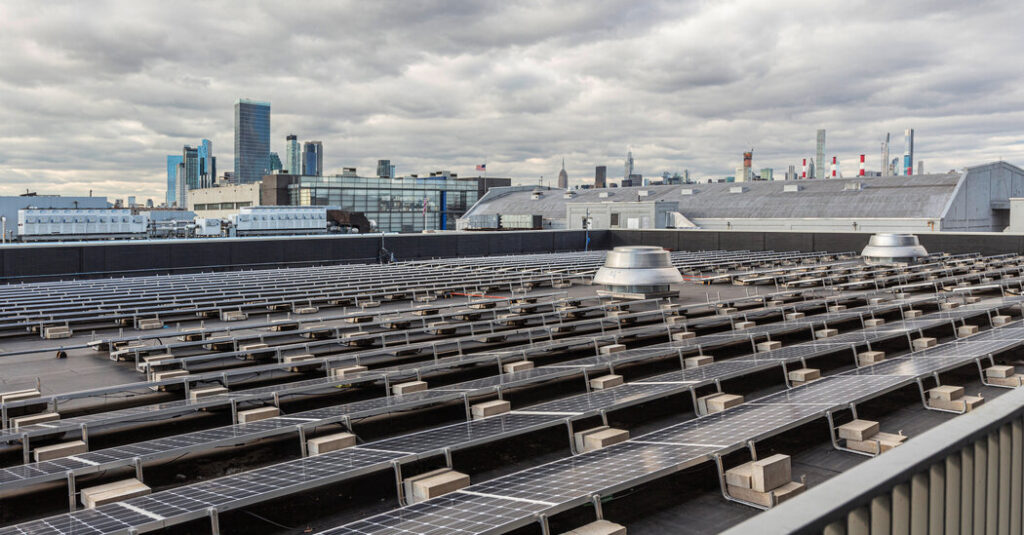
Activists and politicians said that the climate law could reach its goals without depending on penalizing polluters. They want to develop more solar energy, which has been a rare renewable success story in New York, as it has across the country and the world. They said that the state should double the number of small-scale solar projects, subsidize solar installations and ratchet up energy-efficiency programs for low- and middle-income New Yorkers.
Pete Harckham, a Democratic state senator who represents parts of Westchester County and the Hudson Valley, is supporting 12 measures that would expand affordable solar energy and said that energy costs were the No. 1 complaint his office received. “And the costs have everything to do with the price of natural gas,” he said.
The solution, Mr. Harckham said, is to depend less on gas, not more.
Sean Ewart, Ms. Hochul’s deputy secretary for energy, wrote in a recent opinion essay that all manner of energy resources should be developed to meet the state’s skyrocketing electricity demands, which could increase up to 24 percent by 2040, according to the most recent draft of the state’s energy plan.
Grace Ashford contributed reporting.
Hilary Howard is a Times reporter covering how the New York City region is adapting to climate change and other environmental challenges.
The post As New York Energy Costs Surge, Attention Turns to Landmark Climate Law appeared first on New York Times.