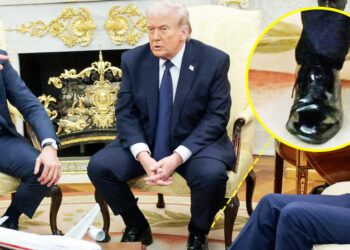
While meeting with Chancellor Friedrich Merz of Germany in the Oval Office on Tuesday morning, President Trump decided to publicly answer reporters’ questions about his war on Iran for the first time.
One of the first questions he got was this: What does he imagine the worst-case scenario in Iran to be?
“I guess the worst case would be we do this and somebody takes over who’s as bad as the previous person,” he said. “Right, that could happen? We don’t want that to happen. It would probably be the worst, you go through this, and then in five years you realize you put somebody in who’s no better.”
Right, that could happen.
He was unflinching on Tuesday about the new war he has kicked off in the Middle East. He insisted it was necessary, and he talked about all the people he said have been thanking him ever since it started. But he also acknowledged, in more ways than one, that he’s not so sure how any of this might wind up.
He could give his “worst case” scenario but he didn’t seem able to give his best case scenario. When asked who he would like to rule Iran, Mr. Trump responded bluntly: “Most of the people we had in mind are dead.”
Come again?
“Now we have another group,” he continued. “They may be dead also, based on reports. So I guess you have a third wave coming. Pretty soon we’re not going to know anybody.”
It was an admission that will do nothing to quell the uproar in Washington that the Trump administration does not have a clear end game in mind.
Mr. Trump said Tuesday that he went to war because Iran was about to attack its neighbors and Israel, and he made the decision to attack so as to pre-empt that action. (Officials with access to U.S. intelligence have said that Mr. Trump has exaggerated the immediacy of any threat Iran posed to the United States.)
“We were having negotiations with these lunatics, and it was my opinion that they were going to attack,” Mr. Trump claimed. He bristled when asked if his hand had been forced by Israel. “If anything,” Mr. Trump retorted, “I might have forced Israel’s hand.”
More than 800 people have been killed in the conflict across the Middle East since Saturday, when the United States and Israel launched their opening attacks. The war has incited a tumult in global markets that intensified on Tuesday, with stocks and bonds slipping and oil and gas prices surging because of attacks on production facilities and tankers and because of Iran’s threats to close the Strait of Hormuz.
At the White House, Mr. Trump basically shrugged at the rising oil prices. “So, if we have a little high oil prices for a little while,” he said, “as soon as this ends, those prices are going to drop.” But by the afternoon, he seemed to be grasping the kind of trouble that rising oil prices could cause for him.
“If necessary, the United States Navy will begin escorting tankers through the Strait of Hormuz, as soon as possible,” he wrote on social media. “No matter what, the United States will ensure the FREE FLOW of ENERGY to the WORLD.”
After the Oval Office meeting, two senior administration officials spoke to reporters to continue making the president’s case for war. At one point, the officials were asked about what Mr. Trump had described as his worst-case scenario for Iran. Who might lead this nation of 90 million people once the fighting stops, they were asked.
The officials told the reporters to refer back to the president’s answer. Which of course was not really an answer at all.
Shawn McCreesh is a White House reporter for The Times covering the Trump administration.
The post Who Will Lead Iran? Trump’s Answer Suggests His End Game Is Still Hazy. appeared first on New York Times.