President Trump has made destroying Iran’s stockpiles of ballistic missiles and launchers a top priority in the war, but Tehran has unleashed waves of another deadly weapon.
Since Saturday, Iran has launched as many as 2,000 drones across the Persian Gulf region. Two hit the U.S. Embassy in Riyadh on Tuesday. And military officials say it was probably an Iranian one-way drone that killed at least six U.S. service members in Kuwait on Sunday.
U.S. military officials initially said that the strike in Kuwait took place at a base that housed U.S. troops. Officials now say the attacks occurred at the Kuwaiti port of Shuaiba about 20 miles away, where Army troops were working in a temporary office space.
In the run-up to the U.S.-Israeli strikes in Iran, U.S. Central Command dispersed troops and personnel in the region, moving them away from military bases that could be targeted by Iran in retaliatory attacks.
But in trying to avoid one threat, the dispersal may have made the American troops more vulnerable to another, military officials said. U.S. bases are fortified in anticipation of drone attacks, while hotels and makeshift office spaces are not.
“They are hitting not just military bases; they’re attacking our embassies directly,” Secretary of State Marco Rubio said on Monday. “They’re attacking facilities that have nothing to do with war or with the military.”
Over the last decade, drones have changed the face of warfare. Cheaply made and easily deployed, they have reshaped battlefields from Ukraine to the Middle East. Iran, which years ago developed its own drone system, the Shahed, is now using it to strike targets — including so-called soft civilian targets — across the region.
Iranian drone strikes have targeted hotels in the region, including those where American troops have been dispersed, military officials said.
Attacks have rocked other Gulf cities including Dubai in the United Arab Emirates and Manama, the capital of Bahrain, and have reached as far as Cyprus. The fortifications at embassies were built to withstand many kinds of attacks, but not waves of drones.
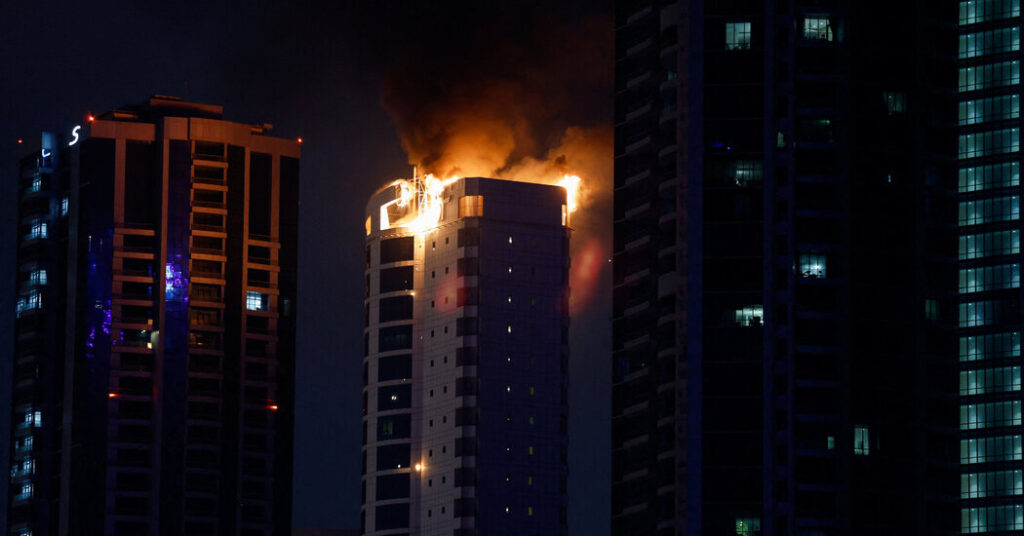
The Pentagon and Middle Eastern countries say that most of the drones have been intercepted. But some have slipped through. A major fire broke out at an oil storage site in the United Arab Emirates on Tuesday after debris from a drone interception fell inside an energy zone in Fujairah.
The difficulty in intercepting drones was evident in figures released on Sunday by the United Arab Emirates. At that point, Iran had fired 165 ballistic missiles, two cruise missiles and 541 Iranian drones at the country since the war had begun on Saturday. The missiles were intercepted or fell into the sea, but 21 drones struck civilian targets.
“Nobody can defend everywhere, of course, so it’s easy targets and a high return on use of an asset,” said Maj. Gen. Paul D. Eaton, a retired Army veteran of the war in Iraq.
General Eaton said that Iran’s flurry of drone attacks could be a sign that it is running short of weaponry and is trying to inflict maximum damage with its remaining stockpiles.
For the United States, a big part of the problem may be that the regime in Tehran is fighting for its very survival, with nothing to lose, said Vali Nasr, an Iran expert at Johns Hopkins University.
“For Iran, this has to be the last war,” Mr. Nasr said in an interview. “They want to make the West believe that wars with Iran will be really costly,” so that the next country to attack Iran will think twice about the fallout.
Iran’s Shahed drones have had a transformative impact on modern warfare, notably arming Russia with swarms of the deadly weapons to launch nightly in Ukraine — and now Tehran is sending waves of them across the region.
Iran’s Shahed drones were designed by the Shahed Aviation Industries Research Center, an Iranian company that works with the country’s Revolutionary Guards. One of their first deployments was in July 2021, when they struck an Israeli-owned oil tanker, according to Israel’s defense ministry.
While ballistic and cruise missiles fly much faster and pack a bigger punch, they cost millions of dollars and are available in relatively limited quantities. A Shahed drone costs tens of thousands of dollars.
“The key to this aspect of the war will be intercepting them as cost-effectively as possible so that the finite number of Patriot interceptors are reserved for ballistic missiles,” said Jeremy Binnie, a Middle East defense specialist at Janes, a defense intelligence firm based in London.
Mr. Binnie said air forces of the Gulf Arab nations could use air-to-air missiles to knock down drones, preserving the scarcer supplies of the more expensive Patriot interceptors for Iranian ballistic missiles. He said Iran has several thousand one-way attack drones in its arsenal.
Defense Secretary Pete Hegseth said the strike that killed troops on Sunday in Kuwait occurred when a “squirter” made its way through American air defenses. He did not indicate what kind of weapon it was, but said that “it happened to hit a tactical operations center that was fortified, but these are powerful weapons.”
A U.S. military official said that the operations center that was hit was not as fortified as most American bases.
Iranian proxy militias in the region have also joined the drone attacks. The Islamic Resistance in Iraq said in a statement on Sunday that it had launched 23 drone attacks targeting U.S. facilities across the Middle East, including the American consulate and the international airport in the Iraqi city of Erbil.
Another Iranian proxy group claimed responsibility for drone attacks on U.S. bases in Erbil.
Eric Schmitt is a national security correspondent for The Times. He has reported on U.S. military affairs and counterterrorism for more than three decades.
The post U.S. and Allies Encounter Iran’s Arsenal of Drones appeared first on New York Times.