“It’s a pleasure to meet you,” Michael Spyres, who is singing Tristan in the Metropolitan Opera’s new production of “Tristan und Isolde,” said during a recent rehearsal break. “Now I have to go die.”
Were it so simple. Tristan’s death scene in the opera’s third act is always complicated: It’s nearly an hour long and glacial in pace, yet, if done well, riveting in its depiction of Tristan’s psychological agony as he succumbs to his drugged passion for Isolde and the hallucinations ushering him into the next world.
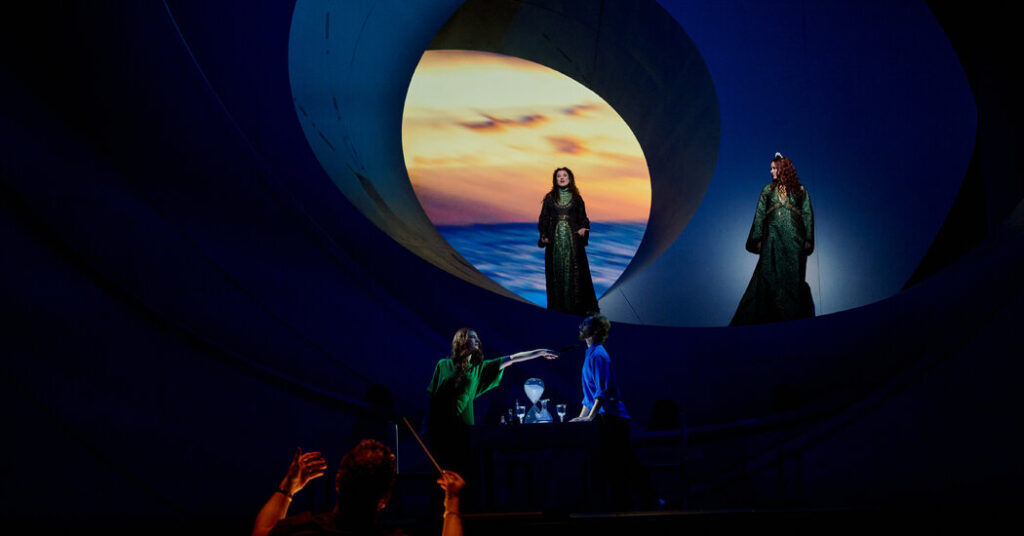
But this new production, which opens on Monday, suggests another level of complexity. There are two Tristans, not one: Spyres dying as he stumbles through a tunnel that appears to float from the rear of the stage to the front, and his double, lying on an operating table at the front of the stage, with a doctor tending to him. At times, they trade places as their parallel worlds — “fable and table,” as the director calls them, one metaphysical and the other mundane and ritualistic — merge and reinforce each other.
The opening of “Tristan” promises to be a milestone for the Met. Its Isolde, Lise Davidsen, is one of the most acclaimed sopranos today and a leading star of the company. And it is being staged by Yuval Sharon, who is making his Met debut after two decades as one of the most adventurous, disruptive and barrier-breaking opera directors on the scene.
“Tristan” is the beginning of a five-year partnership for Sharon and the Met. He will direct Wagner’s four-part “Ring,” which the company will begin with “Das Rheingold” in the 2027-28 season and continue through 2030, when the entire cycle will be presented, with Davidsen as its Brünnhilde.
The decision by the Met, which easily fills its 3,800 seats for tradition-bound productions of classics like Puccini’s “La Bohème,” to turn to Sharon, known for his daring approach to opera, for two cornerstones of its repertoire represents a notable and high-profile gamble. Three weeks before the opening of “Tristan,” all seven performances were close to selling out (The one on March 21 will be simulcast to cinemas as part of the Met: Live in HD series.)
“Nobody wants to see a conventional telling of ‘Tristan,’” said Peter Gelb, the Met’s general manager. “When it comes to ‘Tristan,’ I think their expectations are more to the abstract rather than the realistic, because of the nature of the opera. I can assure you that this production will be unlike anything anyone has seen at the Met or anywhere.”
Throughout Sharon’s career, he has fought the notion of opera as sedentary. In his 2024 book “A New Philosophy of Opera,” he wrote that directors should “unsettle the audience” to keep this art form urgent and provocatively relevant. In the book he described “Tristan” as “the single hardest work in the traditional repertoire to stage.”
In an interview, Sharon said that philosophy had animated him as he approached “Tristan,” an opera that arrived in 1865 like “the monolith that dropped from the sky in ‘2001,’ from this totally different world,” he said, referring to “2001: A Space Odyssey.” His vision of “Tristan” tells a story not just of love and death, but of love, death and rebirth. “The secret is that birth and death are a circle,” Sharon told Spyres during that rehearsal of his final moments. “You are not dying. You are being reborn.”
The onstage tunnel signifies both the final and first moments of life; Sharon likened it to a birth canal.
“We see two ways of dying,” Sharon said. “We see Tristan dying in, I think, a very tragic — and I think what Wagner would say, the wrong way, which is clinging to his ego, clinging to a sense of individuality, holding on to who Tristan is and unable to let go. He dies in a way that’s very painful, but it’s also very recognizable for us in the audience.”
By contrast, he said, Isolde surrenders. “She surrenders to the mystery of life,” he added. “She doesn’t philosophize the way Tristan does, but she sings the language of her final transfiguration.”
Sharon’s staging cost $3.6 million, on the upper end of the scale for a single production. It fills the stage and is the first production, Gelb said, to use the entire height and width of the proscenium: Shimmering, futuristic, a feast of colors and video. “That becomes a real projection screen,” Sharon said to Davidsen, gesturing to what will be the back of the stage as he described the moment she first catches sight of Tristan. “You see his face. You see his eyes.”
The stage is anchored by a centerpiece that will transform over the three acts, from the ship on which Tristan carries Isolde to Cornwall to marry King Marke, to the tunnel, with all its narrative symbolism. Downstage, another story plays out. The table represents what Sharon called a separate reality of the opera: Singers sharing a drink in the first act, gathering for a banquet in the second and watching the operating table where Tristan dies in the third.
“At a time when opera needs to make a statement as to why it exists, I think it’s important to really come out with big, bold statements and say, ‘This is why,’” Sharon said. “We’re taking big risks. We’re taking big swings, we’re trying new things.”
The mezzo-soprano Ekaterina Gubanova, who is singing the role of Brangäne, Isolde’s servant, said she has appeared in 300 performances of “Tristan” and has been struck by its power with audiences, whether it is framed as a modern or a traditional tale.
“There is some witchcraft in it,” she said. “It really touches people, sometimes unexpected people, people who are not into music. It touches them to their deepest core.”
Spyres said that Sharon’s staging was not intended to “shock anyone” or to confuse or distract the audience “We had this conversation about how our job as performers is to bring the audience along with us and not to say, ‘You need to be doing this’ or ‘You need to be thinking this way,’” he said. “We are not in your face trying to fight, or cause cognitive dissonance unnecessarily.”
This is only the second time Davidsen has sung Isolde; she recently made her role debut at the Gran Teatre del Liceu in Barcelona. The bass-baritone Ryan Speedo Green is singing the role of King Marke for the first time before starring as Wotan in the Met’s “Ring.” Yannick Nézet-Séguin, the Met’s music director, will conduct, leading his first fully staged “Tristan.”
“There are very few pillars in this music — it feels like it flows, right from the start,” Nézet-Séguin said of the opera. “It’s set on a boat and it’s on an island. That is mirrored in the music. For a conductor, there is very little to grasp onto. You have to swim with it, and especially make sure that nobody drowns.”
Davidsen said that Sharon had “done great preparation” before arriving for rehearsals, but that while he had strong opinions about this presentation, he was not dogmatic in directing the cast. “That creates for me a better space,” she said. “He makes me better because he questions a lot of things. He makes me think about things over and over again.”
Sharon has no shortage of experience with Wagner’s operas. In 2018, he directed “Lohengrin” at the Bayreuth Festival in Germany, becoming the first American to stage one of Wagner’s works at his own festival. In the United States, he has isolated the third act of “Die Walküre” as its own show, and he adapted “Götterdämmerung” for a parking garage in Detroit during the pandemic.
Sharon, now 47, founded the Industry, a groundbreaking opera company in Los Angeles in 2010. The company, among other things, presented an opera, “Hopscotch,” that took place in 24 cars traveling across the region. In 2020 he was appointed artistic director of the Detroit Opera, where, in addition to his innovative interpretations of Wagner, offered a production of Puccini’s “La Bohème” staged with the four acts in reverse order. He left that role last year, two years before the end of his contract, as the company, citing retrenchment by some of its biggest donors, told Sharon he would not be able to mount any new productions in the near future.
Gelb, even in offering high praise for Sharon, suggested that his vision for “La Bohème” might not have worked in New York. “Quite frankly, I don’t think Met audiences are interested in ‘La Bohème’ backward,” he said. “I do think they’d be interested in ‘Tristan’ being explored to all of its metaphysical heights.”
Sharon wrote in his book about the “public shaming” of being pelted with boos at the 2019 opening of his “Magic Flute,” an audacious replacement for a traditional and beloved staging at the Berlin State Opera. He is thus understandably wary of how the Met audience, which has been known to express displeasure at directors on opening night, might respond to his new vision of an opera that has cast a spell on listeners for centuries. Even if they, as he expects, are riveted by the lavish sets and Wagner’s lush music.
“There will likely be some people for whom this is going to be challenging,” Sharon said. “I think that that is part of the growing process for what opera is for the future.”
Adam Nagourney is the classical music and dance reporter for The Times.
The post The Met Opera Gambles on a Visionary Director for Its New ‘Tristan’ appeared first on New York Times.