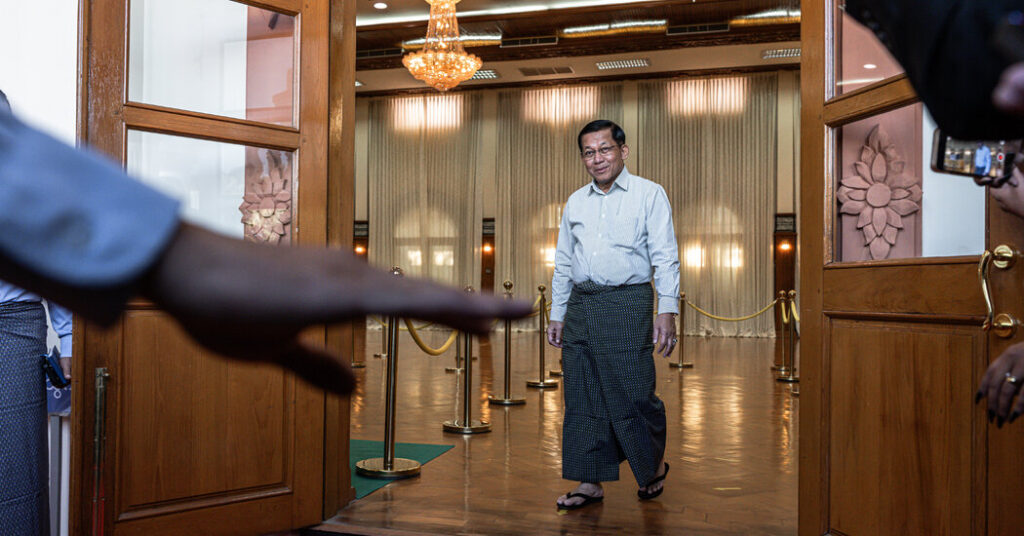
Myanmar’s military ruler collects titles. Senior General. Army Commander in Chief. Brave and Glorious Protector of Buddhism. Great Hero of the Union of Myanmar. Defender of Truth. Doctor of Public Administration. Acting President.
Now Senior Gen. Min Aung Hlaing appears ready to add president to that list.
He has signaled in private that he plans to step down as army chief as early as this month, said two military officers and one retired officer, who asked not to be identified for fear of reprisal. He would need to relinquish the military title because Myanmar’s constitution requires the posts of president and army chief to be held by different people.
The civilian role would give him a veneer of legitimacy, five years after he executed a coup and installed a regime that has ravaged the country and decimated its economy.
“Min Aung Hlaing is obsessed with being president and obsessed like someone who wants to be king,” said U Kyee Myint, a constitutional expert in Myanmar.
But in a country where the military holds the ultimate power, stepping aside as army chief could be risky.
In a bid to legitimize its rule, the junta held an election in December and January, but it was neither free nor fair. Pro-democracy parties were banned, opposition leaders remained imprisoned, and voting was held in only half the country. As expected, the big winner was a military-backed party that will play the main role in selecting a president.
After General Min Aung Hlaing cast his ballot in December in Naypyidaw, the capital, a reporter asked whether he would now become president.
“I am a civil servant,” he replied. “I cannot demand or decide the position I want.”
In fact, over his 15-year tenure as army chief, there have been few limits on his power. During that time, he has compiled a record of death and destruction: persecuting the Rohingya people in what is widely considered a genocide, overthrowing an elected government, killing unarmed protesters in the streets, bombing civilians with fighter jets, driving millions from their homes and wreaking havoc on the economy and health care system.
“People hate the military and they hate him,” said David Mathieson, an independent political analyst who lived in Myanmar for many years before the coup.
The general’s actions have been in keeping with the grisly tradition of Myanmar’s military, which was founded during World War II by Burmese nationalists who sealed their pact with a blood oath.
A career soldier, he graduated from the Defense Services Academy in 1977. Known for holding grudges and bullying younger cadets, he earned the nickname “cat feces.”
Under his leadership in 2016, the military began the ethnic cleansing of its Muslim Rohingya population, eventually forcing more than a million to flee the country.
Western countries imposed economic sanctions on the leading generals and in 2024, a prosecutor at the International Criminal Court in The Hague requested a warrant for his arrest for crimes against humanity.
The general has long signaled his regal ambitions. In 2020, a year before the coup, he visited Htilominlo, a temple in the ancient city of Bagan rich with symbolism for Burmese rulers.
More than 800 years ago, a king with five sons held a ceremony with his five sons and arranged them in a circle with a sacred ornament, or hti, in the middle. When the hti leaned toward the youngest son, the king declared it had chosen the young prince as his successor. As king, the son built the 150-foot tall Htilominlo temple on the spot. Roughly translated as the King’s Wish temple, it has seen a parade of leaders come to pray that they will someday be king.
During his visit, General Min Aung Hlaing prayed and took part in the rare ritual of a placing a new hti atop the temple, which is now a World Heritage site. Photos of the event show him offering a part of the hti to Buddhist monks for their blessing and tossing bank notes to people gathered for the event.
Even now, residents of Bagan refused to discuss his visit, saying they were afraid of reprisal.
“He displayed himself as kind of a king,” said Amara Thiha, a Yangon-based fellow with the Stimson Center, a think tank in Washington. “He is saying, ‘I am now performing the duty that a Burmese king has the responsibility to do.’”
His quest to become president appears rooted in his rivalry with Daw Saw Aung San Suu Kyi, 80, the beloved civilian leader and Nobel peace laureate he deposed in the coup. She remains imprisoned in an unknown location with no access to her lawyer, doctor or family members.
With a new Parliament set to convene this month, becoming president is now well within General Min Aung Hlaing’s grasp. The military will control more than three quarters of the seats, including the 25 percent appointed by the commander in chief.
Mr. Mathieson, the analyst, said, “It seems like whatever route he picks, he has set himself up to be in charge in the next iteration of the regime.”
Sui-Lee Wee contributed reporting.
The post A Junta Chief Eyes the Title of President appeared first on New York Times.