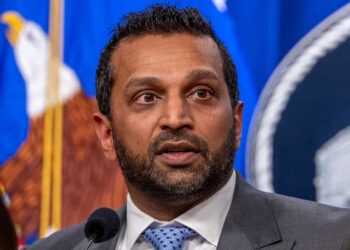
The X feed of right-wing firebrand and podcaster Katie Miller has all the signatures of an acolyte of President Donald Trump. She blasts out attacks on the “transing” of kids, taunts the mainstream media and lobs slurs designed to trigger the left.
But recently that Make America Great Again fire hose has also contained posts that seem off-brand for the former GOP official, whose spouse is Trump’s domestic policy chief Stephen Miller.
“Solar energy is the energy of the future,” Katie Miller posted recently. “Giant fusion reactor up there in the sky — we must rapidly expand solar to compete with China.” Another of her posts suggested solar is more vital to the U.S.than coal power, contradicting White House messaging and policy.
Trump has been blunt about his distaste for solar panels, calling them a “blight” on the landscape, “very inefficient, and very ugly too” and — along with wind turbines — “THE SCAM OF THE CENTURY.” His administration has blocked hundreds of projects from final approval as it prioritizes fossil fuels.
Yet Katie Miller is no outlier in her willingness to buck MAGA orthodoxy on energy from the sun.
A growing number of prominent Trump allies — including former House speaker Newt Gingrich, veteran strategist Kellyanne Conway and GOP pollster Tony Fabrizio — are promoting solar as electricity demand surges and energy affordability climbs the list of voter concerns.
Their clean energy advocacy may be having an impact, as the White House signals it is reconsidering power from the sun. The tone of Trump himself has even changed.
In an interview, Miller said solar is crucial to delivering on the right’s energy and AI dominance agenda. “Look at what Australia did,” she said. “Solar solved their rolling blackout issues. President Trump has prioritized lowering the cost of energy for the American people … I am simply advocating that solar can and should be a driver of the solution.”
Asked if she is getting paid for her advocacy, like some other MAGA heavyweights promoting solar, Miller would not comment. Regardless, these full-throated endorsements of a renewable energy source that has been much maligned by Trump and his advisers represents a departure from what had been a pillar of the MAGA energy agenda.
It reflects a realization taking hold more broadly among Republicans that solar power — long embraced by liberals — is increasingly indispensable to America’s bid to dominate AI, close a yawning “electron gap” with China and contain runaway residential electricity costs. These conservatives describe it as crucial to U.S. competitiveness, the grid’s reliability and their own movement’s political survival. Climate change rarely enters the conversation.
The United States is in the midst of the largest increase in electricity demand in decades, driven by the explosive growth of data centers, giant warehouses of computers built to power AI tools and other software. Tech companies have warned that their ability to expand is increasingly constrained by a lack of available power.
Solar is one of the few options for bringing new electricity generation online quickly — projects can often be planned and connected to the grid in a fraction of the time required for new fossil and nuclear energy sources.
Together with battery storage, solar will account for 79 percent of the new capacity added to the U.S. power grid this year, according to the federal Energy Information Administration. Most of it is destined for Republican states, with 40 percent going to Texas alone.
While the Trump administration’s work to delay permits, cancel projects, gut federal clean energy programs, eliminate climate rules and attack state clean energy targets puts solar power at a disadvantage compared to gas, coal and nuclear energy, it is under increasing pressure from its political base to consider leveraging solar panels to address the U.S. energy crunch and affordability crisis.
Signs the White House is yielding to it emerged last week when the Interior Department revealed it is allowing several large-scale projectsit had blocked to resume moving through the permitting process, acknowledging such installations align with Trump’s energy agenda. In a call with reporters last week, Energy Secretary Chris Wright, who has called solar power “just a parasite”on the power grid, also changed his tone.
“Is there a commercial role for solar power that can add to the grid affordable, reliable energy?” he said. “Certainly there is.”
Not everyone on the right is onboard.
“China loves the ‘we must rapidly expand solar’ narrative because they produced more panels than the market wanted,” Alex Epstein, a fossil fuels enthusiast and free markets influencer, wrote on X in response to a Miller post.
“They are using those panels not to power their grid, which unreliable solar cannot do, but to intermittently save fuel for the coal plants and other reliable plants that do power their grid.”
But such critiques are increasingly overshadowed by the right’s solar supporters. Among the loudest of them may be on-again, off-again Trump adviser Elon Musk, whom Miller worked for as he designed and executed the president’s initiative to slash the federal workforce.
Musk is now throwing his influence behind a moonshot effort to wrest solar manufacturing away from China. His company, Tesla, is planning to build factories that would manufacture 100 gigawatts of solar cells annually in the United States — which the billionaire says will be a linchpin of the U.S. data center boom.
The panels produced each year would harness as much energy as generated by 100 legacy nuclear reactors. Musk’s plans also include solar-powered data centers in space.
There are signs that MAGA support for solar is gaining traction among a wider set of activists.
“Solar and wind power are popular,” Gingrich, a longtime adviser to Trump, wrote in a recent op-edthat warns against federal policies that penalize them. “In the right areas, they make a ton of sense. Further, these technologies grow cheaper and more reliable every year.”
Gingrich did not respond to requests for comment.
In Virginia, a coalition of conservatives pushing for more solar power is printing “Make Solar Great Again” hats. In Wisconsin and other states, legislative Republicans are leading a push to allow farmers to generate power from solar installations on underutilized acreage.
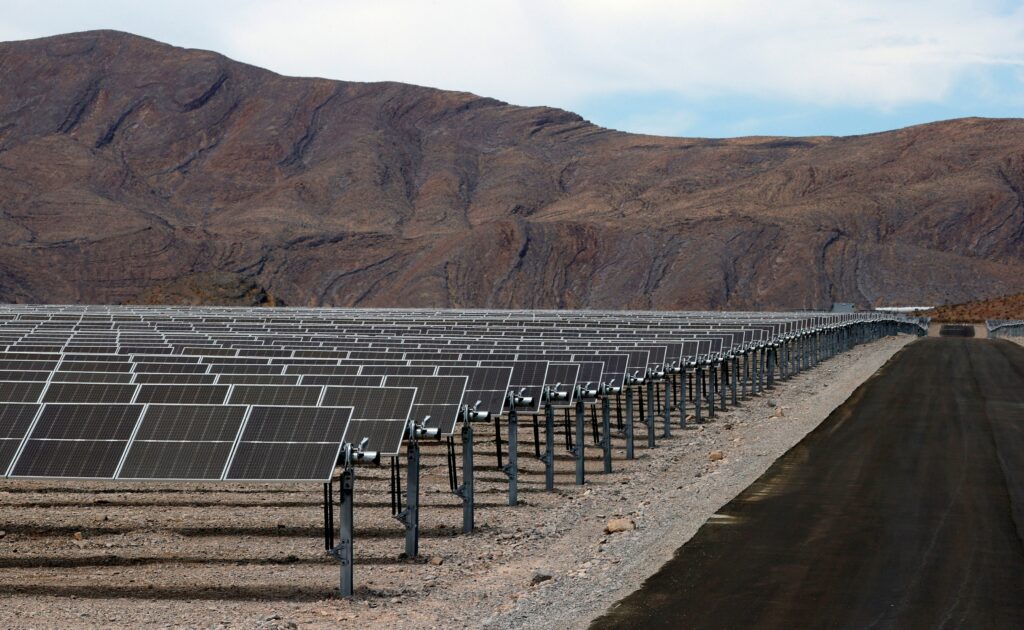
In Nevada, Republican Gov. Joe Lombardo has been boastingabout his ability to talk the Trump administration into advancing three industrial solar projects it had blocked: Libra Solar, Dry Lake East and Boulder Solar III. The projects would sprawl across thousands of acres.
Some Republicans are more comfortable embracing solar now that the GOP-controlled Congress has dismantled tax breaks for the solar industry, which were seen by many conservatives as unfairly tilting the scale in favor of solar panels in the name of a climate crusade they did not endorse.
Now, with the playing field more level, some on the right are crunching the numbers and seeing that solar — often paired with battery storage — is still in many cases the fastest, cheapest option for getting new power online.
“We’re a net importer of energy here and we need to understand how to generate more of our own,” said Wisconsin state Rep. Scott Krug, a Republican. His bill would allow any farmer to use up to a few dozen acres of underutilized land — often where irrigation and other equipment might be stationed — for private solar installations that would feed into the power grid. The proposal has the potential to provide a massive amount of power statewide, he said, and free up energy on the grid for such things as data centers.
In an ironic twist, it is Democrats and utilities fighting the bill, arguing the installations would effectively get subsidized by other ratepayers.
Among the farmers eager to enlist are Trump voters like Lloyd and Ruth Klahn, who have been farming crops including corn and soybeans on their 250-acre farm in Rutland, Wisconsin, since they got married 64 years ago. “We want to save this land for our kids,” said Lloyd Klahn, 86. “By putting solar in now, the grandkids can have something in the future.”
A Richmond-based group funded by industry and philanthropists called Energy Right has been working with conservatives there to push solar forward in the statehouse and local communities. “We’re working to reshape the narrative and show folks in D.C. that people in Trump Country across rural America see the value of this from an economic perspective,” said CEO Skyler Zunk, who worked for Interior Secretary David Bernhardt during Trump’s first term. Energy Right has recently expanded into Louisiana, where it launched its “America First Energy Project.”
The solar industry is meanwhile working hard to sway Trump, enlisting two pollsters central to his political movement, Conway and Fabrizio, to build the case.
In an early February memo summarizing the results of a poll commissioned by the photovoltaic film manufacturer First Solar, Fabrizio’s firm wrote “that the belief by some on the right that solar energy is anathema to right-leaning voters is unfounded.” While The Post generally does not cite polls paid for by advocacy groups, that particular finding is consistent with previous independent polling.
One 2024 poll, by the Pew Research Center, found that while support by Republicans and Republican-leaning independents for solar farms had declined, they were still favored by 64 percent of those voters. They were favored by 91 percent of Democrats. A 2025 Gallup poll found Americans broadly support investment in alternative energy.
Where many Republicans draw the line is on prioritizing solar over other energy forms or bolstering it with government incentives, which independent polls have shown GOP voters generally oppose.
Among those giving solar another look is Trump. A video he promoted on Truth Social in late January evangelizes how solar can play a key role in the AI infrastructure build out. It features venture capitalist Chamath Palihapitiya, an ally of Trump’s AI and crypto czar David Sacks, arguing that tech companies should leverage a Trump-supported federal tax break to fund mass installation of solar panels on tens of millions of residential rooftops, paired with battery storage.
Palihapitiya says in the clip, from the “All-In” podcast he co-hosts with Sacks, that such an initiative would free up massive amounts of power on the grid to fuel data centers and factories, while slashing the electricity bills — possibly down to zero — for tens of millions of Americans.
Trump’s promotion of the idea struck Stephanie Bosh, a senior vice president a the Solar Energy Industries Association, as a sign the renewable energy source’s fortunes are shifting.
“We would not have seen that last year,” she said.
The post Why MAGA suddenly loves solar power appeared first on Washington Post.