Midway through the first movement of Mahler’s First Symphony, time briefly dissolves. The music returns to the shimmering haze of high violins that had opened the piece, before fragmentary bird calls and a startled trumpet signal stir to life and eventually morph into melody. The cellos trace a series of falling fifths: pensive, sighing gestures that seem to belong neither to the expectant realm of the awakening sound nor to the social world of song that follows.
At Carnegie Hall on Friday, the cellists of the Vienna Philharmonic played these downward swoops with fingers gliding so languidly from one note to the next, the motif took on aching poignancy. That kind of audible slide, known as portamento, was common performance practice in Mahler’s era, but today most orchestras dismiss it as sentimental excess. In the hands of these musicians, though, the effect was ineffably melancholic, the manifestation in sound of human reluctance, a tender, stubborn revolt against the progress of time.
In miniature, the gesture also captured something about the orchestra itself. The Philharmonic has long cultivated continuity with its past in ways both loving and divisive, as in its late acceptance of women into the ensemble. Another jealously guarded tradition: This self-governing orchestra functions without a music director. For its annual Carnegie visit last weekend, the guest conductor was Andris Nelsons, leading typically conservative programs: symphonies by Mozart, Dvorak and Sibelius, a tone poem by Richard Strauss and — inevitably, as if by government decree — a Johann Strauss waltz for an encore.
Friday’s program also featured Bartok’s gracious Piano Concerto No. 3, with an underwhelming Lang Lang as soloist. A blip of contemporary music opened Saturday’s concert in the form of Gyorgy Kurtag’s “Petite Musique Solennelle,” an eight-minute processional of dark-hued brass, glacial bells and distantly gleaming trumpets, written for Pierre Boulez’s 90th birthday in 2015. It offered a tantalizing glimpse of what a powerful champion this orchestra could be of contemporary fare.
But when the Philharmonic comes to New York, audiences gather not for adventures in discovery but for inherited style, historical memory and, above all, the Vienna sound: plush strings, sunny woodwinds and velvety horns melting into a brass section layered with confectionary richness.
That sound, however, sometimes takes precedence over precision. Other critics have remarked on the surprising — even endearing — diffidence this elite ensemble has brought to rhythmic coordination on recent New York visits led by Franz Welser-Möst and Riccardo Muti. With Nelsons on the podium, structural cracks appeared whenever moving parts were meant to align. The first movement of the Bartok, for example, shuddered along with Lang pounding much of his part with toneless fury against an orchestra that seemed to splinter into camps aligned with either the soloist, conductor or concertmaster.
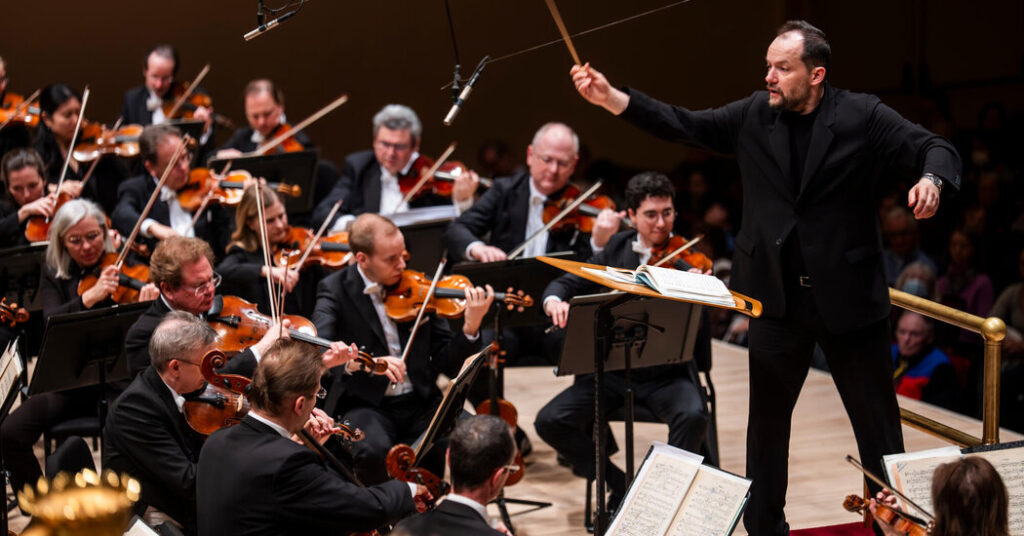
Such flaws seemed to be exacerbated by Nelsons, who appears as a solicitous micromanager on the podium. Swooping arm gestures sketch phrases, fingers tickle trills in the air, his torso undulates to a flute squiggle. Less apparent is metric clarity or an ear for balance. This was especially noticeable on Saturday in Mozart’s “Linz” Symphony, in which the first violins frequently dominated the texture. Mozart may grant them the melody, but without the grounding presence of second violins and violas, the music loses the umami depth that gives Classical transparency its strength. With 22 players in the violin section alone, the balance between instrumental families needed more careful attention. When strings and winds traded identical material in the finale, the woodwinds sounded threadbare by comparison.
But in Romantic repertoire, with its long melodies and surging formations of sound, the ensemble was unmistakably on home turf. In Mahler’s First, they proved fluent not only in the composer’s performance traditions but also in the folk idioms he absorbs, such as the off-kilter charm of the ländler and the rustic exuberance driving the second movement.
The highlight of the weekend came on Sunday, a pairing of Strauss’s “Also Sprach Zarathustra” and Sibelius’s Symphony No. 2.
Strauss’s opening fanfare, familiar far beyond concert halls from the film “2001: A Space Odyssey,” burst forth with radiant trumpets and a monumental timpani declaration, shaped with mystery and awe by the timpanist Thomas Lechner. Where other orchestras favor strident spectacle, the Philharmonic achieved overwhelming grandeur without hardness of tone.
With Sibelius’s Second, the concert ended on a high note. The finale grows patiently from the ground up: repeated cello scales, ruminative at first, gradually gathering confidence and mass, until the brasses rise above the texture in triumph. Lesser orchestras push toward the climax. Here the music organically, intoxicatingly, accumulated force on its way to an elated homecoming.
It almost felt like an answer to those wistful portamento slides in Mahler, where the finger lingered between notes as if reluctant to surrender to forward motion. By the end of Sibelius, hesitation had given way to momentum, the music unfolding with radiant certainty. Each time, emotion emerged from the sculpting of sound over time — and that sound, the Philharmonic once again reminded Carnegie’s audience, remains its star attraction.
The post Two Approaches to Musical Time, From the Vienna Philharmonic appeared first on New York Times.