It was the middle of the night when Charles Foehner, 65, left his apartment in Queens on a long walk to get cigarettes, with a silver revolver in his pocket. He told the police later that he had bought the gun at a bar in the 1990s and had it with him that night because he could not “take a beating at my old age.” It was one in a stockpile of firearms he had amassed over time.
Four miles away, Cody Gonzalez, 32, set off on his own walk toward the older man’s neighborhood, Kew Gardens. He had been pacing, agitated and talking to himself in the cramped apartment of Melinda Maldonado, a kind of surrogate big sister who had helped take care of him for years.
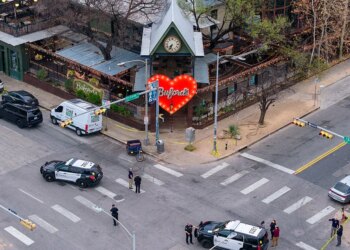
He had a history of mental illness, she said, and would typically go out walking when he became disturbed. By 2 a.m., Mr. Gonzalez was face to face with Mr. Foehner, who was just returning to his building through the back, a cigarette dangling from his lip.
A security camera captured what happened next: Mr. Foehner backing up down a driveway; Mr. Gonzalez, wearing a light jacket and backpack, lurching toward him; Mr. Foehner pulling out the revolver and pointing it at Mr. Gonzalez; Mr. Gonzalez reaching into his own pocket, pulling out his hand and wobbling forward.
Soon, he was dead.
Ms. Maldonado said she had worried something bad might happen if Mr. Gonzalez went out that night. But she had relented. He had always come back before.
“This time around,” she said, “it just didn’t work out that way.”
‘Waiting to Use That Gun’
There is crime, and there is the perception of crime.
People respond differently to what they see as threats, but the presence of a gun — in the hands of the feared or the fearful — can change the outcome of a potentially dangerous situation in unpredictable and irreversible ways for everyone involved.
Bernhard Goetz, an electrical engineer, shot four teenagers after they accosted him on the subway in 1984, when New York was far more dangerous than it is today. He was acquitted of attempted murder but convicted of possessing an illegal gun.
More recently, Daniel Penny, an ex-Marine, choked a homeless street performer to death when that man, Jordan Neely, was acting erratically on the subway and shouting at passengers. Public opinion polls at the time, in May 2023, showed that city residents feared rising crime even though crime rates were historically low after a pandemic-fueled spike.
Mr. Penny was acquitted of criminally negligent homicide in the killing of Mr. Neely, which illustrated how such chance encounters can be fatal even without weapons. But when Mr. Foehner went out for cigarettes that night, he had one.
“That guy to me, personally, is a vigilante,” Ms. Maldonado said. “He was waiting to use that gun.”
Mr. Foehner, interviewed by a detective shortly after the shooting, said it was a simple matter of self-defense.
“I thought he had a knife,” he said. “I thought my life was in danger and I didn’t want to die on the garage driveway.”
Mr. Foehner shot and killed Mr. Gonzalez in the early hours of May 31, 2023.
In the surveillance camera footage, the two men briefly move out of the frame after Mr. Gonzalez reaches into his pocket. Then the camera catches them again, and Mr. Foehner opens fire. Mr. Gonzalez staggers back toward the street and crumples to the ground. The police found his body in a pool of blood, a pen with a TD Bank logo in his right hand.
The shooting came just weeks after Mr. Neely was killed. It did not receive much news coverage. But like the encounters involving Mr. Goetz and Mr. Penny, it showed the sometimes serious consequences of such confrontations, especially as the odds rise that the average person has a gun. Since 2022, when the Supreme Court struck down a restrictive New York law that limited the carrying of guns in public, applications for concealed handgun licenses have surged in the city.
Cody Gonzalez
Ms. Maldonado said she had gotten to know Mr. Gonzalez during his childhood, when her sister worked with his adoptive mother, and that her family had taken care of him after his mother died. He had spent at least some of his life’s later years bouncing between jail and hospital psychiatric units, according to court, corrections and medical records.
Ms. Maldonado, who lives in the Oakland Gardens section of Queens, believed that Mr. Gonzalez was headed to Woodhaven when he was killed. He was a familiar figure in the area, especially near the intersection of Jamaica Avenue and 85th Street, a jumble of discount stores, bodegas, nail salons and other small businesses.
A few years earlier, he had been hospitalized after he was seen kicking cars and trying to steal from delis in the neighborhood, records show. During that stay, Mr. Gonzalez was listed as having anxiety, bipolar disorder, depression and schizophrenia. He was released after about a week despite attacking another patient and being labeled “a danger to self and others,” records show. He was brought back by ambulance a week later.
Mr. Gonzalez offered limited, sometimes conflicting, personal details to hospital staff members. He said he did not know his father and was homeless. He said he received $700 a month in disability benefits and that the antipsychotic and anti-seizure medications he had been given “mess with my emotions” and “make me feel numb.”
“As soon as I’m out of this hospital,” he said during one stay, according to the records, “I’m killing every single one of you.”
Mr. Gonzalez’s criminal record had a similar boomerang quality, with stretches in city jails mostly for petty crimes like criminal mischief. Some of the most serious cases against him came in 2020. In one, he was accused of ransacking an apartment, grabbing the tenant by the throat and, armed with scissors, threatening to kill him if he called the police. He pleaded not guilty to a misdemeanor trespassing charge and did not receive jail time.
A short time before he was killed, Mr. Gonzalez had left a residential treatment program he had been in for a year.
“He didn’t deserve to go out the way he did,” Ms. Maldonado said, adding: “He’s a kid that needs a little love and attention, and needed somebody to help him out with his mental illness condition. And all these people, they charged his Medicaid card and his insurance card, but they never actually gave him the real help that he needed.”
Charles Foehner
Mr. Foehner had no criminal record before shooting Mr. Gonzalez. He was living a retiree’s quiet life after working for many years at delis in Manhattan and then as a doorman.
He and his wife, Jenny Speed, a British immigrant with a job in book publishing, lived with their dog, Biscuit. The couple met working at the Stage Deli near Carnegie Hall. Ms. Speed was a waitress; Mr. Foehner, a cashier. They married in 2005.
The Stage closed in 2012. In an interview, Paul Zolenge, an owner, remembered Mr. Foehner as someone with a “nice personality” who was “a bit of an underachiever” and often late to work. Mr. Foehner was a manager for a time, but “it didn’t work out,” Mr. Zolenge said. “He was too friendly with the help.”
Mr. Foehner often closed up, sometimes as late as 1:30 or 2 a.m., and mentioned having a gun, Mr. Zolenge said. But “I never thought of him as a violent person,” he said.
Before moving to Kew Gardens, Mr. Foehner lived for many years in Richmond Hill, Queens. Jacob Duran, a neighbor there who knew him in passing, said he had read about the shooting and had been surprised to learn that Mr. Foehner was involved.
“He wouldn’t shoot that guy if he didn’t think he had to,” Mr. Duran said.
Daniel Szaroleta agreed. He grew up with Mr. Foehner in Richmond Hill and said his old friend “wouldn’t hurt a fly.” Mr. Szaroleta and his wife were among dozens of people who contributed to a “Free Charles Foehner” legal-defense fund online.
In the fund-raising appeal, Mr. Foehner wrote that he had carried a gun the night of the shooting because “New York ain’t what it used to be, safety-wise, so I took precautions to ensure my return home in one piece.”
Three years earlier, he had complained to The New York Post about an increase in lawlessness in Kew Gardens. “This isn’t our nice little neighborhood anymore,” he was quoted as saying.
‘There Are Too Many Shootings’
After the shooting, according to a police affidavit, Mr. Foehner saw that his hands were bloody. He grabbed Mr. Gonzalez’s backpack, rushed upstairs and called 911.
Paramedics arrived before the police and declared Mr. Gonzalez dead. A detective checked Mr. Gonzalez’s body, reviewed the security footage and went to Mr. Foehner’s apartment. There, he saw a bloodstained jacket on a recliner, with a silver gun — an unlicensed .38 caliber Smith & Wesson revolver — in one pocket.
Mr. Foehner was interviewed at a local precinct and said Mr. Gonzalez had demanded a cigarette, money and his phone and had brandished what looked like a weapon. The police returned to his apartment with a search warrant and, in addition to the .38, found eight revolvers, eight semiautomatic pistols, an AK-47 and eight other long guns, including two more assault-style weapons. All but three of the 26 guns were illegal. Also seized were two body-armor vests and 152 large-capacity ammunition-feeding devices, 10 of them loaded.
A hobby, Mr. Foehner told the police.
He was taken into custody. The judge at an arraignment said there were “strong defenses in regard to self-defense” for the killing but expressed alarm nonetheless.
“What’s concerning the court greatly is the large arsenal of weaponry found in his apartment and an unlicensed weapon on the street in the City of New York, where there are too many shootings,” said the judge, Jerry Iannece of Queens Criminal Court.
Mr. Foehner was not charged in the killing, but he was indicted on dozens of weapons charges that could have meant up to 25 years in prison. He pleaded not guilty and was released on bail.
He wrote in the fund-raising appeal for his defense that New York City “wants me behind bars, and that’s that.”
“Maybe I deserve it,” he continued, “because at the end of the day, I took a man’s life.”
‘A Plaque Instead of a Prison Sentence’
Ms. Maldonado had questions about the killing, so a few days later, at her request, she and her father met with prosecutors and the police. They were told Mr. Foehner would not be charged with murder.
She recalled the conversation as she sat at her kitchen table several months after the shooting. She was surrounded by a stack of Mr. Gonzalez’s hospital records, several of his old pill bottles and notebooks chronicling her many dealings on his behalf. The authorities, she added, had played several videos that they said affirmed their decision.
She was unmoved. She suggested that Mr. Foehner might have lured Mr. Gonzalez to his death. “There’s no audio on the video,” she said. “You can’t hear what’s being spoken about.”
Last November, more than two years after Mr. Foehner was charged, he pleaded guilty to one felony count of criminal weapon possession in exchange for a four-year prison sentence. He won’t legally be allowed to have a gun when he is freed.
“He got off easy,” Ms. Maldonado said in a text message.
Thomas A. Kenniff, Mr. Foehner’s lawyer, disagreed. Speaking outside the courthouse on the day of the plea, he said, “We don’t think he should have ever been facing a criminal indictment.”
Mr. Kenniff, who secured Mr. Penny’s acquittal, called Mr. Foehner a “hero” and said he “would be getting a plaque instead of a prison sentence” if the shooting had happened outside New York City.
At the sentencing in January, Mr. Kenniff described the case as one of “very sad circumstances.”
Then court officers handcuffed Mr. Foehner and led him away.
Kirsten Noyes contributed research.
Ed Shanahan is a rewrite reporter and editor covering breaking news and general assignments on the Metro desk.
The post The Night, and the Gun, That Changed Two Lives appeared first on New York Times.