NOW I SURRENDER, by Álvaro Enrigue; translated by Natasha Wimmer
“Men are so sweet when they do manly things,” a woman comments in Álvaro Enrigue’s new novel, “Now I Surrender,” a baroque and semi-comic anti-Western set primarily along the U.S.-Mexico border in the 19th century. Its subject is the Apache wars, and by extension the Apache extermination. It’s about the ghost nation left behind.
How baroque? The woman who delivers the “men are so sweet” analysis is a former zarzuela singer named Elvis (birth name: Elvira) who wears a nun’s habit and swashbuckling capes; she arrives draped in cartridge belts and has an enormous Colt revolver dangling at her hip. Badges? She does not require any stinking badges.
Elvis quotes Shakespeare, shoots coins out of the sky and makes declarations such as “Yeehaw, cabrones, you’re entering the vagina of the Sonora” as her posse rides into sultry ravines. If you see her coming, it’s worstward ho, to borrow from Samuel Beckett. Up on a horse, her stony gaze tends to veer between “arrogant and interplanetary.”
We’re in Enrigue territory, all right. This gifted Mexican writer, born in 1969, delivers novels that are steeped in history and have a hallucinatory sense of pageantry. Reading him, you sense you are watching the passing of a long, antic, blood-flecked cortège, or a trans-hemispheric second-line parade, one threaded with the vestiges of old mythologies.
His last novel, “You Dreamed of Empires,” was a satirical reimagining of the 1519 meeting between Hernán Cortés, the Spanish conquistador, and Moctezuma, emperor of the Aztecs, in what is now Mexico City. It was, deservedly, one of this publication’s top 10 books of 2024.
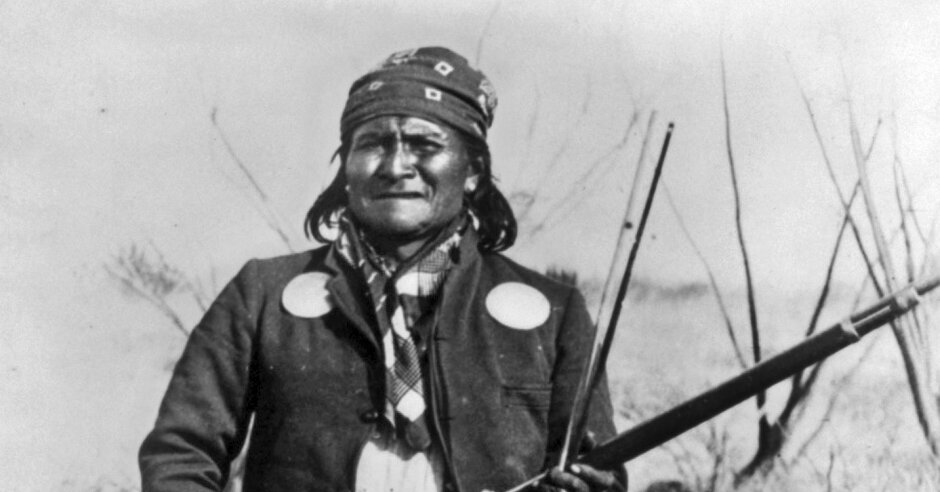
This new work takes its title from the words that Geronimo, the Apache medicine man and military leader, spoke upon his formal surrender to the United States Army in 1886. About a third of Enrigue’s novel deals with the machinations surrounding Geronimo’s capitulation, as well as his final decades as an unlikely celebrity: He appeared at a World’s Fair and at Theodore Roosevelt’s 1905 inauguration, gawked at by tens of thousands, before dying at Fort Sill in Oklahoma.
Another third of the book is about a woman who is kidnapped after an Apache raid in 1836, and about the Mexican lieutenant colonel who, while searching for cattle rustlers, tries to track her down as well. (Elvis is part of his party.) This thread has resonances with the story of Cynthia Ann Parker, an American who was taken at 9 by a Comanche band and later married and had children with a chief. In her 30s, she was separated, against her will, from her Comanche family.
The final third is about a present-day writer with striking similarities to Enrigue who takes his family on a road trip — for him it’s a research excursion — through Apachería, the sun-seared expanse of the Southwest where the historical sections take place.
“Now I Surrender” has been convincingly rendered into English by Natasha Wimmer, the translator of Roberto Bolaño’s best novels, and you can sense a bit of Bolaño in Enrigue: the postmodern playfulness, the cosmopolitanism, the historical conscience. Enrigue’s new one has a bit of Cormac McCarthy’s “Blood Meridian” — that brutal epic, also set along the U.S.-Mexico border — in it as well.
Yet despite the frequent intensities here, the three narratives in “Now I Surrender” never quite cohere. By the end, with the Geronimo material, you sense that Enrigue is filibustering, leaning too heavily on his research, as he introduces character after character and explores every wrinkle of the negotiations over Geronimo’s fate.
He pays such extreme deference to his female characters, with one over-the-top exception, that they are not allowed to be quite human. This is a long book (456 pages) that feels even longer.
He leaves the metafictional scaffolding up, sometimes winningly, declaring early on:
The idea is to write a book about a country that still exists but was erased from the maps. A country that worked just as well or badly as any other country, and that was taken away from us like cassette tapes or incandescent lightbulbs. Where Sonora, Chihuahua, Arizona and New Mexico meet today was an Atlantis, an in-between country. And straddling it were the Mexicans and the gringos, like two children, eyes shut, their backs to each other, while the Apaches scuttled back and forth between their legs, not sure where to go with strangers bubbling up everywhere, filling their lands.
The author character, like Enrigue, lives mostly in Harlem, but he has green card issues and feels caught between loyalties and between worlds. He travels in a station wagon with his second wife and their two children, as well as an older son from his first marriage from whom he feels estranged. I’d be first in line to read an entire memoir from this excellent writer.
But some of this first-person material blends uneasily with the intense kidnapping and almost Sadean torture scenes that dot this novel. Learning that the family has Paul Simon’s “Graceland” on the car stereo as they enter the Mississippi Delta, that the author’s wife rolls her eyes at his devotion to baseball and opera, or that they all have an Asian fusion meal in New Mexico detracts from the spell Enrigue is working to cast.
Enrigue has always been a fox in a hedgehog mask — I mean this as a compliment — but his genre-blending, in this case, is less seamless than it has been in the past.
Here’s one reason I love reading Enrigue anyway. The tough guys in his fiction often have effeminate sides (some of their boots have improbable heels) and they’re always taking miniature pratfalls. They sniff and wipe their earwax on their trousers; they have bits of scrambled egg stuck in their mustachios. If Enrigue were remaking “High Noon,” Gary Cooper would have pubic lice. This author has a natural appetite for subversion.
Enrigue’s novels are not the places to come if you are nostalgic for notional simplicities of the American past. He’s one of the best we have, and he’s not done pushing against conventions. “We all keep scribbling like fools in the notebook of fate,” he writes, “as if anything will ever change.”
NOW I SURRENDER | By Álvaro Enrigue | Translated by Natasha Wimmer | Riverhead | 456 pp. | $30
Dwight Garner has been a book critic for The Times since 2008, and before that was an editor at the Book Review for a decade.
The post The Last Days of the Apaches and a Search for a Nation Erased appeared first on New York Times.