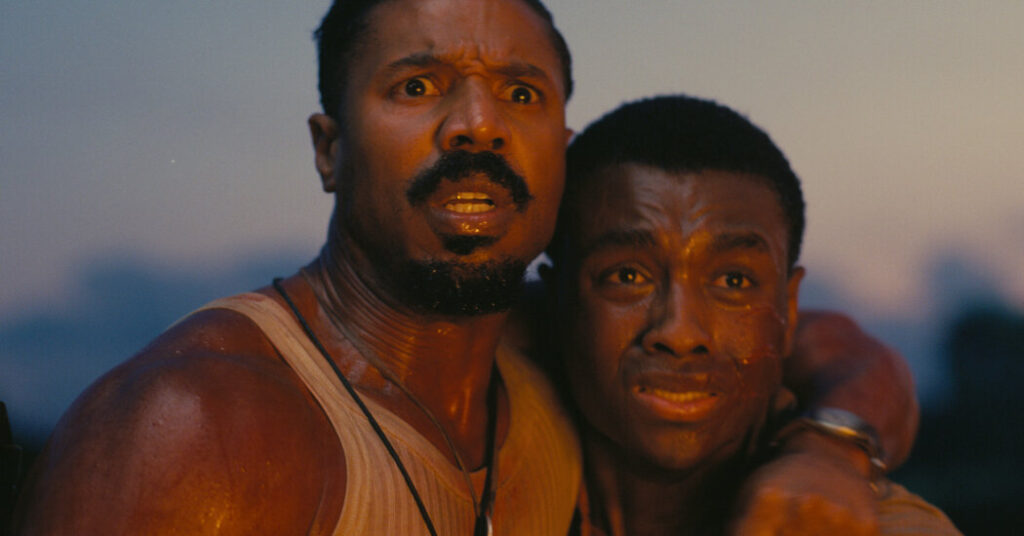
“Sinners” arrived at a time when Hollywood needed it the most.
Amid a maelstrom of videos generated by artificial intelligence, uncertain mergers, budget cutbacks, wildfires and runaway production, studios have become ensnared in the biggest economic crisis they have faced in almost half a century.
In this context, the nearly yearlong success of Ryan Coogler’s “Sinners,” a vampire-themed segregation-era movie, seems even more extraordinary. Arriving last April, it was an immediate box-office hit — its $48 million opening-weekend in domestic sales made it the biggest debut for an original film in six years — and a critical darling. Nine months later, it set a record with a historic 16 Oscar nominations, including one for best picture.
Nevertheless, the film’s greatest accomplishment might be more meta: For as much as “Sinners” is about the embattled musical soul of the young bluesman Sammie (Miles Caton), it is really, in terms of plot, aesthetic and film ownership rights, about the pursuit and price of artistic freedom, not just for its characters, but also for moviemaking itself.
The blues are central to that sense of freedom. That Coogler chose to base his emancipatory tale on the sound is not happenstance but an extension of a longer African American literary tradition. The author Ralph Ellison once wrote that the blues were “an impulse to keep the painful details and episodes of a brutal experience alive in one’s aching consciousness, to finger its jagged grain, and to transcend.” Works by him and many others, including Zora Neale Hurston, Albert Murray, Alice Walker and August Wilson, have all heralded blues singers as the ultimate heroes, using their life stories to reveal, then resist the oppressive conditions of the Jim Crow South.
Opening at a plantation under the sweltering sun in Clarksdale, Miss., “Sinners” also begins with the idea of overcoming suffering through the liberatory impulse of the blues. After meeting his cotton-picking quota for the day, Sammie goes to his father’s church to get a guitar, an object that provides a reprieve from his servitude as a sharecropper. “Been working all week, Pop,” he implores the preacher. “Wanna be free of all this for one day.”
As the movie unfolds, Sammie’s songs, as well as the juke joint where he performs — the one owned by his cousins, Smoke and Stack (both played by a remarkable Michael B. Jordan) — enable him to actualize his desire for autonomy even more. Not just for himself, but also for his fellow Black residents of Clarksdale, who gather there and experience camaraderie, ecstasy and release together. This all culminates in the movie’s most breathtaking scene: Sammie, surrounded by a West African griot, a hip-hop DJ and his fellow revelers, shows how Black music has evolved throughout history. Once the white vampires, including a former Klansman, attack the club, and either kill or turn most of its Black patrons into vampires, this sense of relief is destroyed. The impermanence underscores how precarious and meaningful the space was in the first place.
At the end of the movie, a much older Sammie (played by the guitarist and singer Buddy Guy) can be found in a blues club decades later in Chicago, where he confesses to Stack, “Before the sun went down, I think that was the best day of my life.” To which his cousin soberly adds, “And just for a few hours, we was free.”
That line stayed with me as I pondered whether that sentiment belonged to Coogler’s characters alone, or if it was extended to us in the audience. Upon its release, the film felt like an antidote to the increased censoring of accounts of racial injustice in the United States, and as a celebration of Black culture at a time when organizations around the country were beginning to dismantle long-fought-for diversity initiatives.
Like so many others, I derived pleasure from “Sinners” as sheer entertainment, a seamless blend of science fiction, horror and historical drama filled with Easter eggs that kept us guessing about what we were actually seeing. At the same time, it was a work of art with a sharp racial allegory at its heart. That uncanny combination had audiences spreading the word, ensuring that it was a must-watch on repeat.
Coogler’s potent deal with Warner Bros. became the talk of Hollywood. Much as the fictional twins’ purchase of the building for their juke joint gave them economic and cultural power typically denied to African Americans at the time, Coogler’s contract gave him unique proprietorship: He negotiated for a percentage of gross tickets sales, final cut and full rights to the movie after 25 years. The setup is a blueprint of sorts for maintaining creative control in perpetuity.
For some Hollywood executives, these terms alone were enough to set off a new panic, even though, as Coogler has pointed out, his negotiation was not without precedent: Quentin Tarantino struck a similar deal in 2017 for “Once Upon a Time … in Hollywood,” and George Lucas, Peter Jackson and Richard Linklater have all negotiated such terms. “I’ve been in the industry long enough to know what kind of deals are possible,” Coogler has said.
Coogler has noted that “Sinners” is his most personal story to date and that it was inspired by his grandfather, whom he never knew, and his uncle, who was born in Mississippi and imparted in Coogler his love for the blues.
In so doing, he also gave Hollywood a new freedom narrative, for just a few hours, and for a lifetime, too.
Salamishah Tillet is a contributing critic at large for The Times and a professor at Rutgers University. She won the Pulitzer Prize for criticism in 2022, for columns examining race and Black perspectives as the arts and entertainment world responded to the Black Lives Matter moment with new works.
The post ‘Sinners’ and the Price of Artistic Freedom appeared first on New York Times.