At the Emmett Till and Mamie Till-Mobley National Monument in Mississippi, staff members asked the Trump administration to review an entire exhibit on the Black teen’s brutal 1955 killing by White men and his mother’s decision to publicize it — though the park’s staff warned that its removal would leave the site “completely devoid of interpretation.”
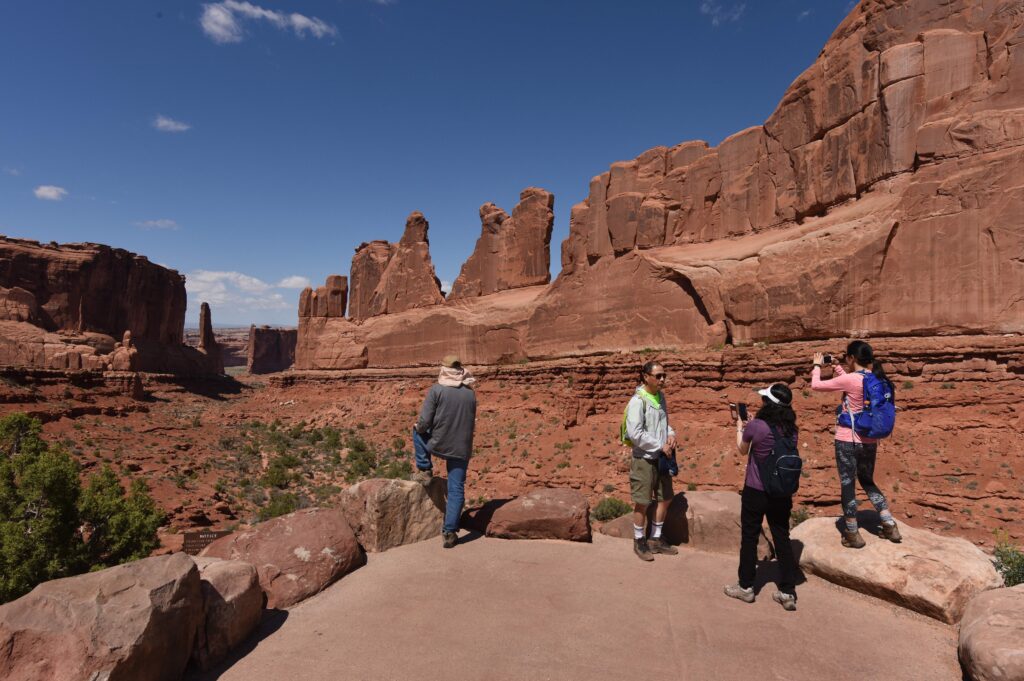
At Arches National Park in Utah, park managers wondered whether a sign about the damage that graffiti and invasive species leave on the iconic red rock landscape violates a Trump directive to focus solely on America’s natural beauty.
And at Harpers Ferry National Historical Park in West Virginia, staff members have asked federal officials to decide whether a document that describes an abolitionist’s murder by a mob might “denigrate the murderers.”
These displays and materials are among several hundred that managers have flagged at hundreds of national park locations since last summer in response to administration orders to scrub sites of “partisan ideology,” descriptions that “disparage” Americans, or materials that stray from a focus on the nation’s “beauty, abundance, or grandeur.” The submissions were compiled in an internal government database and reviewed by The Washington Post, which confirmed its authenticity with current federal employees.
The database does not make clear which of the plaques, maps, films and books ultimately will be removed or recast by the Interior Department, though some have already been axed. But the submissions provide a sweeping portrait of the scope of President Donald Trump’s bid to reconsider how national park sites address the historic legacy of racism and sexism, LGBTQ+ rights, climate change, and pollution — or whether to acknowledge them at all.
A group describing itself as “civil servants on the front lines” posted the database on two public websites Monday, saying in an attached note that it did so to show Americans how the administration is “trying to use your public lands to erase history and undermine science.”
Asked for comment, the Interior Department issued a statement Monday saying that the “draft, deliberative internal documents” in the database “are not a representation of final action taken.” The statement, from spokesperson Charlotte Taylor, asserted that the documents were “edited before being inappropriately and illegally released to the media in ways that misrepresented the status of this effort.”
The department did not respond to questions about the status or process for the reviews, nor about specific examples in the submissions.
The tone and content of the materials described and submitted to Interior by park managers vary widely, reflecting a mix of careful attempts to obey administration orders, confusion about what might violate them and, at times, apparent skepticism about the entire endeavor.
Staff members identified a brochure at Cape Hatteras National Seashore, in North Carolina, for “possible disparaging of a prominent American” because it mentions that aviator and onetime Smithsonian Institution secretary Samuel Langley failed to achieve flight. A park staffer at Glen Canyon National Recreation Area in Arizona asks for clarification about whether displays on California condors’ return from the brink of extinction disparage hunters “or tell a success ??”
Several submissions ask for reviews of book covers, book chapters and entire books on sale at gift shops, including “Incidents in the Life of a Slave Girl,” an autobiography by abolitionist Harriet Jacobs.
“They are mostly on slavery and the black experience in Washington DC as well as a few on Lincoln’s assassination,” wrote a park official at Ford’s Theatre National Historic Site. “Not sure they all disparage historical figures, but they do cover dark periods in American history.”
Another inquiry came from the Thomas Jefferson Memorial in Washington, where employees shared a list of books on the third president. “I am not sure if they really disparage Thomas Jefferson, but they do aknowledge [sic] that he had children with Sally Hemings,” the inquiry notes.
Bill Wade, executive director of the Association of National Park Rangers, said the breadth of the submissions revealed the many hours of work that Trump’s order imposed on already overextended park employees, who “probably should’ve been doing other things most of us believe would be more important.”
The exercise, Wade added, runs counter to the reasons many National Park Service employees gravitated toward their work in the first place. “Park rangers everywhere, and all park employees for that matter, have been passionate about telling true stories about history, and about science,” said Wade, a former superintendent of Shenandoah National Park in Virginia. “It’s a real affront to the values that rangers have.”
Others have embraced Trump’s effort, including Sen. Jim Banks (R-Indiana), who last summer wrote to top officials at Interior and the Park Service over concerns about “woke” projects he said appeared to violate the president’s order.
“The President’s executive order rightfully opposes a decades-long effort by our institutions to usurp American history with an ideology-based narrative that casts America’s founding and history in a negative light,” Banks wrote at the time.
In nearly a year since Trump’s order, National Park sites have responded by removing exhibits that address slavery and the challenges overcome by minority and marginalized groups, as well as signs about the science of climate change.
But there also has been sustained pushback.
Last month, a federal judge in Pennsylvania ordered the Trump administration to restore displays that discussed slavery at a site in Philadelphia where George Washington lived as president.
U.S. District Judge Cynthia M. Rufe of the Eastern District of Pennsylvania compared the displays’ removal earlier this year to the mind control employed by the government in George Orwell’s novel “1984.”
Rufe’s ruling — issued on Presidents’ Day — granted an immediate injunction, requiring the reinstallation of 34 educational panels removed in January by the Park Service from a site at Independence National Historical Park in Philadelphia.
Two weeks ago, a coalition of scientific, preservation and historical groups sued the Trump administration over changes that already have been made, arguing that the removal of information about civil rights, climate change and other topics at multiple national parks amounts to illegal censorship.
That lawsuit, filed in a federal court in Massachusetts, argues that Interior officials ignored well-established principles and legal requirements when seeking to overhaul information presented at national parks.
Democratic members of Congress have also sharply criticized the effort, which they describe as a bid to whitewash the American story. “It is absurd that any president would go down this road of trying to retrofit history and culture in their own image instead of getting actual historians to tell us these stories,” said Rep. Jared Huffman of California, the ranking Democrat on the House Natural Resources Committee.
The hundreds of submissions reviewed by The Post run the gamut, from signs and exhibits about slavery and the civil rights movement, to how the effects of climate change already are altering American landscapes, to how the nation remembers Indigenous people who inhabited lands long before there was a United States.
Not every park flagged materials that needed reviewing under the executive order. The documents review by The Post show that at many locations, officials logged a simple entry: “Nothing to report.”
It is clear that as government workers across hundreds of national parks and other historical sites scoured thousands of signs, read through publications and surveyed countless educational films, they struggled with what exactly might violate Trump’s order not to “inappropriately disparage Americans past or living.”
At Cape Hatteras, staff members asked whether information on the effect of light pollution on turtles might be “disparaging against park users.” The park also pointed out a Junior Ranger booklet’s mention of female pirates in the 17th and 18th centuries dressing like men to hide among ship crews. “Please review for appropriateness,” the park’s staff asked.
But many of the submissions involve weightier topics in the nation’s history.
At Cane River Creole National Historical Park in Louisiana, park staff members flagged a planned exhibit about the history of the train depot that is used as the site’s visitor center. The depot was still segregated when it ended rail service in 1965, and the exhibit relied on extensive consultation and oral history collection with Black community members, according to a former park employee who worked on the project.
“For the community, it means for the first time having that story being told in an honest way — and actually just being told,” said the former employee, who was laid off from the Park Service last year.
It is now unclear whether the exhibit will be installed.
At Harpers Ferry, site of abolitionist John Brown’s raid in 1859, an employee singled out a document that describes how a “mob murders” an abolitionist. “Does this denigrate the murderers?” the employee wrote. “We can reword to: ‘Abolitionist editor Elijah Lovejoy is murdered for his views.’”
A Civil War battlefield driving tour map was also flagged for its inclusion of direct quotes about the cause of the war from secession documents and Alexander Stephens, vice president of the Confederacy. The quotes cite slavery as the cause. “True, but is this considered cherry picking and denigrating southerners?” the park’s staff wrote.
Those quotes were used to provide context and avoid downplaying the role of slavery in the Confederate rebellion, according to a former Harpers Ferry media specialist who inserted them.
Changing the documents and the map would amount to “pulling us back into a position of supporting White supremacy and supporting the ‘Lost Cause’ narrative and erasing the importance of African American history,” said the specialist, who retired last year and spoke on the condition of anonymity for fear of retaliation.
Along the Selma to Montgomery National Historic Trail, staffers highlighted signs and literature that discuss segregation in the South and how “non-violent civil rights demonstrators” crossing the Edmund Pettus Bridge on “Bloody Sunday” in 1965 “were attacked” by armed officers.
“While these statements are historically accurate and supported by firsthand accounts,” staffers noted in the submissions, “they may be perceived as disparaging by individuals who are less familiar with the history of the Civil Rights Movement.”
Amid the numerous materials submitted for review at Arlington House, the Robert E. Lee Memorial, just across the Potomac River from the District, was a line in a Junior Ranger book that reads, “In 1829, Robert E. Lee promised to serve in the Army and protect the United States. In 1861, he broke his promise and fought for slavery.”
Staffers at Arches National Park raised questions about a sign devoted to the effects of human-caused climate change already visible in the park. “The park seeks guidance on whether this entire panel is within the scope of Secretary’s Order 3431 and should be covered or removed,” the submission reads.
In other places, it appears that park officials are wrestling with whether entire exhibits — or even entire sites — somehow conflict with Trump’s order to “focus on the greatness of the achievements and progress of the American people.”
At the Mississippi site commemorating Till, the very place deals with one of the grimmest examples of racial violence in the United States.
Without this exhibit to share the difficult Till story, the new NPS site would be almost completely devoid of interpretation,” an employee notes in an inquiry shared with The Post. “The exhibit emphasizes ‘progress of the American people’ toward a better future.”
Wade said he was encouraged by the ruling that ordered the Trump administration to restore displays that discussed slavery at the site in Philadelphia. Wade’s group was also among the plaintiffs in the recently filed lawsuit seeking to halt the administration’s changes and deletions at national parks, saying they amount to censorship.
But if such legal avenues ultimately fail, Wade said, he suspects the push to alter the telling of history at many sites will continue.
“The impact is that the visitors are just not going to get true, accurate stories,” he said. “I just think the public ought to be really concerned about that.”
In some places, such as the preserved home of civil rights activist Medgar Evers or the Manzanar National Historic Site in California, where the U.S. government once incarcerated Japanese Americans during World War II, the entire site exists to commemorate painful moments in the nation’s history.
“If you take away the stories, you take away the purpose of the park itself,” Wade said.
The post National Park Service database flags hundreds of items that might ‘disparage’ America appeared first on Washington Post.