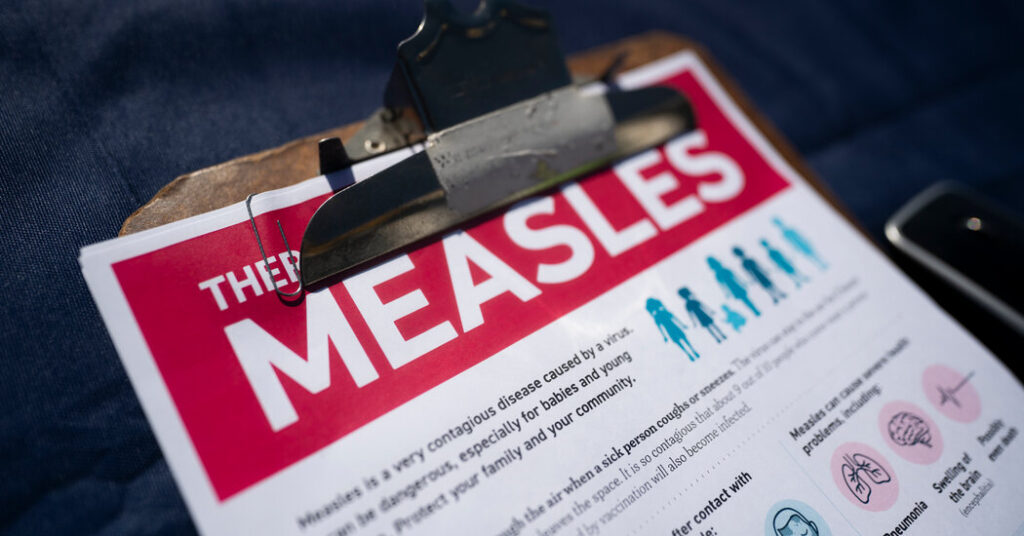
A highly anticipated meeting to review the United States’ measles elimination status has been postponed until November.
An international panel of experts had invited the United States to a meeting in April to determine whether the ongoing spread of measles would cost the country its status, a designation granted to nations that have not had continuous spread of measles for more than a year.
But U.S. health officials asked the panel, convened by the Pan American Health Organization, to delay the review until the organization’s annual meeting in November, said Andrew Nixon, a spokesman for the Department of Health and Human Services. He said the agency needed more time to analyze its measles data.
Losing measles elimination status would mark a grim and embarrassing moment for the nation’s public health: The United States achieved elimination status in 2000 after a nearly 40-year campaign to promote the vaccine, and has maintained that status every year since.
But losing the status now seems inevitable to many public health experts. There have been constant outbreaks in the United States since January 2025, with no clear end in sight. Last year was the worst year for measles in the United States in more than two decades, and there have already been 10 new outbreaks this year.
Sebastián Oliel, a spokesman for the Pan American Health Organization, which is affiliated with the World Health Organization, said the delay reflected the “extent of the analysis” that the United States is conducting while also juggling ongoing measles outbreaks. To collect the information needed for the review, the Centers for Disease Control and Prevention must work with state and local health departments to trace contacts of infected people and collect samples for genetic testing, then analyze that data.
Mr. Oliel added that the review of Mexico’s elimination status, also scheduled for April, would be pushed to the November meeting as well. The date of the annual meeting has not yet been set.
Still, some experts found it hard to ignore the political convenience of the new meeting date: If the United States were to lose its elimination status, that would now most likely happen after the November midterm elections. In the lead-up to the midterms, Health Secretary Robert F. Kennedy Jr. has pivoted away from his vaccine agenda, which includes scaling back the number of recommended shots for children and has proved unpopular in recent polls.
“Having worked at C.D.C., I know they have incredibly talented people, and they could easily do this analysis far faster than seven months,” said Dr. Bruce Gellin, a former director of the H.H.S. vaccine program and a former epidemic intelligence service officer at the C.D.C.
Dr. Walter Orenstein, who sits on a national committee that reviews the C.D.C.’s report on elimination status before it is submitted to the Pan American Health Organization, agreed: “I don’t see why a delay of that long would be needed.”
“It is awfully coincidental, with the midterm elections,” he added.
Neither H.H.S. nor the Pan American Health Organization answered questions about the political ramifications of the new meeting date.
Paul Rota, a microbiologist who recently retired after helping the C.D.C. respond to measles outbreaks for more than 30 years, said that the extra time might be warranted. The analysis is complex: Scientists must parse whether a single measles outbreak continued uninterrupted for longer than a year, which would result in losing elimination status, or whether there were multiple separate outbreaks.
Outbreaks in Mexico and Canada have further complicated the data analysis, since scientists must determine which U.S. cases were brought in by an infected international traveler and which resulted from contact with a sick person within the country.
And the group of people responsible for analyzing this data, he said, is likely to be spread thin, as they also help states respond to active measles outbreaks.
For example, that team is helping South Carolina respond to an outbreak that has so far sickened 985 people, making it the largest measles outbreak in recent U.S. history.
“It’s been nonstop action for a year,” Dr. Rota said. “You’re looking at a handful of individuals to do all that work.”
Teddy Rosenbluth is a Times reporter covering health news, with a special focus on medical misinformation.
The post Meeting on U.S. Measles Status Is Delayed Until November appeared first on New York Times.