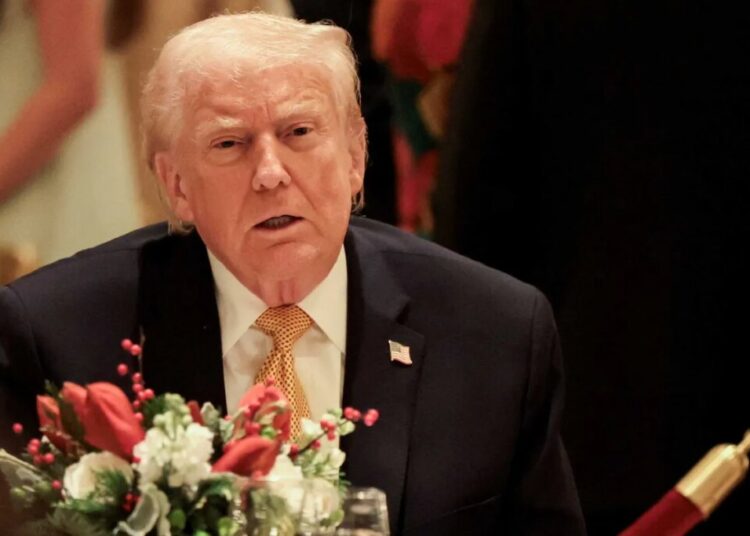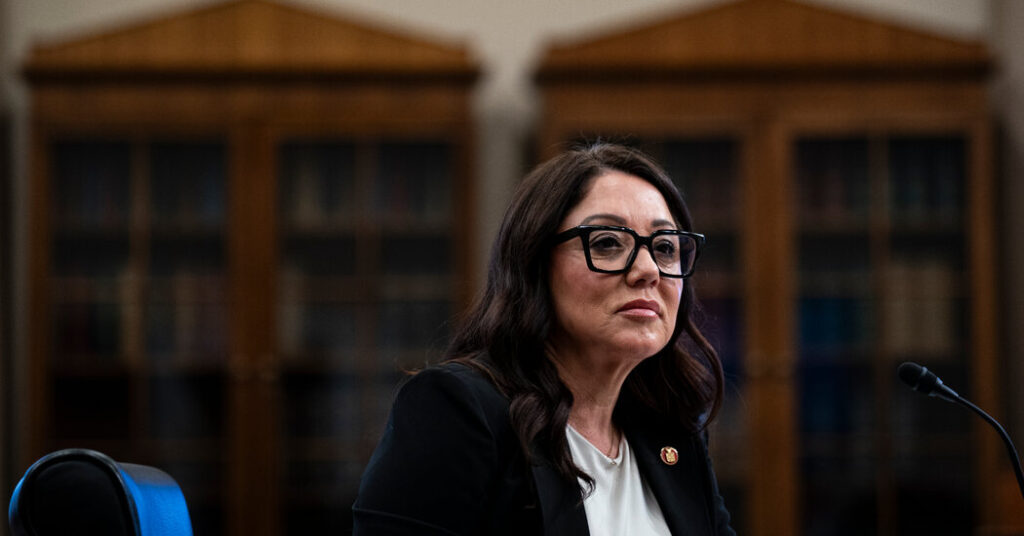
In the weeks after President Trump nominated Lori Chavez-DeRemer to be his labor secretary, she told potential deputies, Labor Department veterans and administration officials that her vision for the role was that of a figurehead.
Since she took office last March, that has meant traveling the country meeting with workers and employers, while back in Washington the Labor Department has descended into crisis.
The agency’s inspector general has opened an inquiry into allegations of professional misconduct by Ms. Chavez-DeRemer and her closest aides. Investigators have spoken with several dozen witnesses and reviewed evidence and allegations that the secretary used department resources for personal trips, that she was having an affair with a member of her security team and that her aides tried to steer grants to favored political operatives.
Ms. Chavez-DeRemer’s husband has been barred from the department’s headquarters, after female staff members accused him of making unwanted sexual advances. His lawyer has said the accusers were working with department employees, whom he did not name, to force Ms. Chavez-DeRemer out of office. Police and prosecutors have said they would not bring a case against her husband.
In interviews, more than two dozen current and former department employees from across the political spectrum described a toxic workplace characterized by an absentee secretary, hostile aides and a deeply demoralized staff. Most of them spoke on the condition of anonymity because they were not authorized to discuss department business or because they feared retribution.
“The crisis at the Department of Labor is a crisis of leadership,” said Helen Luryi, who until April worked in the department’s Women’s Bureau. “Over the past few weeks we’ve learned that not only is she not doing her job, she’s embroiling the department in scandal and possible criminal activity. It’s frankly embarrassing.”
The department’s troubles spilled into the open in January, after an internal complaint was filed with the inspector general. Senator Charles E. Grassley of Iowa, the Republican chair of the Judiciary Committee, has called the allegations troubling and sought internal records and statements from the department.
A spokeswoman for the Labor Department, Courtney Parella, said, “The secretary remains focused on advancing the president’s America First agenda and carrying out the department’s mission to support American workers.”
Ms. Chavez-DeRemer’s chief of staff, Jihun Han, and deputy chief of staff, Rebecca Wright, have been placed on leave during the internal investigation, people familiar with the inquiry said. They have been accused of concocting official trips for the secretary so that she could spend time with friends and family, bullying staff members and trying to silence critics within the department.
The investigation has in some ways improved morale, some department employees said, by exiling some of the secretary’s closest and most problematic allies, even as it threatens to unravel the executive office.
Some of the turmoil is familiar from other agencies during the second Trump administration: chaos and uncertainty during the high days of DOGE, the Elon Musk-led effort to slash federal spending; low morale among longtime employees; unpredictable priority changes.
But much of the department’s trouble is particular to Ms. Chavez-DeRemer’s leadership and the staff she brought with her, people familiar with her tenure said.
Happy Valley
Ms. Chavez-DeRemer, 57, started in local politics two decades ago, as a member of the City Council and later mayor of Happy Valley, Ore. In 2022, she was elected as a Republican to the U.S. House.
She was known in Congress for aligning with Democrats, especially on labor matters. She co-sponsored the Protecting the Right to Organize Act — a Democratic push to expand labor protections and collective bargaining rights. The bill has been introduced several times, most recently last March, but has stalled in the Senate.
In March 2024, a former employee filed a federal employment-discrimination lawsuit against Ms. Chavez-DeRemer’s congressional office, saying Ms. Wright, the congresswoman’s district director in Oregon, had retaliated against her for filing a sex-discrimination claim and had refused to accommodate her health disabilities.
According to the complaint, Ms. Wright had told the former employee that she was fired for unprofessionalism, citing questions she had asked Ms. Chavez-DeRemer at a staff retreat. The lawsuit was dismissed last March after a settlement was reached, court records show.
The federal government paid $98,650 last year to settle an employment-discrimination claim in Ms. Chavez-DeRemer’s office, records show. It was the only such award or settlement in 2025 for a House office. The award did not name its related case.
In November 2024, Ms. Chavez-DeRemer lost her re-election bid. Soon afterward, Sean O’Brien, the president of the Teamsters union — who had spoken at the 2024 Republican National Convention — urged Mr. Trump to choose her as labor secretary. Her father was a member of the Teamsters, she has often reminded people, and she had strong support from the union.
Her nomination met consternation from some Republicans, who were concerned about her support for organized labor, and cautious optimism on the left, where some lawmakers crossed party lines to vote for her confirmation.
“Labor advocates breathed a sigh of relief,” said Ms. Luryi, the former employee in the department’s Women’s Bureau, which lost around half of its employees this past year. “But then she came in and started echoing Trump’s rhetoric.”
During her Senate confirmation hearing, before an audience packed with Teamsters, Ms. Chavez-DeRemer distanced herself from her pro-labor record in Congress. Asked if she still supported the Protecting the Right to Organize Act, she said she would support Mr. Trump’s agenda.
She was sworn in as secretary on March 11, as DOGE was slashing the department’s work force and dismantling programs. When Ms. Chavez-DeRemer and her top aides wanted to have a birthday party for her at the Frances Perkins Building, the department’s headquarters, staff questioned using departmental funds, so they renamed it a swearing-in celebration, a person familiar with the planning said.
Ms. Chavez-DeRemer and dozens of political staff members socialized at hightop tables with blue tablecloths and drank wine. Screens showed pictures of her. Guests sang “Happy Birthday,” and Ms. Chavez-DeRemer blew out candles on a cake, according to people who were there. The date was April 7 — her birthday.
“I did not have a birthday party,” Ms. Chavez-DeRemer told members of the House Appropriations Committee weeks later when questioned about the event.
Mr. Han, the chief of staff, sent a departmentwide memo after the party threatening criminal charges against members of the staff who spoke publicly about department business, ProPublica reported.
America at Work
After taking office, Ms. Chavez-DeRemer embarked on a cross-country tour called “America at Work.” She said she planned to meet with workers and employers in every state to understand their needs. Among her first stops was Nevada, where she spoke at a Teamsters conference in April. She met with Teamsters again in August in Chicago. Often when she traveled, her calendar showed one or two short events, leaving the rest of the day free.
It is not unusual for labor secretaries to spend a lot of time on the road, but their days are usually packed. Ms. Chavez-DeRemer was traveling for enjoyment, some department employees said. Some of her aides, however, thought her travel was booked with an eye to increasing her political profile and building her brand, people familiar with her staff’s discussions said.
Ms. Chavez-DeRemer has visited 48 states as part of the tour. She was scarcely in the Perkins Building, and had little to do with the daily operations or policy imperatives of the department. When at headquarters, she was generally secluded in her second-floor office suite, with security stationed at her door.
In the secretary’s absence, Keith Sonderling, the deputy labor secretary, has run the day-to-day operations of the department, employees said. He has standing meetings with the heads of enforcement agencies, and has directed departmental policy priorities.
Between November 2024 and November 2025, the department shed about 14 percent of its staff, according to a New York Times analysis.
Among the hardest-hit divisions was the Office of Federal Contract Compliance Programs, which enforces equal-employment-opportunity laws for federal contractors. Around 300 members of its 480-person staff were pushed out. Others were reassigned in the department.
“It’s like if you were an Italian restaurant cook and then went to work at a Chinese restaurant,” said Aliyah Levin, who worked at the office for 17 years and was reassigned to the Wage and Hour Division.
Growing Scandal
Anthony D’Esposito, a former Republican congressman from New York, had just been sworn in as the Labor Department’s inspector general in the first week of January when the complaint against Ms. Chavez-DeRemer and her aides was filed.
His investigators have expanded their examination beyond the secretary’s travel and use of department resources to whether grants were improperly directed.
“Secretary Chavez-DeRemer is not privy to the investigative strategy or internal decisions made by the I.G.,” said Nick Oberheiden, a lawyer representing her in the investigation. “With those with whom the secretary has an obligation to cooperate she will — gladly, promptly and confidently.”
Mr. D’Esposito’s office also learned of at least two women’s claims that the secretary’s husband, Dr. Shawn DeRemer, had made unwanted physical advances on them at the Perkins building. The women were political appointees who worked closely with Ms. Chavez-DeRemer, according to people familiar with their claims.
Dr. DeRemer, an anesthesiologist, was barred from the building. Because the alleged misconduct took place in a federal building, the claims were referred to the Federal Protective Service, a division of the Department of Homeland Security, which declined to bring a case.
One of the women went to Washington’s Metropolitan Police Department, which filed a report on Jan. 24 about a claim of forced sexual contact in December at the Labor Department.
After The Times reported the ban and the investigation, a lawyer who said he was representing Dr. DeRemer released a letter calling the accusations false. The lawyer did not respond to requests for comment.
The Washington police said the investigation had ended after federal prosecutors found no evidence of a crime. Dr. DeRemer remains barred from the Perkins Building.
Mr. Han and Ms. Wright, the chief of staff and deputy chief of staff, have not yet been interviewed by the inspector general’s office, two people familiar with the matter said.
In a sign that Ms. Chavez-DeRemer may not have grasped the gravity of the allegations against her and her staff, she recently asked officials if Ms. Wright would soon be cleared to return to work.
This week, Ms. Chavez-DeRemer is scheduled to complete her America at Work tour, with stops in Hawaii and then Oklahoma, where she is set to meet with Mr. O’Brien, the president of the Teamsters.
“Lori Chavez-DeRemer is the most engaged labor secretary we’ve had under a Republican administration, consistently visiting workplaces and meeting with workers across the country,” said Kara Deniz, a spokeswoman for the Teamsters. “We look forward to continuing to work with her.”
Rebecca Davis O’Brien covers labor and the work force for The Times.
The post Labor Secretary Is a Rare Presence at Department in Turmoil appeared first on New York Times.