The talks were not going well, but there were signs that they would continue. The top U.S. diplomat was due to travel to the Middle East on Monday and negotiating teams were due to meet again in Geneva for a fourth round of discussions later in the week.
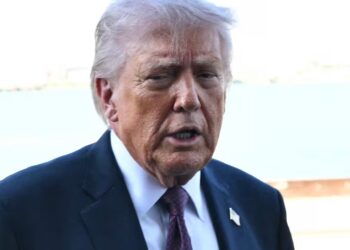
“We’ll see what happens. We’re talking later,” President Donald Trump told reporters Friday, adding that he was “not happy” with the way Iran was approaching negotiations over the fate of its nuclear program amid his repeated threats to attack unless his demands were met.
Hours later, U.S. and Israeli forces launched widespread strikes across Iran, killing much of the country’s political and military leadership. The assault has sparked multiple rounds of retaliation from Iran and threatened to plunge the region into chaos.
Although U.S. officials say that the talks were in good faith, critics of the Trump administration call the abrupt shift to war duplicitous, if not deceitful. Iranian Foreign Minister Abbas Araghchi, who had led the Iranian delegation, told ABC News on Sunday that the United States had “attacked us in the middle of negotiation.”
The White House declined to comment for this article. The State Department did not respond to a request for comment.
Oman’s foreign minister, who had been mediating the talks in Geneva, also appeared shocked at the abrupt turn away from diplomacy.
Badr Albusaidi had traveled to Washington on Friday in what he saw as a “last-ditch” effort to forestall war, according to two people familiar with his plans. The foreign minister had hoped to make his case directly with Trump and Secretary of State Marco Rubio, according to these people, who like some others spoke on the condition of anonymity to discuss the matter with the news media.
He instead met with Vice President JD Vance as Trump and Rubio were already on their way to Mar-a-Lago, the president’s Florida estate, from which they oversaw the start of Operation Epic Fury overnight Saturday.
“I am dismayed. Active and serious negotiations have yet again been undermined,” Albusaidi wrote on social media after the strikes, adding later that the “sooner talks are resumed the better it is for everyone.”
During his second administration, Trump has sought to combine his self-proclaimed status as a dealmaker with an overt willingness to use military force to get what he wants. His critics have called it a 21st-century version of gunboat diplomacy — an imperial-era form of foreign policy based on military force — while experts have been left to guess whether the efforts at negotiation are genuine or simply an attempt to disarm and deflect.
The talks with Iran appeared to be “a ruse,” said Brett Bruen, a former State Department official who served on the National Security Council during Barack Obama’s presidency, adding that the current administration will eventually struggle to continue using such tactics as it is becoming “increasingly hard for foreign leaders to take Trump at his word.”
“This may work in real estate where one side wants to sell and another wants to buy,” Bruen said, but in diplomatic and trade negotiations, there almost certainly would be a “reluctance to make real concessions” moving forward on the part of anyone engaging with the U.S.
Trump, for his part, has said he hopes to return to negotiations with whatever is left of Iran’s leadership. U.S. officials, meanwhile, have said that their talks were aimed at reaching a genuine compromise and that the decision to strike was made only at the last minute.
A senior administration official told reporters Saturday that the Iranian negotiators were well aware that the U.S. was moving large amounts of military hardware into the region and willing to use it.
“We communicated to them that this was something that would occur if we did not see real progress on a real deal very quickly,” the senior official said.
Rubio’s since-canceled trip to Israel this week, disclosed publicly weeks ago and widely seen as an attempt to brief Israeli Prime Minister Benjamin Netanyahu ahead of any military action, was formally nixed Saturday after the strikes began.
Although the last round of talks in Geneva — where negotiators Steve Witkoff and Jared Kushner had been meeting with Iranians — were described as productive by the Omani mediators and a next round had been scheduled for this coming Friday, there is now no indication they will come to pass.
In June, a similar situation arose when Witkoff was due to hold talks with Iranian counterparts in Oman. Days before the meeting was to occur, Israel carried out attacks on several Iranian military leaders, and Witkoff did not attend.
Aaron David Miller, a former State Department diplomat who has advised Republican and Democratic administrations on the Middle East, said that Trump must have known there would not be another round of talks last summer but that he “continued to create the fiction” there would be.
It kept Iranian leaders off guard, Miller said, which “allowed the Israelis to engage in their decapitation strategy.” The U.S. later joined the assault, striking at Iranian nuclear sites and leaving them “totally obliterated,” in Trump’s words.
Araghchi, the Iranian foreign minister, told ABC News on Sunday that it had been “a very bitter experience for us.”
The Trump administration also had made intermittent attempts at talks with Venezuelan President Nicolás Maduro before embarking on a stunning military operation in January that resulted in his arrest and the regime he once led cowed into obedience.
The U.S. had amassed a huge military presence off the coast of Venezuela before the Jan. 3 raid to capture Maduro. But soon tensions with Iran were growing, sparked largely by Tehran’s bloody crackdown on anti-government demonstrations.
Trump had pledged to intervene, urging protesters to stay in the streets and promising that “HELP IS ON THE WAY.” Around that time, the administration moved some military assets in the Caribbean Sea into the Middle East.
Trump wrote on social media Jan. 28 that “a massive Armada is heading to Iran.” By that time, the protests had largely fizzled after a brutal response from government forces left thousands dead, according to independent estimates.
Iran and the U.S. resumed talks, meeting several times in recent weeks. The last meeting, on Thursday, lasted hours. The Omani foreign minister, Albusaidi, described the outcome as positive, telling CBS News that a deal was “within our reach, if we just allow diplomacy the space it needs to get there.”
Nate Swanson, a former State Department official who worked on negotiations with Iran last year, said that he did not believe the recent talks were a feint and that a deal was simply “never close to coming together,” which he said was “due to mismatched objectives and approaches.”
Iranians were expecting to negotiate within the confines of a 2015 nuclear deal reached under the Obama administration, Swanson said, but the Trump administration had the “exact opposite expectation” and wanted something different and “better” to justify Trump’s withdrawal from that deal during his first presidency.
Iran’s supreme leader, Ayatollah Ali Khamenei, had grown more obstinate after the June strikes on Iran, Swanson added, giving his negotiators even less room to reach a deal than they previously had.
Briefing reporters Saturday, the senior administration official appeared to confirm this, stating that the U.S. negotiators had told the Iranians that they would need to stop enriching uranium and that in return, the United States would give them “free nuclear fuel forever.” The Iranians rejected this proposal, the official said.
Another senior administration official said that the U.S. negotiators’ proposals were being “met with games, tricks, stalling tactics,” and that they had briefed Trump on this. “Obviously he weighed the different options,” this official said.
Two people familiar with the talks said the Iranians had tried to appeal to Trump’s business sense by promising commercial investment between the two nations, including the purchase of commercial airplanes.
Behnam Ben Taleblu, senior director of the Iran program at the hawkish Foundation for Defense of Democracies think tank, said it appeared that Trump had expected Iran to act like a “supplicant” and was too impatient to try to get results through negotiations.
“The president’s patience for diplomacy is just like his patience for military confrontations: He wants things to be short, sharp and decisive,” Ben Taleblu said.
Miller cited Witkoff and Kushner, Trump’s personal friend and son-in-law, respectively. Both men primarily had experience in the business world rather than diplomacy before entering the administration, but they had been tasked not only with the Iran talks but also with shepherding negotiations between Russia and Ukraine, plus Israel and Hamas.
“How is it possible that these two guys can manage three of the most complicated conflicts in the international system successfully?” he said. “The answer to the question is: They’re not.”
The post Iran strikes spark accusations of bad-faith diplomatic negotiations appeared first on Washington Post.