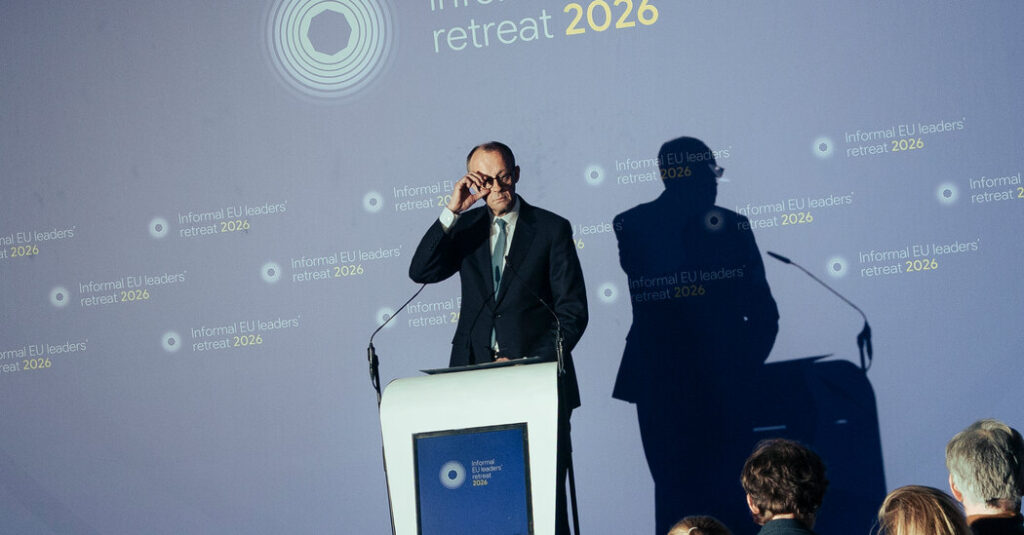
On Monday, Chancellor Friedrich Merz of Germany touches down in Washington for a two-day visit. There’s a lot to discuss with President Trump: the bruised trans-Atlantic relationship, the confusion around tariffs, the brutal war in Ukraine and the new military campaign in Iran. He might be grilled about his trip to China last week, too. For someone less than a year in the job, it’s a mighty undertaking.
But Mr. Merz has bigger problems than Mr. Trump. With low approval ratings, an ailing economy and the far right on the rise, his chancellorship is in choppy waters. To make matters worse, this is a big election year in Germany, with five of the country’s 16 states going to the polls. The Alternative for Germany, or AfD, is poised to make advances — perhaps even taking control of a regional government for the first time. The danger is enormous.
For Mr. Merz and his party, the Christian Democrats, it presents a serious challenge. Since becoming the major force in the coalition government last spring, they have often seemed nervous, panicked and riddled with self-doubt. Their offering to the public has generally lacked both style and substance. But with the Social Democrats — the coalition’s junior party — in electoral decline, it is up to the Christian Democrats to check the far-right charge. The future of German democracy is in their hands.
Their tendency to chase after the AfD, rather than repel it, does not bode too well. During the election campaign early last year, an immigrant killed two and injured more in an attack in Bavaria. In response, Mr. Merz — leading in the polls — pushed through anti-migrant measures that relied on votes from the AfD. The uproar was immediate. Politicians, including fellow Christian Democrats, lambasted Mr. Merz for his willingness to work with the far right, breaching the firewall that has kept it at bay.
Once Mr. Merz was in office, things didn’t get much better. In October, the country’s foreign minister, Johann Wadephul, traveled to Syria for the first time since the fall of Bashar al-Assad. After visiting a heavily damaged suburb of Damascus, he questioned whether Syrians living in Germany would want to return — something many Christian Democrats were demanding. Again, there was uproar: Mr. Wadephul was accused of undermining the party’s strict stance on migration and capitulating to out-of-date liberalism. The infighting was ugly.
These episodes are part of a wider convergence. In recent years, Germany has steadily shifted right. Migration policies that would have been unthinkable a few years ago, such as pushbacks at the border or restrictions on family reunifications, now find broad support in the political mainstream. At the same time, the AfD is trying to appear more moderate, with some figures suggesting that the party drop its call for “remigration” and tamp down its more extreme conduct. When it comes to migration today, the center and the far right are increasingly hard to distinguish.
The AfD plans to exploit this blurring of the lines. Last summer, my newspaper, Die Zeit, got its hands on an internal party strategy paper. It laid out a road map for how the AfD could become strong enough to govern nationally by 2029, when the next general election is due. The plan goes like this: Split the center by pushing the Social Democrats to the left and the Christian Democrats to the right. Meanwhile, show openness to working with the Christian Democrats, portraying yourself as a fellow conservative party.
The Christian Democrats mustn’t fall for it. In an encouraging sign, Mr. Merz unequivocally ruled out any partnership with the AfD at his party’s congress last month. There were also proposals to support a social media ban for children, stimulate investment and cut red tape. This focus on what matters most to Germans, especially the troubled economy, is a step in the right direction. But Christian Democrats must define who they are, too. To do so, it may be useful to revive a word that was long key to German conservatism: “bürgerlich.”
“Bürger” means citizen, the category of person in premodern Germany that, though not aristocratic, was free to participate in public life. Within their cities, citizens could assume office and govern. A sense of self-determination and civic responsibility is still attached to the term, which nowadays means belonging to the middle classes and adhering to a certain set of values. The positive attributes associated with it are decency, civility, integrity, composure and moderation.
The AfD claims to be “bürgerlich,” too. But for the most part, it evokes the negative connotations of the term — conformism, self-satisfaction and contempt for others. The party is full of disdain for perceived outsiders, not only immigrants but also welfare recipients. For many AfD politicians, restoring order really means creating an ethnically homogeneous society. To see that there is nothing civil or moderate about them, you need only to listen to their speeches or follow their social media channels.
On the world stage, Mr. Merz has proved capable. He has resisted Mr. Trump’s depredations, corralled allies in defense of Ukraine, pushed for greater European cooperation and navigated a complicated relationship with China, demonstrating calm and poise throughout. Now, he must be similarly proactive at home. Against the AfD’s appropriation, he and the country’s conservatives must reclaim “bürgerlich” — and properly embody it.
An unassuming bronze statue on a street corner in Berlin encapsulates the stakes. It’s a memorial to Walter Lübcke, a local politician who was shot and killed by a right-wing extremist in 2019; the attacker reportedly supported the AfD and attended party events. Set beside the headquarters of the Christian Democrats, the statue is a warning that the line between conservatism and far-right extremism must never be crossed. Mr. Merz would do well, away in Washington, to heed it.
Anna Sauerbrey (@annakatrein) is an editor and writer at the German weekly Die Zeit.
The Times is committed to publishing a diversity of letters to the editor. We’d like to hear what you think about this or any of our articles. Here are some tips. And here’s our email: [email protected].
Follow the New York Times Opinion section on Facebook, Instagram, TikTok, Bluesky, WhatsApp and Threads.
The post Germany’s Chancellor Is in Washington. It Gets Worse. appeared first on New York Times.