For more than a year, Israel has carried out near-daily airstrikes in southern and eastern Lebanon despite its fragile cease-fire with Hezbollah. And for more than a year, in a sharp departure from decades of hostility toward Israel, Hezbollah did not respond.
Until Monday.
Around 1 a.m., Hezbollah, an Iran-backed Lebanese militant group, fired rockets and sent a swarm of drones toward Israel in retaliation for the killing of Iran’s supreme leader, Ayatollah Ali Khamenei. It was a largely symbolic move that now threatens to drag Lebanon, still reeling from Hezbollah’s last war with Israel, into yet another.
Soon after, Israel unleashed a dizzying barrage of airstrikes across more than 50 villages in southern and eastern Lebanon, and pounded the southern edges of Beirut in blasts that thundered across the city.
By late Monday morning, the Lebanese government had issued a fiery response of its own to Hezbollah, banning all its military activities and demanding that the group hand its weapons over to the state. Hezbollah showed disregard for “the will of the majority of Lebanese,” Prime Minister Nawaf Salam said after an emergency cabinet meeting on Monday morning.
The declaration amounted to the government’s strongest stance yet against Hezbollah, the militant group and political party that has served as the ultimate power in Lebanon for decades.
“What Hezbollah did is practically a suicide mission,” said Maha Yahya, director of the Malcolm H. Kerr Carnegie Middle East Center in Beirut. “It’s launching rockets knowing full well that it is starting a war that it cannot fight against an enemy it cannot hurt.”
The group’s actions are “causing mass displacement and destruction — and there is a lot more to come,” she added.
The immediate and widespread backlash to Hezbollah’s decision to fire at Israel reflects just how war-weary Lebanon has become over the past two and half years.
Hezbollah launched rockets at Israeli positions in October 2023 in solidarity with Hamas, another Iran-backed group. That prompted Israel to respond in what spiraled into a blistering yearlong war that left much of Lebanon and Hezbollah battered.
Israeli airstrikes pummeled towns and villages across the south and east, leaving many in near ruin. Hezbollah’s vast arsenal was decimated, much of its military ranks wiped out and its longtime leader, Hassan Nasrallah, killed.
By the time a cease-fire between Hezbollah and Israel was reached in November 2024, the group was struggling to convince even its most fervent supporters among Lebanon’s Shiite community that the conflict had ended in anything but a defeat.
The year that followed offered glimmers of the possibility of a new chapter in Lebanon, a small Mediterranean country the size of Vermont that includes a fractious political and social mix of Shiite and Sunni Muslims, Christians and Druse, who once all battled one another in a blood-soaked, 15-year civil war.
The Lebanese state emerged from years of political paralysis emboldened and sought to seize on a moment of weakness for Hezbollah, with its military might severely weakened and political footing shaky. Western allies, particularly the United States, pressed the Lebanese state to disarm Hezbollah, which many within Lebanon viewed as having dragged the country into an unwanted and deadly war.
Within Hezbollah, new dynamics began to emerge, as well, analysts say.
With many of Hezbollah’s military leaders killed, members of Iran’s Islamic Revolutionary Guards Corps, or the I.R.G.C., appeared to take greater control of Hezbollah’s military arm, analysts say. Whispers grew of rifts between those military figures and Hezbollah’s political leadership over how to respond to the pressure to disarm, which raised fundamental questions about how and in what form the group could survive.
Those rifts were evident as late as last month, when Hezbollah’s Lebanese political leaders offered private assurances to Lebanese government officials that they knew the risks involved in engaging in war and would not do so, according to a Lebanese official and a Western diplomat who spoke on condition of anonymity because they were not authorized to speak to the news media.
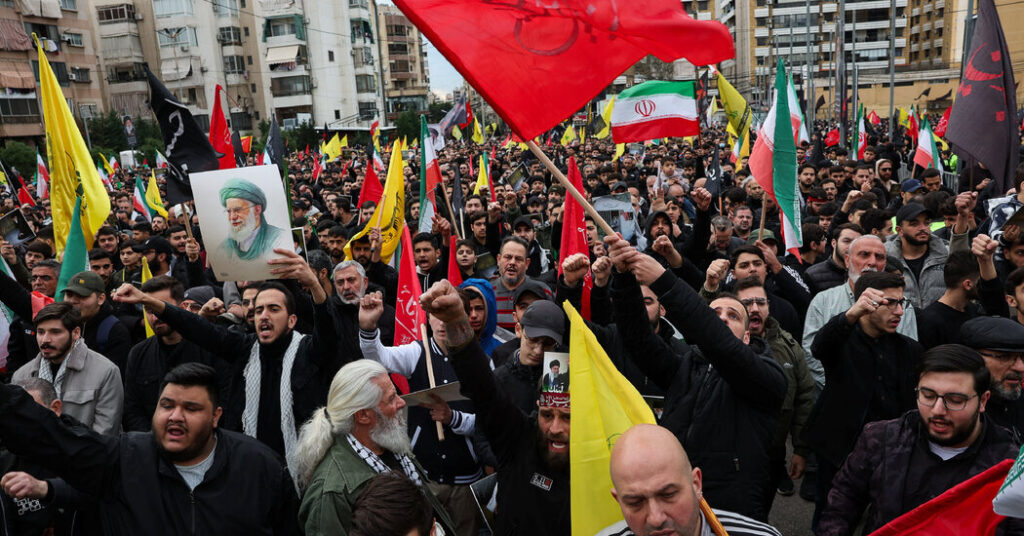
After the killing of Ayatollah Khamenei, Hezbollah drew thousands of people to gatherings mourning his death in a public and defiant display of the support it still has among many in its loyal base despite being exhausted from war.
Then, in the hours after that gathering, Hezbollah’s patron, Iran, appeared to seize the reins, analysts say. With the renewed Israeli bombardment causing more deaths and displacement among its core followers, whether Hezbollah could maintain that base of support has now been thrown into question.
“Hezbollah has been increasingly micromanaged by I.R.G.C. officers, particularly since Nasrallah was killed, and the decision to attack Israel was clearly made in Tehran,” said Paul Salem, a senior fellow at the Washington-based Middle East Institute. The group was “very well aware that the Shia community was in no mood to go through this again, so politically, internally, even within their own community, this is terrible for them,” he added.
Hezbollah’s attack on Israel on Monday also laid bare how Iran sees the current war as an existential threat, analysts say, and is willing to sacrifice Hezbollah — and by extension Lebanon — for its own survival.
“Iran summoned Hezbollah knowing that it would not be able to win this war with Israel,” but prefers to see it “die fighting rather than to accept surrender,” said Lina Khatib, an associate fellow at Chatham House, a London-based research organization.
By Monday evening, at least 52 people had been killed and 154 more wounded by the Israeli strikes in Lebanon, according to Lebanon’s minister of social affairs, Hanin al-Sayyed. Across the country, people were bracing for what many feared could be a much larger war than the escalation in 2024.
As the day wore on, people fell back to their well-worn wartime routines: Stock up on fuel, food and water; turn schools into makeshift shelters; turn on phone alerts for evacuation warnings from the Israeli Defense Forces.
The loud thrum of Israeli drones over Beirut — a near-constant soundtrack in the city since the cease-fire went into effect — suddenly brought a renewed sense of danger, with the dull thuds of strikes in the southern outskirts echoing occasionally across the city.
“I expect this is going to be the final war between Hezbollah and Israel and it will likely end in Hezbollah’s obliteration,” Ms. Khatib said. “Nothing is off-limits; it’s now or never for Israel.”
Christina Goldbaum is The Times’s bureau chief in Beirut, leading coverage of Lebanon and Syria.
The post Despite Its Weakness, Hezbollah Plunges Lebanon Back Into War appeared first on New York Times.