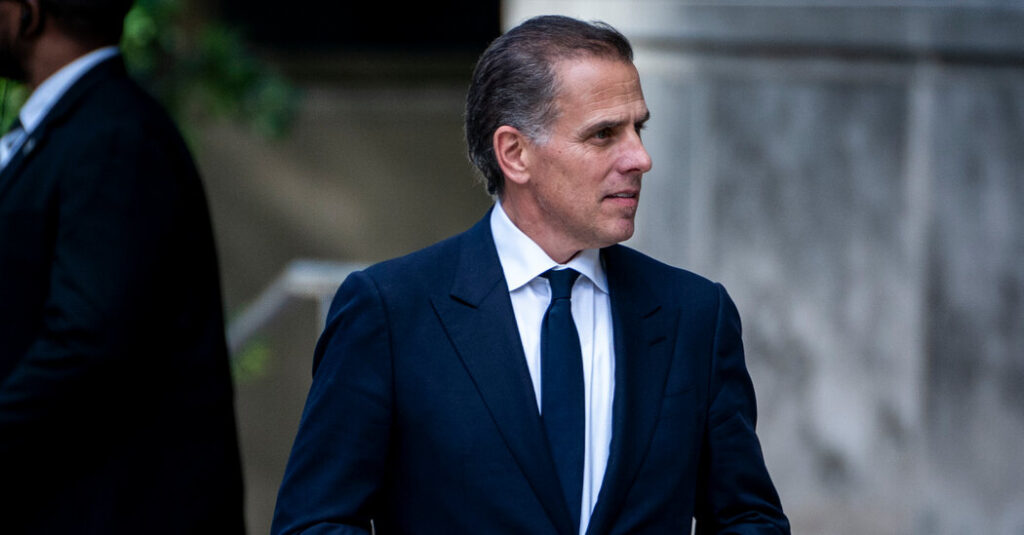
When President Joseph R. Biden Jr. pardoned Hunter Biden last year just days before leaving office, he shielded his son from the threat of prison.
But formally forgiving Hunter Biden’s crimes did not technically erase his convictions, nor did it ensure he got to keep his law license.
The former president’s son is now looking to another powerful source for additional help: the Supreme Court.
He is hoping that a favorable ruling in a case the court is hearing on Monday could clear a path to undo his gun conviction and eventually help him restore his license to practice law. The case challenges the constitutionality of the gun statute under which Mr. Biden was convicted in 2024.
“It would be a small step in getting back some of what I lost,” Mr. Biden told The New York Times, adding that he had been watching the case closely.
At issue is a law enacted as part of the Gun Control Act of 1968, which makes it illegal for “an unlawful user” of drugs or someone who is “addicted” to them to have a gun. Lawmakers passed the legislation in response to the assassinations of Robert F. Kennedy and Martin Luther King Jr.
Mr. Biden’s interest is a reminder that the case, which was brought by a Texas gun owner who was arrested after admitting to using marijuana, could have major implications for millions of Americans who use the drug or struggle with addiction.
Mr. Biden said he thought the court should clarify the law. Few people, he said, were aware of the statute and its consequences, which he said required the government to determine a gun owner’s state of mind and conclude whether he or she was “addicted” to drugs.
“Who knows who is technically an addict at any given time?” he asked. “If it stands as it is, it means tens of millions Americans who regularly use marijuana could be technically prosecuted.”
It puts Mr. Biden, a prominent Democrat, in the unusual position of being on the same side as the National Rifle Association and other groups that want to loosen gun laws.
The sordid details of Mr. Biden’s saga played out for years against the broader political battles between Mr. Biden’s father and Donald J. Trump. A favorable outcome before the Supreme Court does not guarantee he will get his law license back. Among other complications, he separately pleaded guilty in 2024 to federal tax charges.
Mr. Trump has criticized Hunter Biden’s personal life, struggles with drugs and foreign business dealings. In March 2025, after Mr. Trump returned to the presidency, he revoked Mr. Biden’s Secret Service protection.
A jury convicted Mr. Biden in June 2024 of lying about his drug use on a federal firearms application when he purchased a handgun in 2018, and of illegally owning a gun while using drugs. The offenses occurred during a period in his life when Mr. Biden has said he was addicted to crack cocaine. Mr. Biden told The Times that he has been sober since 2019.
He was pardoned while awaiting sentencing in both cases. He faced a maximum sentence of up to 17 years or a fine of up to $1.3 million in the tax case, in addition to a punishment of up to 25 years in prison in the gun case.
The following year, Mr. Biden, a 1996 graduate of Yale Law School, was stripped of his law licenses. He voluntarily accepted disbarment in Washington last April, a decision that avoided a potentially drawn-out fight over whether his criminal convictions required him to relinquish his license.
Last December, a Connecticut judge disbarred Mr. Biden in that state, finding that he had violated its rules on attorney conduct. The proceeding came in response to complaints that Mr. Biden’s convictions made him ineligible to practice law in the state despite the pardon.
“If they strike down the law altogether, I can still go back — given the fact that I’ve been given a pardon — and try to get relief,” Mr. Biden said in the interview.
Mr. Biden, now the development director for BASTA, a tenants rights nonprofit that represents renters in Southern California, said a broad ruling could potentially allow him to file what is known as a writ of coram nobis, a rarely used legal mechanism meant to correct errors after a final conviction.
“I’d have to assess the realistic chances of winning,” Mr. Biden said, adding that he would also need to figure out whether he could afford such a legal challenge or find a lawyer to assist.
Federal prosecutors involved in the cases against Mr. Biden have pushed back strongly against his allegations that politics played a role in his prosecution. His conviction in the tax case could likely complicate his efforts to regain his law license even if the Supreme Court strikes down the gun law.
Decisions in the case “remained impervious to political influence at all times,” David C. Weiss, the special counsel who investigated the allegations against Mr. Biden, wrote in a report.
Mr. Weiss said that claims of unfair or selective prosecution were “baseless” and had “no merit,” adding that “repeating them threatens the integrity of the justice system as a whole.
Daniel Suhr, the president of the Center for American Rights, one of the groups that brought a bar complaint against Mr. Biden, said in an emailed statement that even if one of the convictions against Mr. Biden “was tangentially impacted by” the Supreme Court’s gun case, “it would not change the overall finding that Mr. Biden lacked the character to be a lawyer.”
Julie Tate contributed research.
Abbie VanSickle covers the United States Supreme Court for The Times. She is a lawyer and has an extensive background in investigative reporting.
The post Could a Supreme Court Case Help Hunter Biden Get His Law License Back? appeared first on New York Times.