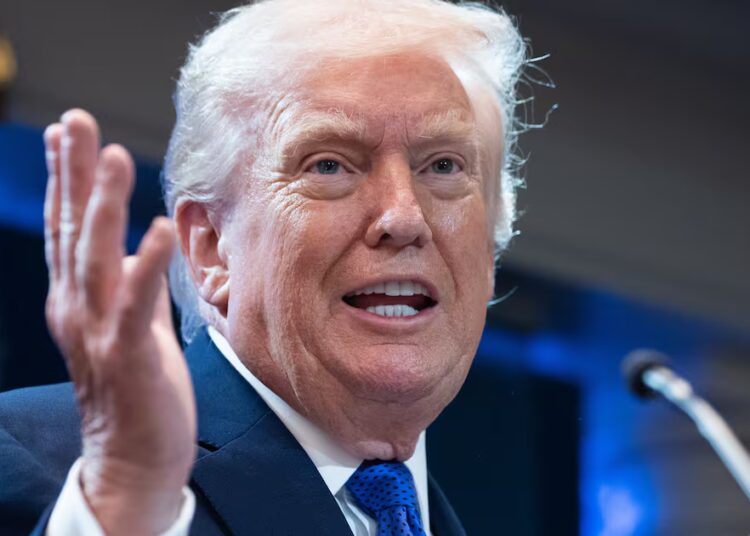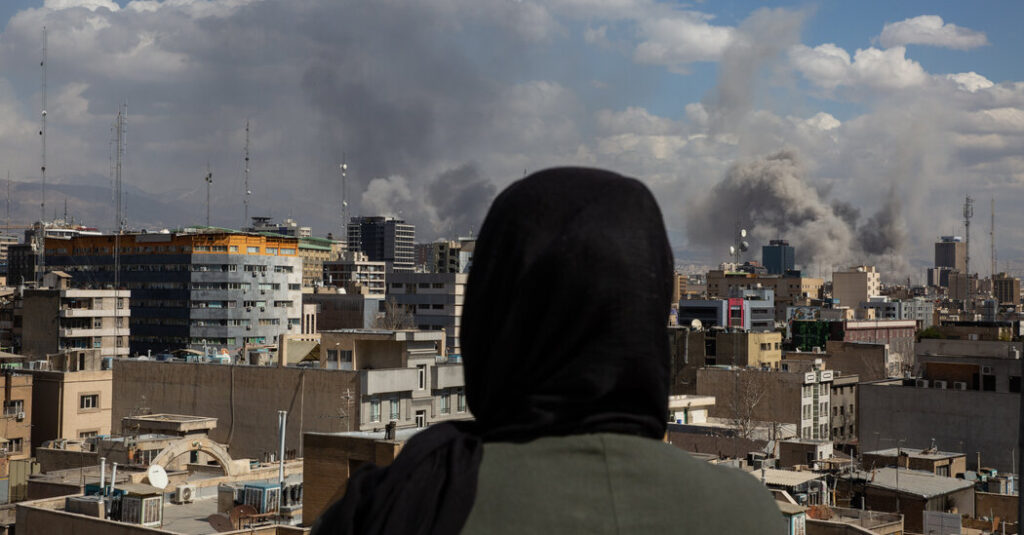
As American and Israeli warplanes continue to bombard Iranian cities, European allies have been left in a familiar place: on the sidelines. President Trump cut them out of planning for a conflict that has direct implications for their security.
The awkward patchwork of responses from European leaders — a mix of guarded approval and plaintive calls for a return to diplomacy — attest to the complexities of dealing with a United States increasingly untethered to post-World War II rules and norms.
Chancellor Friedrich Merz of Germany suggested on Sunday that Mr. Trump was doing a job that Europe could not do itself. Spain’s prime minister, Pedro Sánchez, flatly rejected the strikes as destabilizing. President Emmanuel Macron of France tried to keep the focus on Europe’s campaign to defend Ukraine.
“For Europeans, the dilemma is that they were always defenders of the liberal world order,” said Vali R. Nasr, a professor of international affairs at the Johns Hopkins School of Advanced International Studies. “But their response to the war in Gaza, and now their response to the bombing of Iran, underscores the incoherence of their position.”
Europe’s inability to control its message is not altogether surprising. From the president’s capricious tariffs to his open-ended military campaigns, America’s allies are discovering, to their chagrin, that it’s Mr. Trump’s world and they’re just living in it.
Whether it was the targeted killing on Saturday of Iran’s supreme leader, Ayatollah Ali Khamenei, or the nighttime capture in January of Venezuela’s president, Nicolás Maduro, Mr. Trump has acted without any pretense of enlisting international support, a stamp of approval from the United Nations, or legal legitimacy.
“I don’t suppose it ever crossed his mind that he should consult the Europeans,” said Kim Darroch, who served as Britain’s ambassador to Washington during Mr. Trump’s first term. “It shows that America First mainly means America Alone.”
It was not always this way. Mr. Darroch contrasted Mr. Trump’s latest attack with his missile strike on Syria in April 2018. Back then, the United States was joined by Britain and France, after the Syrian government carried out a chemical weapons attack on civilians during that country’s civil war.
Such collaboration, Mr. Darroch said, is hard to imagine in the second Trump administration, given the makeup of Mr. Trump’s national security team and unyielding tone of its language, especially at it applies to the European Union.
In one way, he said, Mr. Trump’s brazen disregard of the Europeans has made it easier for the leaders. Had he asked for European support in the strikes against Iran, Mr. Darroch said, they would likely have felt obliged to rebuff him, driving an even greater wedge between Europe and the United States.
While European leaders were careful to note they were not involved in the strikes, they endorsed two of Mr. Trump’s ostensible goals: preventing Iran from obtaining a nuclear weapon and degrading its missiles, some of which could theoretically hit Europe. Some also welcomed the elimination of its supreme leader.
A spokeswoman for the French government, Maud Bregeon, said Ayatollah Khamenei was “a bloodthirsty dictator who oppressed his people,” degraded women and minorities, and was responsible for the deaths of thousands of civilians. “We can only be satisfied with his death,” she told reporters.
Germany said the White House had notified it in advance of the attacks, the only European country that said it had been given that courtesy. On Sunday, Mr. Merz voiced surprising tolerance for Mr. Trump, given the lack of consultation. “Now is not the moment to lecture our allies and partners,” Mr. Merz said, ahead of a trip to Washington to meet with Mr. Trump. “Despite all doubts, we share many of their goals without being able to achieve them ourselves.”
Arancha González Laya, a former foreign minister of Spain, said Europe’s cautious response reflected both its skepticism about Mr. Trump’s war aims, and the fact that the war in Ukraine remains its overriding priority.
“Europe is looking at this through the eyes of Russia in Ukraine,” said Ms. González Laya, who is the dean of the Paris School of International Affairs at Sciences Po, a French university. “We’re much closer to the risks than the U.S. is,” she said, citing Iranian missiles that could hit European targets.
On Sunday, the leaders of Britain, France and Germany issued a joint statement in which they said they were are “appalled by the indiscriminate and disproportionate missile attacks launched by Iran against countries in the region, including those who were not involved in initial U.S. and Israeli military operations.”
Whatever their ambivalence about the American operation, the risks of being drawn into it are real. Britain’s prime minister, Keir Starmer, said on Sunday that he would allow British bases to be used for “defensive” strikes, hours before a drone crashed into a Royal Air Force base on the island of Cyprus in the Mediterranean.
Amid the fears of escalation in the Middle East, Mr. Macron separately promoted a military operation in the North Sea in which French Navy helicopters dropped Belgian forces aboard a tanker carrying Russian oil. He called it a “major blow” against the so-called shadow fleet, which helps finance the war in Ukraine.
Mr. Macron is sticking to a plan to deliver a speech Monday about France’s nuclear deterrence in Europe, despite the likelihood that it will be overshadowed by Iran. French officials said the timing of his remarks, at a submarine base in Brittany, would demonstrate the value of having an independent military force in dangerous times.
Among European leaders, only Mr. Sánchez of Spain came out squarely against the attacks. “We reject the unilateral military action of the United States and Israel, which represents an escalation and contributes to a more uncertain and hostile international order,” he wrote on social media.
Ms. González Laya recalled that Spain’s support of the American invasion of Iraq in 2003 triggered the fall of a previous Spanish government. She said that hostility to Mr. Trump in Spain made this a popular position for Mr. Sánchez, her former boss, to take, at a time when he is facing political problems.
For every European leader who has struggled to respond to Mr. Trump, there are leaders elsewhere in the world who are well positioned to profit from him. Indeed, some already have.
Prime Minister Benjamin Netanyahu of Israel has succeeded, twice now, in getting the United States to back a long-sought military campaign against Iran, even though its rationale for the United States this time is questionable.
Analysts say President Vladimir V. Putin of Russia could use Mr. Trump’s new enthusiasm for regime change to justify his aggression in Ukraine. The same goes for President Xi Jinping of China, who seeks to control Taiwan, which China regards as a breakaway province.
In Europe, critics say, acquiescing to Mr. Trump’s military adventurism in the Middle East could exacerbate problems closer to home. He might, for example, feel emboldened to revisit his designs on Greenland.
“They’re having trouble navigating this new world because they are caught between these two positions,” Mr. Nasr said. “If you’re defending the principle that the U.S. and Israel can bomb everybody they want, you can’t turn around and say, ‘This doesn’t apply to Ukraine.’ Why wouldn’t the United States take Greenland?”
Ana Castelain contributed reporting from Paris and Christopher F. Schuetze from Berlin.
Mark Landler is the Paris bureau chief of The Times, covering France, as well as American foreign policy in Europe and the Middle East. He has been a journalist for more than three decades.
The post As Trump Bombs Iran, America’s Allies Watch Fitfully From Sidelines appeared first on New York Times.