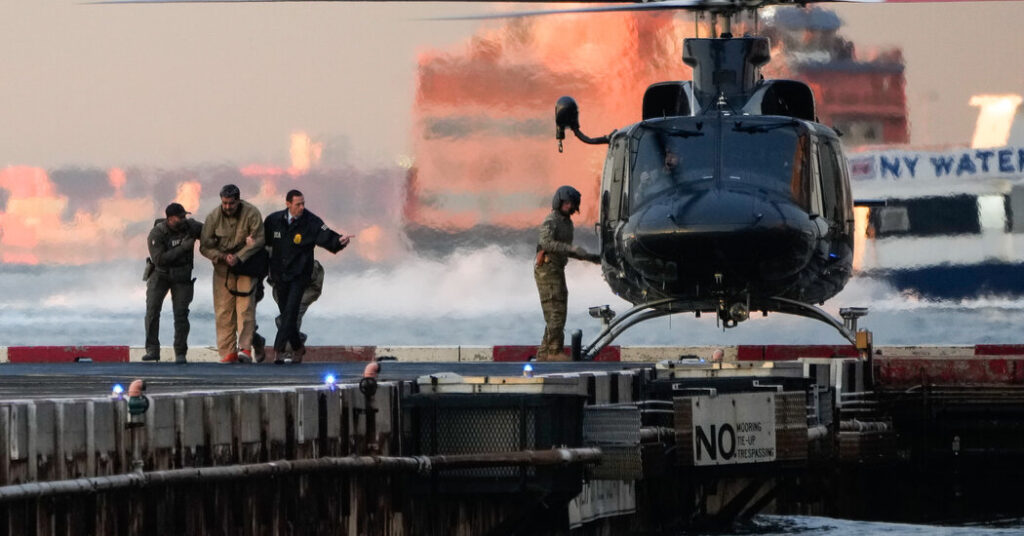
When Nicolás Maduro and his wife walked into their apartment deep in a Caracas military base on an early January morning, they had no way of knowing that their every movement was being tracked by American intelligence. Or that the apartment, including the safe room, had been replicated in Kentucky by a Delta team that did dozens of practice runs figuring out how to immobilize the guards and breach the doors.
Ayatollah Ali Khamenei apparently ignored the evidence that the C.I.A. was tracking him and his top leaders, too, an operation that President Trump exposed in a social media post eight months ago. When the United States and Israel discovered that he and his national security team would be gathering Saturday morning, they advanced the timeline for their attack.
Mr. Maduro is now in the federal detention center in Brooklyn. Ayatollah Khamenei’s state funeral is being planned for the coming days. And the rest of the world’s leaders are left to mull the combination of exquisite American surveillance capabilities and a president who seems to take delight in using that information to capture or kill his perceived enemies.
American intelligence agencies have long wiretapped, geolocated and monitored senior leaders, back to the earliest days of the Cold War. Fifteen years ago, WikiLeaks revelations included documents that gave glimpses of how the United States attempted to track China’s leaders and its nuclear weapons. Germany’s former chancellor, Angela Merkel, was outraged to discover that her personal cellphone was tapped by the country’s closest ally, and complained to President Barack Obama that it reminded her of growing up in East Germany.
Today, merely tapping into a foreign leader’s conversations seems like a quaint remnant of post-Cold War spycraft.
Today, the real-time ability to locate a leader is the holy grail. And the surge in the number of electronic sensors deployed on street corners and doorbell cameras and toll highways, combined with artificial intelligence techniques to quickly parse truly vital information from billions of data points those sensors generate, has transformed the art form of surveilling V.I.P. whereabouts.
It has allowed intelligence agencies to track motorcades. (In Washington, presidential and vice-presidential movements are usually still announced by blaring motorcycles and familiar helicopter flight patterns, but cabinet members and the C.I.A. director move more discreetly.) Around the world, spy agencies have learned how to monitor the opening and closing of electronic doors at leadership compounds, and to locate the cellphones of bodyguards and family members who may travel with a foreign leader but are usually a lot sloppier about encrypting their messages and using burner phones.
“If we had had this capability with a high degree of certainty to get Saddam Hussein through a precision strike, we wouldn’t have had the Iraq war,” said Glenn Gerstell, the general counsel of the National Security Agency from 2015 through 2020, a period that included part of Mr. Trump’s first term. “The only way to get him was to have boots on the ground. But now, with heightened capabilities, we can target individual leaders.”
(In fact, American forces tried to take out Mr. Hussein in the opening hours of the war. But he had left the home they targeted a few hours earlier.)
As Mr. Trump has shown, this targeting ability opens new options for presidents seeking to change the attitude of foreign regimes — or change their leadership.
Mr. Trump’s decision to snatch Mr. Maduro from his bed, but keep the rest of the Venezuelan leadership in place, is an experiment in remote-control occupation. After the Delta team landed by helicopter that early January night, killed Mr. Maduro’s Cuban and Venezuelan guards, and seized him seconds before he could lock himself in that safe room, Mr. Trump blessed the installation of Vice President Delcy Rodriguez as acting president.
She will stay there, he has said, as long as she follows Washington’s instructions. And clearly he is enamored of the early results. In a brief conversation with The New York Times on Sunday, on the second day of the American and Israeli attack on Iran, he cited the Venezuela experience as a model for what he was trying to accomplish in Iran.
“What we did in Venezuela, I think, is the perfect, the perfect scenario,” Mr. Trump insisted. “Everybody’s kept their job except for two people.”
In the Iran case, Mr. Trump had flagged for Ayatollah Khamenei that the United States was watching his every movement — a revelation that, had it appeared first in the media, might well have triggered a Justice Department leak investigation.
“We now have complete and total control of the skies over Iran,” he posted on Truth Social in June 2025, as he cut short his participation in a summit and flew back to Washington to talk about how the United States would participate in the attacks Israel had begun on the country.
Then he added: “We know exactly where the so-called ‘Supreme Leader’ is hiding. He is an easy target, but is safe there — We are not going to take him out (kill!), at least not for now.”
For good measure, Mr. Trump added an all-caps demand for “UNCONDITIONAL SURRENDER!”
It is impossible to know whether Ayatollah Khamenei was following Mr. Trump’s posts, but he certainly did not seem impressed by the warning. On Saturday, even with an American naval force deployed around Iran and fighter jets visible on satellite images massing on American and Israeli bases, Ayatollah Khamenei was in his official residence. So were national security leaders. And while the United States did not launch the missile that killed him, it was the C.I.A.’s warning, backed by indicators from other U.S. intelligence agencies, that killed him in one of the first Israeli strikes.
It is not clear how far the United States can push this new power — or whether it would risk using this targeting capability in the case of the leader of a country that had nuclear weapons available to retaliate.
Notably, Mr. Trump is not messing with China’s Xi Jinping, or Russia’s Vladimir V. Putin or even North Korea’s Kim Jong-un, who has an arsenal of 60 or more nuclear weapons. “I’m not sure you can extrapolate this capability into a universal ability to track every leader everywhere,” said Paul Kolbe, who served as the C.I.A.’s station chief in Moscow early in Mr. Putin’s rule. “But this is why Putin is so paranoid about his location,” and moves frequently among his many houses.
“If you are the leader of an adversary nation, you should be pretty worried,” Mr. Kolbe said. “But if you are Putin or Xi, not so much, because of the stakes at play. The lesson that keeps getting taught is that if you don’t have nukes, you are far more vulnerable.”
The Iranians do not have nuclear weapons, which might make them hesitate before naming a new supreme leader, who would move to the top of the target list. Nonetheless Majid Takht-Ravanchi, the Iranian deputy foreign minister, said on CNN on Monday morning that the government remains in place and Ayatollah Khamenei’s replacement would soon be announced.
“We have a president,” he said. “We have head of judiciary. We had the head of parliament. The supreme leader was assassinated — was murdered by Israeli and American aggression.”
Now, he said, “the new leader is going to be elected. So everybody — everything is in order.”
David E. Sanger covers the Trump administration and a range of national security issues. He has been a Times journalist for more than four decades and has written four books on foreign policy and national security challenges.
The post As Maduro and Khamenei Learned, It’s Harder Than Ever for Leaders to Hide appeared first on New York Times.