Last year, as President Trump swung from one erratic tariff policy to the next, Asian economies largely withstood the chaos. That resilience is now under threat as a conflict in the Middle East rapidly escalates, after Mr. Trump said that the U.S. military would continue to strike Iran for several weeks.
Concern spiked in many Asian capitals on Monday over the disruption to the flow of oil from the Middle East, a region that supplies half or more of the oil that several large economies consume.
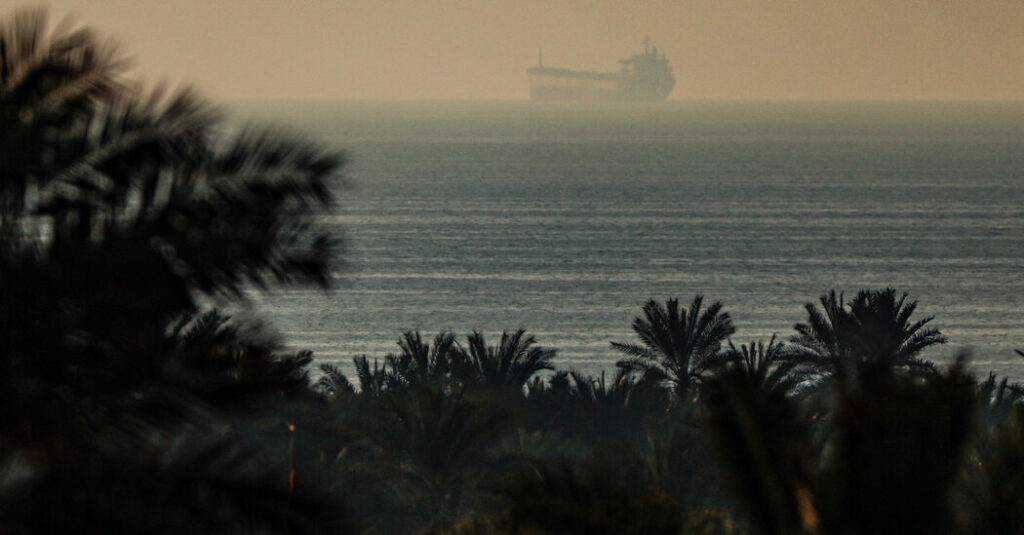
In China, Japan, South Korea, Taiwan and India, leaders are focused on the Strait of Hormuz, a narrow shipping corridor on Iran’s southern border through which one fifth of the world’s supply of oil flows, much of it eventually landing in Asia.
Countries have stockpiles of oil and gas that can see them through the next weeks and months, but a longer war in the region or decision by Iran to blockade the Strait of Hormuz would pose a more serious threat to their economies.
Experts said that Iran was unlikely to try to block the waterway because the country depends on its oil and gas exports to China for revenue. It would also be catastrophic for the global economy, economists warned.
Nevertheless, there was palpable concern in the oil markets, with prices spiking on Monday. Tankers avoided the area and diverted to longer routes, while the cost of insuring them began to climb and ports started to contend with backlogs.
The price swings and uncertainty are complicating an already delicate balance governments have struck between domestic economic challenges and geopolitical calculations.
China on Monday called on “all parties to immediately cease military operations, avoid further escalation of tensions, and prevent the regional instability from exerting a greater impact on global economic development,” according to Mao Ning, a spokeswoman for China’s foreign ministry.
Oil from the Middle East is crucial to China’s overall energy security. If the conflict were to drag on, “China does not have the capacity to cushion the shock,” said Muyu Xu, a senior crude oil analyst based in Singapore for Kpler, a market research firm. “It would be catastrophic not just for China, but for the global market,” Ms. Xu said.
Beijing is already facing an economic slowdown at home, where a property crisis weighs heavily on households that invested their savings in real estate. Excessive competition among local companies in China has set off a deflationary spiral, and youth unemployment is high. Beijing has turned to manufacturing to help fuel its economic growth and weather a fierce trade war with the United States that led to punishing U.S. tariffs on Chinese goods that at one point hit 145 percent.
In a few weeks, China’s top leader, Xi Jinping, is expected to meet with Mr. Trump in what may now become an even more tense encounter.
China imports a little over half of its seaborne crude oil from the Middle East. Around a quarter of that comes from Iran. A loss of Iranian supply would eventually force China to purchase more oil, likely at higher prices, from other sources.
China has enough crude oil onshore to last 115 days, according to Kpler. It also operates three major crude pipelines, two of which transport oil from Russia and Kazakhstan and are shielded from Middle East disruptions.
The ruling Communist Party has poured billions of dollars into developing renewable energy like solar power and electric vehicles. But, in the short term, it would have to look for new supplies of oil in a prolonged crisis.
“China can’t pivot to domestic demand fast enough to offset collapsing export margins and absorb an oil price shock simultaneously,” said Han Lin, the country director for the Asia Group, a consulting firm. “The U.S. trade war compresses the very profits Chinese industry needs to fund the green-energy transition that would reduce Middle East exposure.”
Japan and South Korea are even more vulnerable to disruptions in the Strait of Hormuz because of heavy reliance on Middle Eastern oil and gas and limited domestic energy production.
Japan, in particular, imports more than 90 percent of its oil through the strait. South Korea depends on the Middle East for about 70 percent of its crude imports.
On Sunday, the Japanese shipping giant Mitsui O.S.K. Lines, one of the world’s largest transporters of fuel, announced that it was halting operations in the Persian Gulf following reports that the Iranian military was cautioning vessels to avoid the strait.
For now, both countries have measures to offset the immediate effects.
Japan holds a total of 254 days of private and state-held oil reserves, according to government data. South Korea had enough in store to cover more than 210 days of consumption as of the end of last year, data from the country’s state-owned national oil and gas company indicated.
“We will take every possible measure to ensure the stable supply of energy for our nation,” Prime Minister Sanae Takaichi of Japan said, speaking in Parliament on Monday.
In South Korea, officials began examining contingency plans, including the release of oil reserves should there be a prolonged closure of the Strait of Hormuz, according to local media reports.
But even if oil keeps flowing, a continuing surge in energy prices will probably take a significant economic toll.
Japan and South Korea already spend well over $100 billion annually on energy imports, meaning that further price increases would worsen their trade balances.
Japan, in particular, is also grappling with a prolonged bout of inflation that is weighing on household budgets. Any government moves to lighten the burden on consumers, such as cash handouts or tax cuts, risk exacerbating Japan’s immense sovereign debt levels and could spur further jitters in its debt markets.
Nearby in Taiwan, a dependence on imported fuel has long been one of the island democracy’s most glaring vulnerabilities.
Taiwan imports more than 96 percent of its energy, most of it from the Middle East. About 60 percent of Taiwan’s oil — and about a third of its natural gas — arrives by ship from countries via the Strait of Hormuz.
Any shortage of energy supplies to Taiwan could endanger the global economy, which relies on the island’s manufacturing powerhouses for semiconductors used in smartphones, electric vehicles and artificial intelligence systems. A handful of factories in Taiwan make the vast majority of the world’s advanced computer chips, and they depend on a consistent supply of electricity.
Saudi Arabia is Taiwan’s largest supplier of oil, and Taiwan gets a quarter of its liquefied natural gas from Qatar.
Taiwan has enough oil in reserve to power the country for about 120 days, according to Chen Shih-Hau, a director focused on energy security at the Taiwan Institute of Economic Research, a private research group. Taiwan’s natural gas supply would last only about 11 days, Mr. Chen said.
Major tech companies like Taiwan Semiconductor Manufacturing Company have backup generators designed to keep power running during short-term emergencies, said Jheng Ruei-he, a senior analyst at Chung-Hua Institution for Economic Research, a government-funded think tank in Taipei. But such equipment isn’t meant to be a long term stand-in for the national power grid.
Taiwan’s Ministry of Economic Affairs said in a statement on Monday that the country had long-term contingency plans to ensure a stable power supply.
In at least one corner of Asia, Mr. Trump’s trade ambitions appeared to be running up against his aims to force a change in leadership in Iran.
Until recently, India’s main source of oil came from Russia. But as part of a trade deal that the country clinched with Mr. Trump last month, India was supposed to replace that Russia supply with oil from other sources — mainly from the Persian Gulf.
Reporting was contributed by Alex Travelli in New Delhi; Murphy Zhao in Hong Kong and Amy Chang Chien from Taipei.
Alexandra Stevenson is the Shanghai bureau chief for The Times, reporting on China’s economy and society.
The post Already Weathering a Trade War, Asia Now Faces a New Energy Threat appeared first on New York Times.