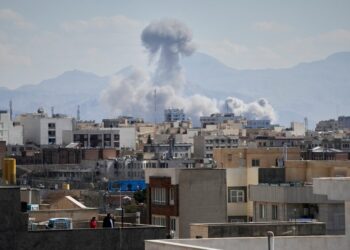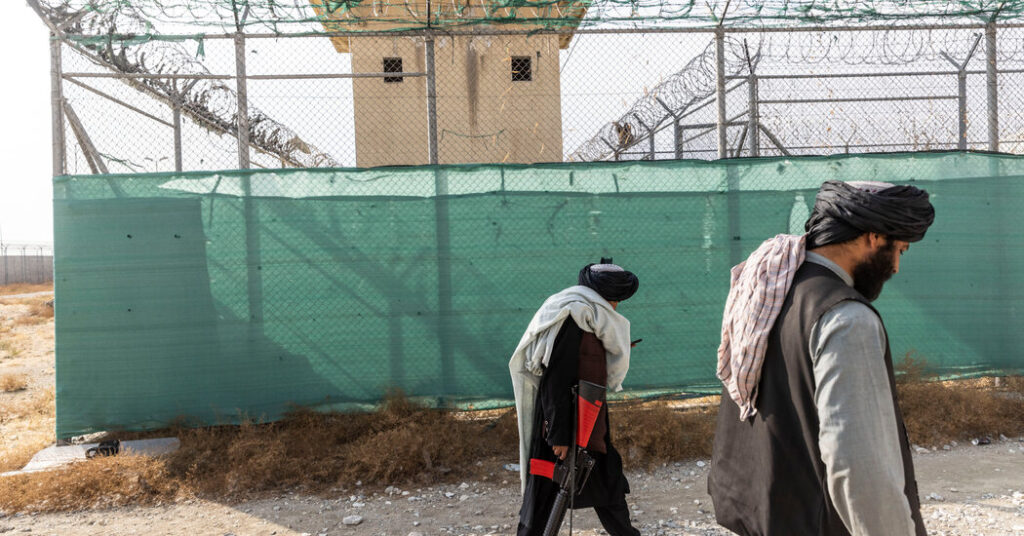
Afghan officials said Sunday that Pakistan had conducted airstrikes on Bagram Air Base, its most prized military asset and one coveted by President Trump.
“This morning at around 5 a.m., several fighter jets belonging to Pakistan’s military regime attempted to carry out a bombing operation within the airspace of Bagram Air Base,” Fazal Rahim Meskinyar, a spokesman for the Parwan Province police, where Bagram is, said in a statement.
Mr. Meskinyar said that Afghan antiaircraft weapons had repelled the missiles, and that there were no reported casualties.
Hamidullah Fitrat, a spokesman for the Taliban government, said Sunday evening that Afghanistan had faced an “aerial aggression” at the base. He did not say whether the attack had caused any damage.
Pakistani military officials did not respond to requests for comment.
Bagram Airfield was the nerve center of the 20-year U.S. war in Afghanistan and a big trophy when the Taliban retook control of the country in 2021 after the United States withdrew its forces.
Since returning to the presidency in 2025, Mr. Trump has said that the United States should never have abandoned Bagram and that he wanted to reclaim it. “We’re trying to get it back because they need things from us,” he said in September.
Mr. Trump said Bagram was strategically important for the United States because “it’s an hour away from where China makes its nuclear weapons.”
The Pakistani military has hit dozens of small Afghan military bases, ammunition depots and outposts in recent days, declaring that it is in “open war” against the Taliban government.
Targeting Bagram is different. Until Sunday, the Pakistani strikes had not been aimed at major infrastructure, and nothing with the symbolic significance that Bagram holds.
Since regaining control of the base, the Taliban have showcased Afghanistan’s military arsenal on Bagram’s runways every summer, organizing celebratory parades on the anniversary of their return to power.
The base, about 25 miles north of the capital, Kabul, has massive twin runways, one of which, at 11,800 feet, is Afghanistan’s longest, designed to sustain heavy fighter planes and transport carriers. But recent reports have suggested that the Afghan government now makes limited use of the airfield. “We have neither weapons nor forces in Bagram,” Bakht ur-Rahman Sharafat, the director general of Afghanistan’s national airline, said on social media on Sunday.
The attempted strikes on Bagram came on the second day of a coordinated attack by the United States and Israel on major cities and infrastructure in Iran. On Saturday, the attacks killed Iran’s longtime supreme leader, Ayatollah Ali Khamenei, a seismic political shift that raises the prospect of broader instability in the Middle East and South Asia. Iran has responded with strikes on Israel and several other Middle Eastern countries that host U.S. military bases.
Afghanistan and Pakistan have been trading attacks for months, but the violence has now reached its highest level in years. Pakistan has said the strikes are in retaliation for the Taliban government’s support of a militant group that has killed hundreds of Pakistani security forces in recent years.
Afghanistan has responded with attacks on Pakistani outposts along its 1,600-mile shared border with Pakistan. Afghan officials have rejected Pakistan’s accusations that they support the militant group, Tehreek-e-Taliban Pakistan, also known as the Pakistani Taliban. In private, however, they have acknowledged the presence of the group’s militants in Afghanistan.
On Sunday, Pakistan also carried out airstrikes in Kabul. A loud explosion rumbled through the city of six million as residents began their daily Ramadan fast. The fighting resumed on Sunday night, with heavy antiaircraft fire heard in central Kabul.
Both Pakistani and Afghan forces have ignored calls by neighboring countries to respect a truce during the holy month of Ramadan.
It remains unclear what objectives Pakistan wants to accomplish with the latest military campaign. Analysts say that more strikes on Afghan military infrastructure are likely to lead to retaliatory attacks from militant groups supporting the Taliban government, including the Pakistani Taliban.
The Pakistani military is far bigger than Afghanistan’s, but over the weekend some analysts questioned Pakistan’s endgame for its campaign — or if it had any.
“Pakistan has the capacity to do airstrikes, but where do we go from there?” said Ayesha Siddiqa, a Pakistani military analyst and senior fellow at King’s College London. “Is it about forcing the Afghans to surrender Bagram? There doesn’t seem to be an endgame in sight,” Ms. Siddiqa said in a telephone interview.
Though the Taliban government has rebuffed Mr. Trump’s effort to take back Bagram, it has called for Afghanistan and the United States to rebuild economic and diplomatic relations.
“The United States is well aware that its 20-year military presence in Afghanistan constituted a failed policy,” Amir Khan Muttaqi, Afghanistan’s foreign minister, told The New York Times in Kabul in January. “We seek positive relations with the United States across all domains — without any military presence.”
Elian Peltier is The Times’s bureau chief for Pakistan and Afghanistan, based in Islamabad.
The post Afghanistan Says Pakistan Tried to Strike Prized Air Base appeared first on New York Times.