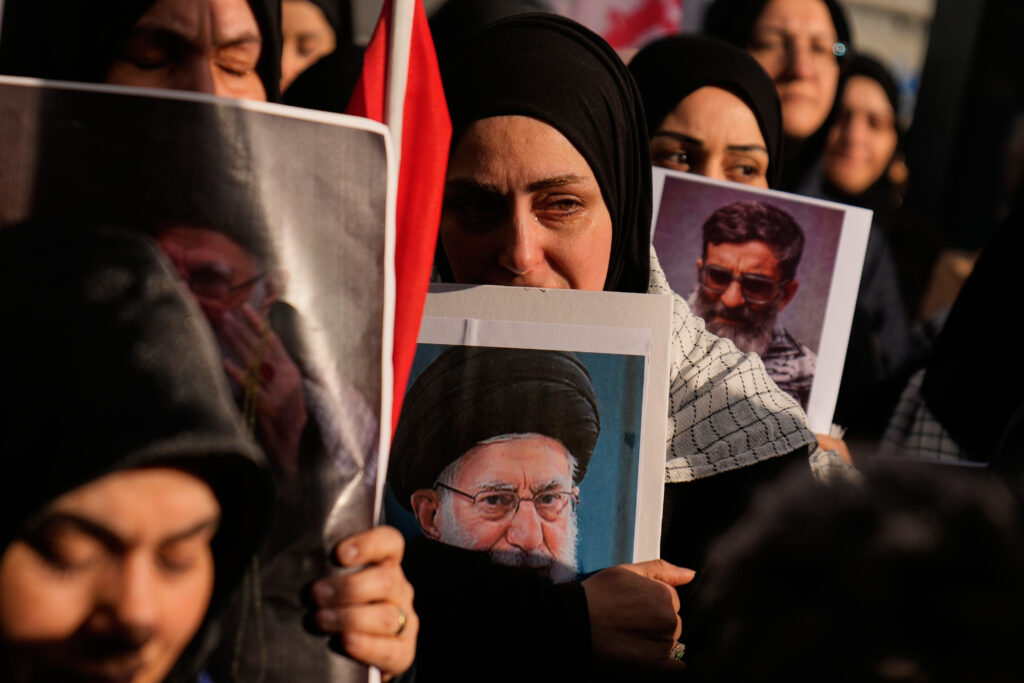
Iran announced the first step in a succession process that remains opaque and fraught with uncertainty Sunday after the government confirmed the killing of Supreme Leader Ayatollah Ali Khamenei in U.S. and Israeli attacks.
What comes next is uncertain. Iran’s constitution calls for an assembly of experts to choose the next supreme leader, but that may not be possible in wartime. And with so many of the country’s top leadership reportedly targeted in the U.S. and Israeli strikes, it is unclear who remains among the country’s power brokers and those considered candidates to replace Khamenei.
“The martyrdom of the Supreme Leader at the hands of Israel and the criminal America was a great disaster for our country,” said Iranian President Masoud Pezeshkian in an address to the nation Sunday, his first since the conflict erupted.
An interim leadership council assumed its duties and began leading the country, Pezeshkian said. “With the power of God, we will continue the path of the Imam, the path of the dear leader, and the path of all those who seek justice in the world with power,” he said.
Long anticipated, the succession of Iran’s 86-year-old supreme leader was always expected to bring with it a degree of regime instability. But now, that will likely be magnified, with various rivals and factions jockeying for wartime power amid vastly diminished popularity and perhaps support among Iran’s military establishment.
Iran has only held one other supreme leader succession, that which brought Khamenei to power in 1989 after the death of Ayatollah Ruhollah Khomeini, the founder of the Islamic Republic. Though the process is outlined in the country’s constitution and the Iranian system has had years to prepare, experts caution that a smooth process is nearly impossible.
“Irrespective of what the guidelines say and what the politics may have been, it was always going to be improvisational,” said Suzanne Maloney, a vice president at the Brookings Institution who has advised both Democratic and Republican administrations on Iran policy.
“Under the circumstances of an existential conflict, the succession process is going to be very much dictated by the context of the moment,” Maloney said. In the near term, she expects Iran to keep the temporary council in place.
The supreme leader is both the head of state in Iran and a religious figure, believed to be a representative of God by his Shiite followers. Khamenei served in the position for 37 years, during which time he greatly expanded the power and scope of rule over the democratically elected civilian government. As supreme leader, Khamenei had the last say on all matters in the country, but often only arrived at decisions after a lengthy consultative process.
Iran’s former president, Ebrahim Raisi, had long been considered the next in line to Khamenei. But after Raisi’s death in a 2024 helicopter accident, the question of succession has remained open, creating a kind of power vacuum. Several names have been considered frontrunners, but most lack a significant public profile.
One of the top contenders on the interim council appointed Sunday is Ayatollah Alireza Arafi, who has deep ties to the Iranian system and security establishment. He is a member of the guardian council and the assembly of experts, the body that chooses the next supreme leader.
After Raisi’s death, one of Khamenei’s sons, Mojtaba, was widely expected to be the favored successor, but Khamenei was reportedly against the idea of transferring the position along hereditary lines. Others in Iran feared such a move would echo the very ruling system — the shahs of the Pahlavi dynasty — that the Islamic republic under Khomeini toppled in 1979.
It’s unclear how many figures from Khamenei’s inner circle where killed alongside him or elsewhere during U.S. and Israeli strikes. The status of his son Mojtaba remains unclear, but state media confirmed Khamenei’s son-in-law and daughter-in-law were killed Saturday.
“The structure of the Islamic Revolution has been designed in such a way that after the martyrdom of any commander, at any rank or level, qualified and capable individuals immediately replace them,” read a report Saturday from the state-run Fars News Agency.
As long as the war continues, the succession process could remain a secondary concern to Iran’s remaining leadership, according to Alex Vatanka, an Iran analyst with the Middle East Institute.
“The succession process is not key in the short term because they’re going to try and fight on. Firing off missiles does not require a supreme leader,” he said. But if Iran’s regime survives war with the United States and Israel, the supreme leader’s role could be critical to holding the system together in a weakened state.
Already this year, Iran faced massive nationwide protests that began in response to economic grievances but quickly morphed into thundering calls for an end to the regime. The protests plunged the country into crisis and Iran’s leadership chose to respond to the unrest with overwhelming violence, killing thousands of people in a matter of days.
In the aftermath of the protests, many Iranians reached by The Washington Post described deep, simmering anger toward their government. And some said they were eagerly anticipating a U.S. attack as President Donald Trump threatened Iran with an expanding military buildup over the past month.
Celebrations broke out in Tehran and other parts of the country after news of Khamenei’s death Saturday night. Amid the ongoing near-total internet blackout it was impossible to determine how widespread the celebrations were. But Iranians reached inside the country by The Post reported that security forces were deployed Saturday night to break up the revelers.
When Trump announced the initial waves of U.S. and Israeli attacks against Iran he issued a direct call to the Iranian people.
“Bombs will be dropping everywhere. When we are finished, take over your government. It will be yours to take,” Trump said. “This will be probably your only chance for generations.”
Prominent members of Iran’s opposition are hoping Khamenei’s death will build momentum for protests and demonstrations. Reza Pahlavi, the son of Iran’s deposed shah and a prominent opposition exile, has repeatedly called on Iranians to rise up against the regime. After Khamenei’s death he issued a renewed call to the country’s security forces to defect.
“Any attempt by the remnants of the regime to appoint a successor to Khamenei is doomed to fail from the outset,” he wrote. Though he has lived in exile for most of his life, Pahlavi is Iran’s most prominent opposition leader, and in recent mass protests inside the country Iranians chanted for his return.
“To the military, law enforcement, and security forces: any effort to preserve a collapsing regime will fail,” he said in a social media post.
The post Who leads Iran now? An uncertain path to new supreme leader after Khamenei’s death. appeared first on Washington Post.