I’m in Washington, D.C., and have been following the U.S. strikes on Iran with my colleagues here.
Regime change in Iran has been on the mind of U.S. administrations for decades. In 1953, the C.I.A. helped orchestrate a coup that overthrew Iran’s democratically elected government and reinstated the pro-western Shah. And ever since the 1979 Iranian revolution that in turn overthrew the Shah and established an anti-American theocracy with nuclear ambitions, Tehran has been in Washington’s sights.
My colleagues in D.C. tell me that Pentagon officials have done a lot of work over the years on what it might take to oust Iran’s leaders. But no administration acted on it — until now. Today I write about what the death of Iran’s supreme leader means for Iran and the Middle East.
Iran’s supreme leader is dead. What now?
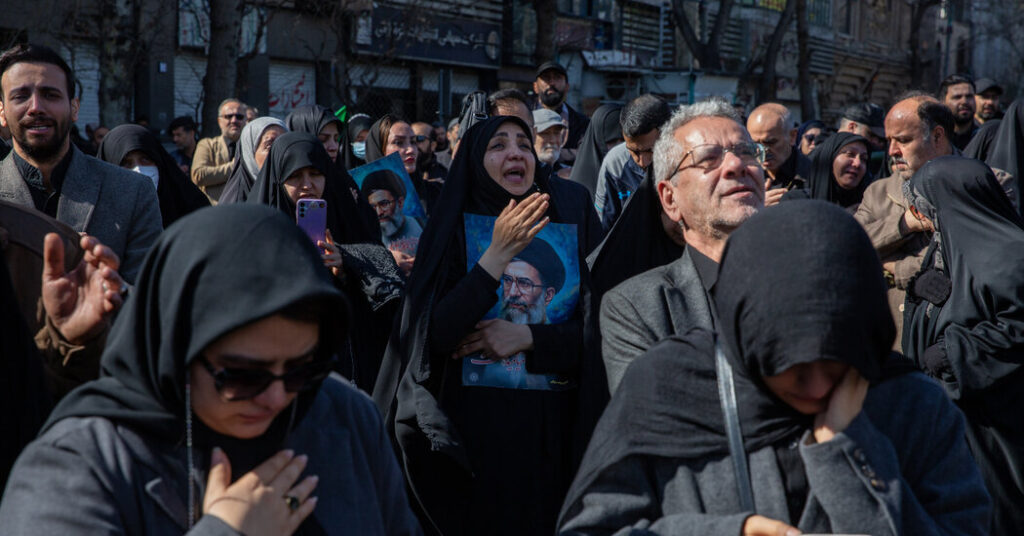
He presided over Iran for more than three decades, overseeing its transformation into a regional power while ruling at home with an iron fist. His death, which came as a result of Israeli airstrikes, based on American intelligence, has sent Iranians into the street — some to mourn, but also many to celebrate — as the government he led vows revenge.
Ayatollah Ali Khamenei was the supreme leader of Iran’s theocratic government. (Read his obituary.) Whoever takes his place — and how they come to power — will shape the future of this conflict, Iran and even the broader Middle East.
A succession plan
The U.S.-Israeli attacks on Iran began on Saturday with strikes that largely focused on military targets, like the missile launch sites scattered throughout the country.
The most prized target was a high-security compound in the heart of Tehran, where C.I.A. agents had learned that a meeting of top Iranian officials was taking place. Khamenei was nearby. Satellite images showed the compound reduced to rubble, and rumors of the Supreme Leader’s death began circulating quickly. President Trump announced the death on social media on Saturday. Iran confirmed it hours later.
What happens next isn’t clear.
For now, Iran’s top national security official, Ali Larijani, has said an interim committee will run the country until a new ayatollah is chosen. Last June, during the 12-day war with Israel, Khamenei named three candidates who could replace him, with the successor to be appointed by a conservative body of clerics.
The goal, as my colleague Farnaz Fassihi wrote before this weekend’s bombing began, is to ensure that the Islamic Republic survives, regardless of what the Trump administration may have in mind.
‘Take over your government’
After weeks of mixed messages around Trump’s goals for a war with Iran — was it to punish the government for killing tens of thousands during recent protests? To finish the job on its nuclear program? To eliminate the ballistic missiles threatening Israel? — the president issued a full-throated call for regime change on Saturday.
What was notable, though, was who he called on to achieve this goal.
“When we are finished, take over your government,” he urged, in a message aimed at the Iranian people. “America is backing you with overwhelming strength and devastating force. Now is the time to seize control of your destiny.”
This approach — urging Iranians to overthrow their own unpopular government — allows Trump to avoid sending in ground troops to finish the job, something the administration has insisted it will not do. The lessons from the Iraq war are fresh on everyone’s mind.
But it’s also a scenario, as my colleague David Sanger writes, “that rides almost entirely on the ability of the Iranian people, largely unarmed and unorganized, to seize the moment.” Many analysts are skeptical that will work.
Intelligence agencies believe the organized opposition in and outside Iran remains relatively weak, according to reporting from my colleague Julian Barnes, who covers U.S. intelligence agencies and national security.
That raises the question of whether the Trump administration, for all it is urging Iranians to rise up, actually thinks outright regime change is likely — or whether it hopes for a softer, Venezuela-style decapitation. There, the Trump administration ousted the president — but rather than helping a democratically elected leader into power, it left the vice president of the old regime in charge.
“This is an administration that prioritizes stability,” Julian told me. They’re envisioning a situation in which “something like the Venezuela scenario plays out and that the next people up are ready to make a deal with the United States.”
One scenario U.S. officials are imagining, Julian told me, is that Iran’s powerful Revolutionary Guards take greater control over the country and pursue a less confrontational line with the U.S. in order to protect their economic and political interests. In that scenario, the next supreme leader may be just as hard-line but would have less power.
But there are multiple scenarios that could unfold, and these officials don’t have a huge degree of confidence in any one of them, Julian said.
“They have unleashed forces here that they cannot control,” he said. “No one can predict how it’s going to play out.”
Chaos and change
Amid all the uncertainty, one thing seems clear. The death of Khamenei will be some kind of turning point for the Islamic Republic.
Inside Iran, he had become the face of a regime that had lost the trust and faith of the Iranian people that once propelled it to power in a popular uprising. It was under his leadership that the brutality against protesters escalated.
In the U.S., many viewed him as the main obstacle to a lasting nuclear deal and by extension to a peaceful Middle East.
“There’s a reason so many people are saying it’s a good thing Khamenei is dead,” Julian told me.
His departure has finally opened up the possibility for change. But what kind of change?
“There are people who believe this war will come to a swift end, and there will be a more cooperative government in Iran. There are people who believe a democratic spring will emerge in Tehran,” Julian said. “But it’s just as possible that this unleashes chaos and disruption. We just don’t know yet.”
MORE TOP NEWS
The latest on Iran
Iran unleashed deadly retaliatory attacks on Sunday against Israel and the countries of the Persian Gulf, home to several U.S. military bases, as the U.S. and Israel carried out more airstrikes in Iran. In the video above, our Iran bureau chief Erika Solomon describes how ordinary Iranians are responding. Follow our live coverage here.
-
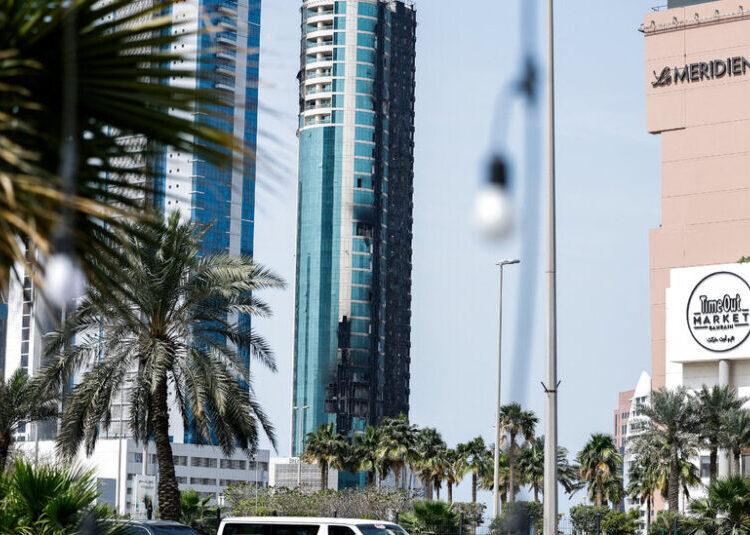
Three U.S. troops were killed in action; at least nine people were killed in Israel; and at least four people were killed in attacks across the United Arab Emirates, Kuwait, Qatar, Bahrain and Oman, according to official reports tallied by The New York Times.
-
In Iran, dozens of children were killed at a girls’ elementary school on Saturday, according to Iranian state media. Videos verified by The Times show that the school is adjacent to an Iranian naval base.
-
The fighting shut down shipping through the Strait of Hormuz, the conduit for one-fifth of the world’s oil supply.
-
At least 22 people were killed in protests across Pakistan, including 10 who died as crowds tried to storm the U.S. consulate in Karachi.
-
The C.I.A. helped pinpoint a gathering of Iranian leaders. Then Israel struck.
-
Here are maps that show where Israeli and U.S. airstrikes took place.
My colleagues at The Morning newsletter and I want to answer your questions about the conflict in Iran. What do you want to know?
OTHER NEWS
-
The Trump administration began allowing U.S. companies to send oil to private businesses in Cuba.
-
OpenAI signed a deal to work with the U.S. military after Trump ordered all federal agencies to stop using A.I. technology from Anthropic.
-
The U.S. delayed announcing a multibillion-dollar package of arms sales to Taiwan to avoid upsetting China.
-
Jeffrey Epstein maintained a small stable of elite doctors to treat, and manipulate, young women from overseas who were having sex with him.
-
Here’s how the BAFTAs bungled its response to a racist slur from a man with Tourette’s.
-
Top of The World: The most clicked link in your newsletter yesterday was about Jacinda Ardern, New Zealand’s former leader, relocating to Australia.
SPORTS
Formula 1: Teams are trying to make sense of confusing new rules as the season begins.
Tennis: Daniil Medvedev won the men’s singles title at the Dubai Tennis Championships, whose finals went ahead despite Iran’s missile attacks in the region.
Football: Four Asian Football Confederation Champions League matches have been postponed after the U.S. and Israel attacked Iran.
NOSTALGIC TECHNOLOGY OF THE DAY
The iPod
— Apple’s iconic music player is finding new fans, some of whom weren’t even born when it was first released nearly 25 years ago. The device, discontinued in 2022, “just grounds me, and it feels convenient to be in one place at one time, instead of everywhere at once,” said one devotee.
MORNING READ
Venezuela’s capital, Caracas, a proud city laid low by economic decline, authoritarian rule and brain drain, is stirring back to life after the ouster of Nicolás Maduro. New restaurants are opening, nightclubs are packed and start-ups are flourishing in what some call a revival.
Much of this budding optimism is grounded in hopes that Venezuela’s oil industry could grow this year, and by the easing of some authoritarian restrictions. But the moment is fragile. Read more about Caracas from our former bureau chief in the region, who recently made his first trip there in years.
AROUND THE WORLD
The fleeting life of a Korean dessert
It’s a dense, egg-size ball of pistachio and shredded phyllo wrapped in a marshmallow coating: rich, nutty and sweet, with a texture that’s crunchy or sandy, depending on whom you ask. This is the Dubai chewy cookie, a South Korean reimagining of Dubai chocolate.
In January, South Koreans couldn’t get enough of this dessert, which is neither a cookie nor from Dubai. But a month later, the enthusiasm seemed to wane. I got swept up, and spent a whole morning searching for one with the help of a tracking website. I finally succeeded last month, but as the craze faded, so did some of my excitement. Was the treat worth it? The cookie’s brief life span reflects the country’s fast-moving food trends, which are driven more by hype than taste. — Yan Zhuang, a reporter in Seoul
RECOMMENDATIONS
Enjoy: The Trisha Brown Dance Company staged a snippet of a famous piece, “Set and Reset,” in the offices of The New York Times. Check it out.
Travel: Fluffy snow, hot springs and great skiing? Welcome to Hokkaido, Japan.
Scroll: This kitchen nook in a 1950s California ranch house shows off a designer’s favorite objects.
Watch: Werner Herzog’s new documentary, “Ghost Elephants,” follows a search for an elusive species.
RECIPE
During the late 1920s or early 1930s, the Cuban socialite Elena Ruz Valdés-Fauli asked for a sandwich at a restaurant in Havana: turkey, strawberry preserves and cream cheese in a soft medianoche roll. The off-menu request eventually became a beloved national dish, combining the sweet and the salty.
WHERE IS THIS?
Where is this path?
TIME TO PLAY
Here are today’s Spelling Bee, Mini Crossword, Wordle and Sudoku. Find all our games here.
You’re done for today. See you tomorrow! — Katrin
Additional reporting by Yan Zhuang.
We welcome your feedback. Send us your suggestions at [email protected].
Katrin Bennhold is the host of The World, the flagship global newsletter of The New York Times.
The post What Now in Iran? appeared first on New York Times.