BRUSSELS — America’s key European allies stressed on Saturday that their forces did not participate in the U.S.-Israeli attack on Iran, refraining from publicly backing President Donald Trump’s operation, even as some officials seemed to offer tacit support.
While many of the continent’s top leaders would welcome a change in Iran’s leadership, they also appeared reluctant to get involved. Officials said they were wary of a spiraling conflict without a clear end that could engulf the region, upend global trade and drag in their own nations.
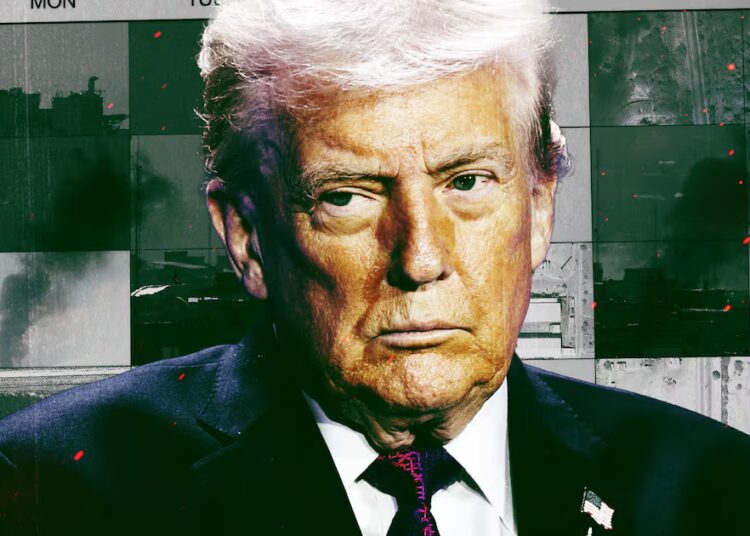
France, Germany and Britain, once partners with the Obama administration in brokering a deal on Iran’s nuclear program, called for a return to negotiations. Talks had continued as recently as this week, until Trump initiated what he called a “massive” campaign on Saturday to “destroy” Iran’s missile systems, “annihilate” its military and spur regime change in Tehran.
The attack on Iran presented Europe with a new test in the already-strained transatlantic relationship, as the appeals for restraint clashed with Trump’s assertion that force would succeed. A drawn-out war could highlight Europe’s internal divisions and its difficulty managing an unpredictable U.S. president, who campaigned on ending wars and criticized past American military intervention in the Middle East, only to recently use military power in Venezuela and Iran.
Still, the Europeans put the onus squarely on Tehran, condemning its retaliation, and they carefully avoided criticizing the U.S. and Israeli barrage that shook Tehran on Saturday.
Paris, Berlin and London were central to crafting the 2015 nuclear deal with Tehran, which Trump abandoned in 2018. But his administration has largely excluded the Europeans from talks this year, following a pattern in other recent U.S. foreign policy interventions, including the capture of Venezuelan leader Nicolás Maduro, and negotiations on Russia’s war in Ukraine.
“We have consistently urged the Iranian regime to end Iran’s nuclear program, curb its ballistic missile program, refrain from its destabilizing activity in the region and our homelands, and to cease the appalling violence and repression against its own people,” leaders of the three European nations said.
As Iran struck back against U.S. bases in the Persian Gulf, European officials promised to protect their personnel and citizens in the Middle East, where countries including France and Britain also have military bases and significant interests.
Officials across Europe said they had few if any clues about Washington’s day-after plan should the Iranian government collapse.
“It very much appears that this is now in regime change territory and the question is what do they intend to do afterward,” said a senior British official, who like others, spoke on the condition of anonymity to discuss sensitive diplomacy.
Others said attempts to gain even vague insights into U.S. planning instead revealed confusion in corridors of the State Department and the Capitol. As the drumbeats of war intensified in recent days, the administration offered different rationales for an attack, such as support for Iranian protesters who faced a deadly crackdown, or Tehran’s rejection of U.S. demands in nuclear talks.
“If you really want regime change, how is that supposed to work,” asked a senior German security official. “Our understanding is that up to very high echelons people in D.C. don’t know more than we do.”
Already, the U.S.-led attack is exposing fault lines in the 27-nation European Union and within NATO, where some nations like Norway and Spain warned against violations of international law, while others, such as Italy and Germany, refrained from criticism.
British Prime Minister Keir Starmer said that while his country had “no role” in the strikes, “We have long been clear — the regime in Iran is utterly abhorrent.”
British officials earlier did not address whether the U.S. had permission to use U.K. bases, including Diego Garcia, which is home to a base for U.S. bomber aircraft. The U.S. in recent weeks shifted scores of aircraft to bases in Europe and the Middle East, as Washington demanded Tehran dismantle its nuclear operations in faltering talks.
“Our forces are active and British planes are in the sky today as part of coordinated regional defensive operations,” Starmer said in Saturday’s speech. “It is vital now that we prevent further escalation and return to a diplomatic process.”
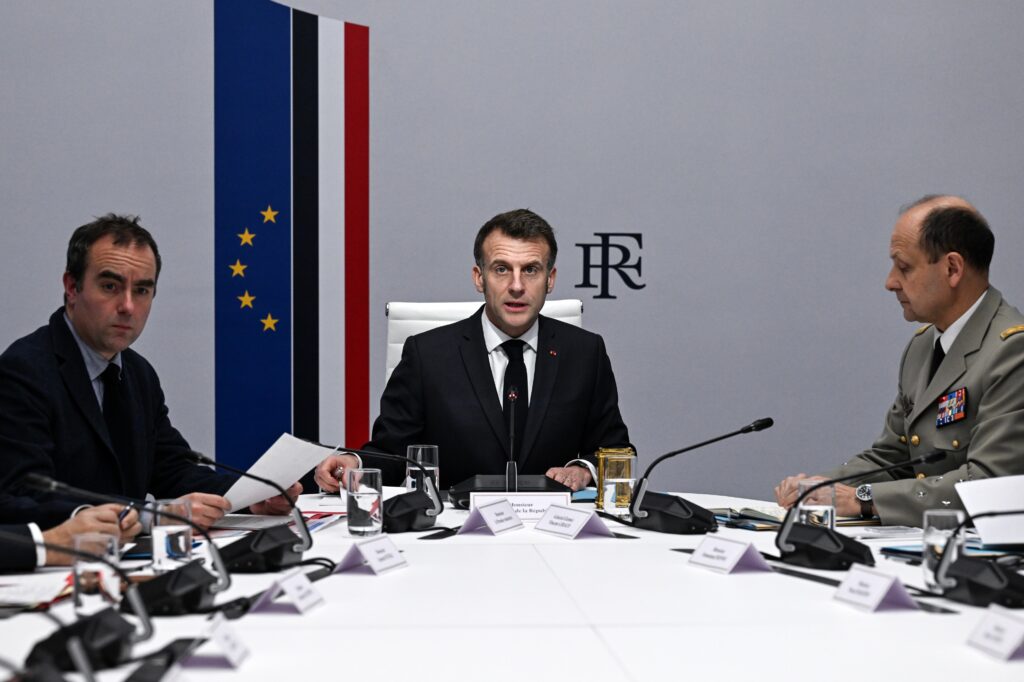
French President Emmanuel Macron was more forceful, saying the escalation “is dangerous for all” and “it must stop.” He called for a meeting of the United Nations Security Council.
Iran’s leadership “must understand that it now has no other option” than to negotiate over its nuclear and ballistic missile program, Macron added, noting that France was “neither warned nor involved.”
France and Britain pledged to help defend partners in the region. The two in the past have deployed military assets to intercept Iranian missiles or drones lobbed at Israel.
For another NATO ally, Turkey, which borders Iran, the attacks sparked fears of a spillover, and of a further emboldened Israel, which is widely understood to possess nuclear weapons but has never acknowledged it. Turkey said Saturday that it would not allow the use of its airspace for the strikes.
Europeans have not forgotten the disastrous legacies of Western interventions in Libya, Iraq or Afghanistan. When President George W. Bush launched a different American war in the Middle East — the 2003 invasion of Iraq — NATO was bitterly split. France and Germany opposed it; Bush went ahead anyway and found European partners to join the coalition.
In Iran, the continent’s leaders see a common enemy. A European official said some capitals, which share Washington’s goal of preventing Iran from developing a nuclear weapon, are doing a balancing act: privately welcoming the campaign on one hand, and on the other, trying not to contradict the image they have touted of Europe as a defender of international law on Greenland or Ukraine.
The European Union’s foreign policy chief, Kaja Kallas, said she spoke to her Israeli counterpart on Saturday and coordinated “with Arab partners to explore diplomatic paths.”
While leaders stressed a need for regional stability, some observers noted they did little to question the legality of the attack.
“Not a word about international law,” said Gerard Araud, a former French negotiator in Iran nuclear talks, calling the remarks “a de facto endorsement” of the U.S.-Israeli attack.
In Italy — where Prime Minister Giorgia Meloni is one of the European leaders closest to the Trump administration — officials had hoped for a diplomatic solution, but still endorsed American pressure on Iran ahead of the strikes.
“We hope the war will last as little as possible,” Italian Foreign Minister Antonio Tajani told reporters on Saturday. Yet it can only end, he added, “should Iran decide to substantially block its nuclear option, and halt the production of missiles.”
A government spokesman in Germany, a staunch Israel ally which has taken a hard line on Iran, said Israel provided Berlin with advance notice of the strikes.
Among the few to outright condemn the strikes, as well as Tehran’s response, was Spanish Prime Minister Pedro Sánchez, who has had strained relations with the Trump administration and is a leading critic of Israel’s war in Gaza.
The U.S.-Israeli escalation “contributes to a more uncertain and hostile international order,” Sánchez said. “We cannot afford another prolonged and devastating war in the Middle East.”
Rachel Ellehuus, director of the London-based Royal United Services Institute, said conservative-led governments or parties in Europe were more supportive of the American strikes, with criticism more likely from the left.
Some viewed the European response so far as indicative of a new dynamic in transatlantic relations, which have been shaken by deep rifts with the Trump administration on everything from trade and Greenland to Russia.
“We saw something a bit different because the U.K. denied the use of [bases in] Diego Garcia, and insisted on more clarity,” Ellehuus said. “At the same time, they’ve been very careful not to criticize the U.S., and I think that’s because ultimately, they would also like to see the Iranian regime out of the picture.”
It stands in contrast with some past U.S. interventions — such as in Afghanistan — that European and British governments have not directly joined the military campaign in Iran, said Sanam Vakil, director of the Middle East and North Africa Program at Chatham House.
That speaks in part to the strained transatlantic ties. Now that a military operation has begun, however, many European leaders will hope the U.S. and Israel “actually get the job done and don’t leave the situation in a terrible mess that Europe will have to pay the price for,” Vakil said.
Rifts with Washington aside, she added, Starmer’s government also seems “careful to not repeat the mistakes of the 2003 Iraq War that didn’t just cost the in terms of lives and dollars, but also cost the United Kingdom in terms of reputation damage.”
Faiola reported from Rome and Miller from London.
The post Wary of wider conflict, European allies stress they didn’t join Iran strikes appeared first on Washington Post.