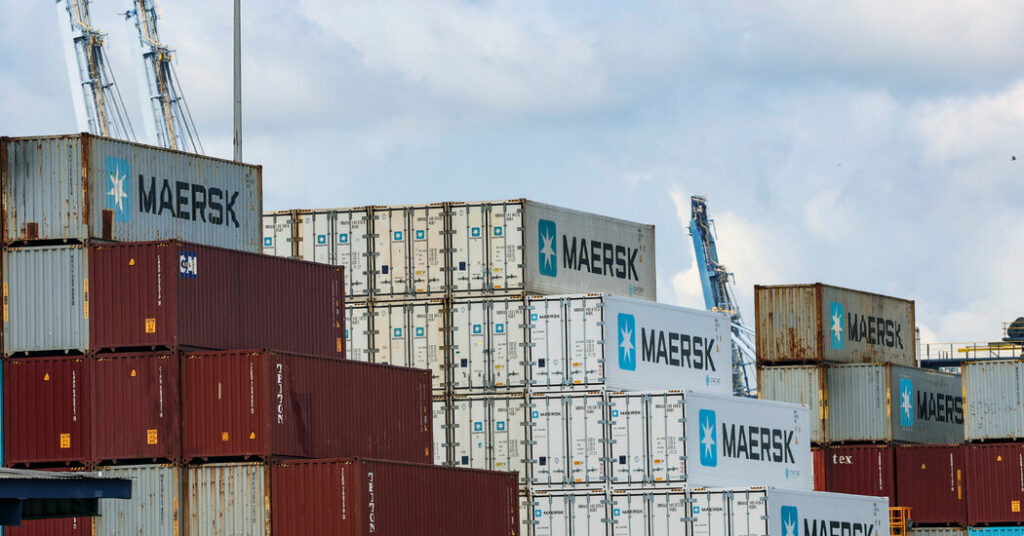
Maersk, a large shipping company, said on Sunday that it was going to stop sending some of its vessels through the Red Sea, a sign that the conflict between Iran and the United States and Israel is reverberating through global supply chains.
Though the conflict is centered on the Persian Gulf region, shipping companies fear that the Iran-backed Houthi militia in Yemen could resume their attacks on vessels in the Red Sea hundreds of miles to the west. The Houthi started attacking ships in the Red Sea soon after the conflict between Israel and Gaza began in 2023, but the attacks subsided last year.
Maersk had recently resumed sending vessels through the Red Sea and its opening to the south, the Bab-el-Mandeb Strait, where shipping had been particularly exposed to Houthi attacks. But Maersk said Sunday that it had paused doing so because of “the deteriorating security situation in the Middle East region.”
The Suez Canal, long a crucial shortcut for shipping, is at the northern end of the Red Sea, between the Sinai Peninsula and Egypt. Ships seeking to avoid the Red Sea and the Suez Canal instead travel around the southern tip of Africa on their voyages between Asia and Europe, a far longer voyage that adds to costs.
After the U.S. and Israeli attacks on Iran began on Saturday, several large shipping operators said they were avoiding the Strait of Hormuz which is on Iran’s southern border, between the Persian Gulf and the Gulf of Oman, sharply reducing oil tanker traffic.
While stocks have fallen across the Middle East, where many exchanges open for trading on Sunday, Saudi Aramco, the state-owned oil company, has gained more than 3 percent as many analysts expect oil prices to jump because of the turmoil.
Jason Karaian contributed reporting.
Peter Eavis reports on the business of moving stuff around the world.
The post U.S.-Israeli Attacks on Iran Disrupts Shipping in the Red Sea appeared first on New York Times.