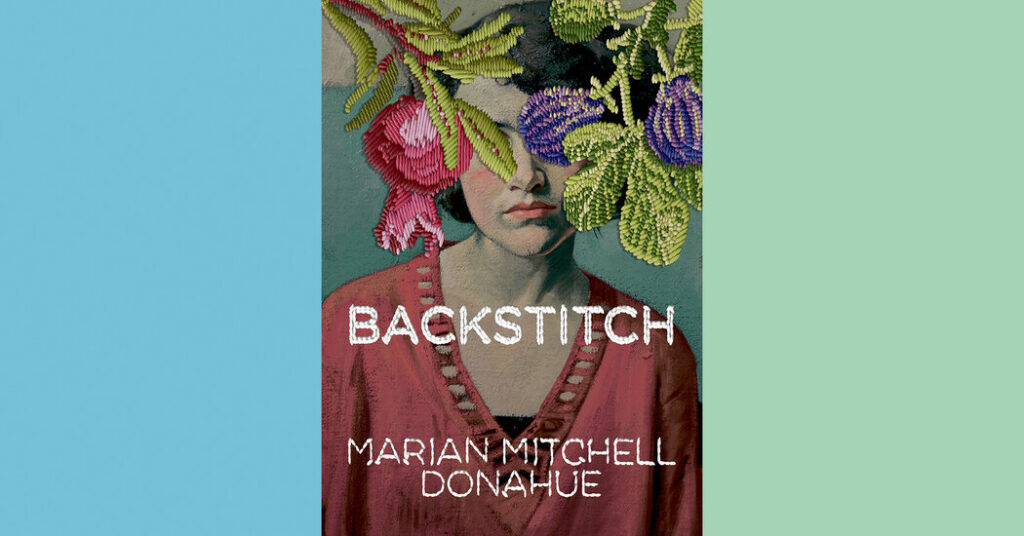
BACKSTITCH, by Marian Mitchell Donahue
For reasons both political and personal, one of the most common questions that major female artists face concerns their relationship to parenthood. Some recent subjects of big retrospectives, like Agnes Martin and Hilma af Klint, were childless; others, like Ruth Asawa, whose six children played in her studio as she worked, were both parents and artists without any obvious tensions between the two.
Then there are mothers whose art practices intersect with their parenting in more complicated ways. Sally Mann’s dreamlike, intimate, large-format black-and-white photographs of her son and two daughters, whom she began photographing as small children, created both controversy and international renown.
“Backstitch,” Marian Mitchell Donahue’s debut novel, centers on Alice Snyder, an artist-mother who has achieved posthumous fame in part by depicting her two daughters in paintings and textiles. The novel opens seven years after her untimely death in a studio fire. Her older daughter, Violet, arrives in Washington to attend a retrospective show of her mother’s work, to which Violet’s younger sister, Marigold, also the show’s curator, has contributed the final piece.
The novel is structured as a tour of the exhibition. With Violet, we move from Alice’s early work, starting with “Two Girls With Fruit,” through her career as a painter and fabric artist who embroiders on her canvases. Each artwork is described in the language of the museum’s interpretive text; accounts of the lives of the people involved follow.
We get Marigold’s and Alice’s perspectives, too, and the book roams in time, exploring all three characters’ childhoods. Along the way, we learn about the two men who shaped Alice’s adult life: her exploitative ex-boyfriend, Gabriel, and her sweet, stable husband, Arthur. It is as if we are walking through the galleries, encountering Alice’s art and delving into the minds of the people who inspired it, participated in its creation and bore its costs. The novel works like a puzzle, and Donahue handles this ambitious structure with deftness and confidence.
What comes into focus is the contrast between Alice’s public talent and private troubles. Her artwork is quietly feminist, domestic, personal, introspective. In embroidering a rose, she hopes to capture “its softness, the heavy elegance.” But in life, Alice is intense, moody, explosive, fiercely loving and very angry, sometimes selfish, sometimes cruel, passionate about her art and prone to “breakdowns and freak-outs.” She creates an “unquiet home.”
When Violet and Marigold become young women and assess the impacts of their mother’s volatility and their father’s complicity, the novel crackles with life. In one notable scene, Violet tells Alice that she does not want Gabriel to own her mother’s painting of her and therefore her face. “It’s not your face,” Alice says. “It’s my art.” Violet replies: “It is my face. … It is my face.” Both are right, of course, and the irreconcilability of these claims is a moving source of emotional complexity. Donahue cannily stages other such confrontations, too, in which artistic representation and ownership collide with gender, power and love.
The novel’s formal ambition and ranginess allow for the occasional misstep — a gap in characterization, a redundant scene, an unsurprising or overly dramatic plot point — but its achievements are nonetheless impressive. The title of Marigold’s capstone artwork, “What It Was Like to Be There,” aptly describes the effect of this fascinating and rewarding book.
In the end, the sisters have each other, and they have their mother’s legacy, however painful. The wideness of Donahue’s lens, which encompasses the perspectives of not only the artist-parent but also her daughter-subjects, is illuminating but not exhaustive; like any retrospective show, the novel suggests the full picture of Alice’s identities and contradictions through representative moments. In that, it feels true. As the artist herself notes while depicting a hazily recalled beach visit with her own mother: “She should have done something like her memory. Small, warm and incomplete.”
BACKSTITCH | By Marian Mitchell Donahue | Galiot | 305 pp. | Paperback, $19.99
The post Two Sisters Explore the Complex Legacy of Their Mother’s Art appeared first on New York Times.