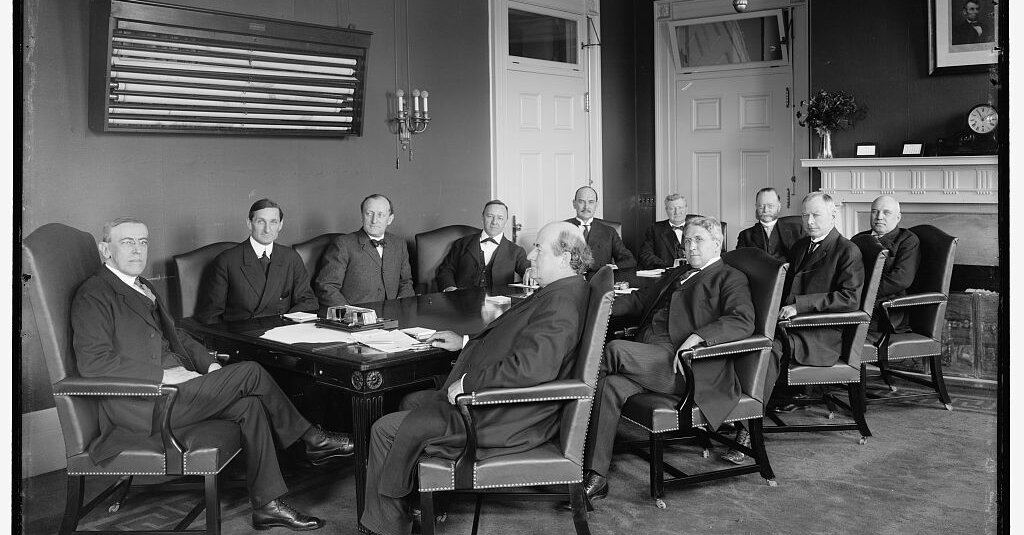
In 1912, the first Southerner to win the presidency after the Civil War was able to garner a groundswell of support from Black voters by making a bold promise.
“Should I become president of the United States,” Woodrow Wilson declared, “Negroes may count on me for absolute fair dealing and for everything by which I could assist in advancing the interests of their race in the United States.”
By the end of his term, it became clear that Wilson’s promises would ring hollow.
He packed his cabinet with white supremacists, whom he allowed to segregate the federal work force and dismiss, demote and demean Black employees. He hosted a screening of “The Birth of a Nation,” a film glorifying the Ku Klux Klan, in the East Room of the White House. And he fomented a climate for Black Americans where “every man who dreams of making the Negro race a group of menials and pariahs is alert and hopeful,” wrote W.E.B. Du Bois, one of the prominent Black leaders who had initially supported him.
More than a century later, Wilson’s presidency has taken on new resonance among historians and critics of President Trump. They see distinct parallels between Wilson’s abandonment of promises to Black Americans and Mr. Trump’s policies and politics since he took office a second time last year. Mr. Trump’s gutting of the federal government, his assailing of diversity policies and his occasional use of racist imagery have made Wilson’s administration especially relevant now, they say.
“What Wilson was able to do in terms of banishing Black progress and demonizing Black people is shaping up to be very, very similar,” said Noliwe Rooks, a professor and the chairwoman of Africana studies at Brown University.
Mr. Trump has said he has done more for Black people than anyone since Abraham Lincoln freed slaves, and his administration points to measures he has taken to help Black Americans such as supporting criminal justice reform and Historically Black Colleges and Universities.
“I am, by the way, the least racist president you’ve had in a long time,” Mr. Trump said last month, as he faced rare backlash from his party for posting a racist video clip on his social media feed that portrayed the Obamas as apes. (He deleted the video but refused to apologize for it, instead blaming a staff member.)
Ms. Rooks compared Mr. Trump’s posting of the clip to Wilson’s decision to show “The Birth of a Nation” at the White House 111 years ago.
“Trump posting an A.I.-generated image of the Obamas as apes is Wilson’s screening for the algorithmic age,” Ms. Rooks said. “The technology is different, but the function is identical: the presidency co-signing dehumanizing imagery. And just like Wilson, the image doesn’t float free of policy.”
Promises of ‘Fair Play’
Like Wilson, Mr. Trump was buoyed in his effort to claim the White House by securing a surprising surge of Black voters, with Mr. Trump’s 2024 campaign winning a higher percentage than any other Republican in nearly a half-century.
In his inaugural address last year, Mr. Trump made a similar pledge: “We set records, and I will not forget it,” he said. “I’ve heard your voices in the campaign, and I look forward to working with you in the years to come.”
But within hours of taking office, Mr. Trump immediately began to target many of the underpinnings of Black mobility. On his first day, he ordered the dismantling of diversity, equity and inclusion programs and the firing of the predominantly Black employees who staffed them. He branded Black history as unpatriotic and “divisive.” He equated diversity with incompetence and removed high-ranking Black officials in the government. He moved to weaken longstanding civil rights guardrails to restore what he called “merit” and fairness.
By the end of his first year, Mr. Trump had slashed the federal work force by nearly 300,000 people. His biggest cuts targeted agencies that had employed a disproportionate number of Black employees, a measure economists and experts say poses the biggest threat to the Black middle class in modern history.
Historians who have documented Wilson’s presidency say it is Mr. Trump’s crusade against D.E.I. and the federal work force that is the most poignant parallel.
Mr. Trump’s promise to shepherd in a “merit-based” society is reminiscent of Wilson’s promise of “fair play.” Mr. Trump’s designation of D.E.I. and even parts of Black history as “divisive” echoes Wilson’s defense of segregating federal agencies, which he claimed was in Black people’s best interest because it would reduce “friction.” And Mr. Trump’s claim that he purged the federal government of “waste, fraud and abuse” echoes Wilson’s promise of “efficient and clean public administration.”
In recent months, Mr. Trump and members of his administration have been even more explicit that their efforts have been driven by remedying what they perceive to be reverse discrimination against white people.
Eric S. Yellin, a history professor at the University of Richmond, said the “fair play” Wilson promised actually cloaked a more insidious goal.
“It was a euphemism for the argument that Black people who had these positions were not worthy,” said Dr. Yellin, who wrote “Racism in the Nation’s Service: Government Workers and the Color Line in Woodrow Wilson’s America.” “And when you connect worthiness to danger, they move from unequal to threat.”
When Wilson arrived in Washington, the federal government was a rare example of relative equality. Black people were working alongside their white counterparts at every level of government, including hundreds in white-collar jobs, earning far higher wages than other African Americans across the country.
That perturbed Wilson’s cabinet, which quickly moved to segregate the U.S. Postal Service and the Treasury Department, two of the largest employers of Black Americans in the government. Black employees were fired or demoted to lower-level jobs, relegated to separate and inferior lunchrooms and other facilities, and accused of making white women feel unsafe.
Those who remained were humiliated: A Black worker in the Postal Service was surrounded by screens so white workers would not have to look at him, according to a report by a Labor Department historian and a letter from the N.A.A.C.P.; another employee had a cage built around him to separate him from his white counterparts, Mr. Dubois wrote; a clerk in the Treasury secretary’s office was assigned to rewrite all correspondence to address Black employees by their first names.
Growing White Resentment
Like Wilson, Mr. Trump took office when there was growing white resentment in the country. The yearslong racial justice movement spurred by the murder of George Floyd in 2020 gave rise to anti-D.E.I. activists; Mr. Trump vowed on the campaign trail to reverse what he called an “anti-white feeling” in the country.
Mr. Trump returned to a government where a number of Black Americans held historic appointments, such as the first Black woman to serve on the Federal Reserve’s Board of Governors and the first Black chairman of the Surface Transportation Board. And Mr. Trump’s predecessor, Joseph R. Biden Jr., had ordered the government to infuse equity in virtually all of its policymaking, to deliver on his inauguration promise to dismantle “white supremacy.”
Mr. Trump and his administration moved quickly to undo those efforts. And they employed similar — if more symbolic — tactics to Wilson’s.
Mr. Trump rescinded a civil rights-era executive order that barred discrimination among federal contractors, and even revoked statutes that barred segregated facilities. He disparaged the high-ranking Black officials he ousted as inept or corrupt. Members of his administration have reveled in having less diversity among their ranks. And when Mr. Trump fired the first Black librarian of Congress, an esteemed academic with a doctorate, he baselessly accused her of promoting D.E.I. The two-sentence dismissal email addressed her simply as “Carla.”
In a statement, a White House spokesman, Kush Desai, dismissed the comparisons.
“President Trump’s economic agenda created historic prosperity for working-class Americans during his first term, including for Black Americans who enjoyed historically low unemployment and high wage growth,” Mr. Desai said. “The president is implementing this same agenda again so every American can thrive.”
Michael Austin, an economics professor and an ambassador for Project 21 at the National Center for Public Policy Research, a think tank that aims to promote conservative viewpoints among African Americans, said that comparing Mr. Trump and Wilson “flips history upside down.” While Wilson “centralized power and used it to sort citizens by race,” he said, Mr. Trump was limiting federal authority and strengthening the private sector, where Black people have prospered.
“Wilson used government to divide Americans,” Mr. Austin said. “Shrinking government does the exact opposite.”
Generational Effects
The impact of Wilson’s tenure was felt for generations, researchers have found, and experts say Mr. Trump’s stands to do the same.
Like Mr. Trump, Wilson did not explicitly endorse racist policies but elevated them nonetheless. In the award-winning book “The Unseen Truth: When Race Changed Sight in America,” Sarah Lewis, a Harvard professor, discussed how Wilson’s segregationist policies led to what she called “racial detailing,” a more covert form of cementing a racial hierarchy.
“Through Wilson, federal segregation was both inaugurated and unseen at the same time,” Ms. Lewis wrote. “It is a duality mirrored in his legacy: His achievements have also come alongside an easy disregard of exercised, policy-framing racism of a kind that was, as the renowned constitutional scholar and Princeton University president Christopher L. Eisgruber put it, ‘significant and consequential even by the standards of his own time.’”
One study conducted by two professors at University of California, Berkeley, found that Wilson’s segregation policies hurt not only the economic mobility of Black civil servants but also that of their children. The researchers found evidence that “the descendants of Black civil servants who were exposed to Wilson’s presidency exhibit lower levels of education, earnings and social mobility” than those of white ones.
Another report, released this year by the Joint Center for Political and Economic Studies, a think tank that tracks and advocates Black economic advancement, warned of similar outcomes based on Mr. Trump’s first year back in office.
By the end of last year, the Black unemployment rate stood at 7.5 percent, the highest of all racial groups and far beyond the 4.4 percent overall. The rate was a marked increase from 6.2 percent in January 2025, when Mr. Trump took office, and a surge from its record low of 4.8 percent in 2023. In January, the rate fell only slightly to 7.2 percent.
“The systematic withdrawal of protections, investments and accountability mechanisms that have historically assisted Black communities from economic shocks combined with a substantive increase in Black unemployment all point to 2025 as a regression and recession for African Americans,” the Joint Center report said. “This report is both a warning and a call to action.”
Erica L. Green is a White House correspondent for The Times, covering President Trump and his administration.
The post Trump Says He Is the ‘Least Racist’ President. But His Term Echoes a Grim Past. appeared first on New York Times.