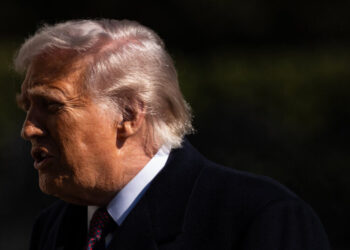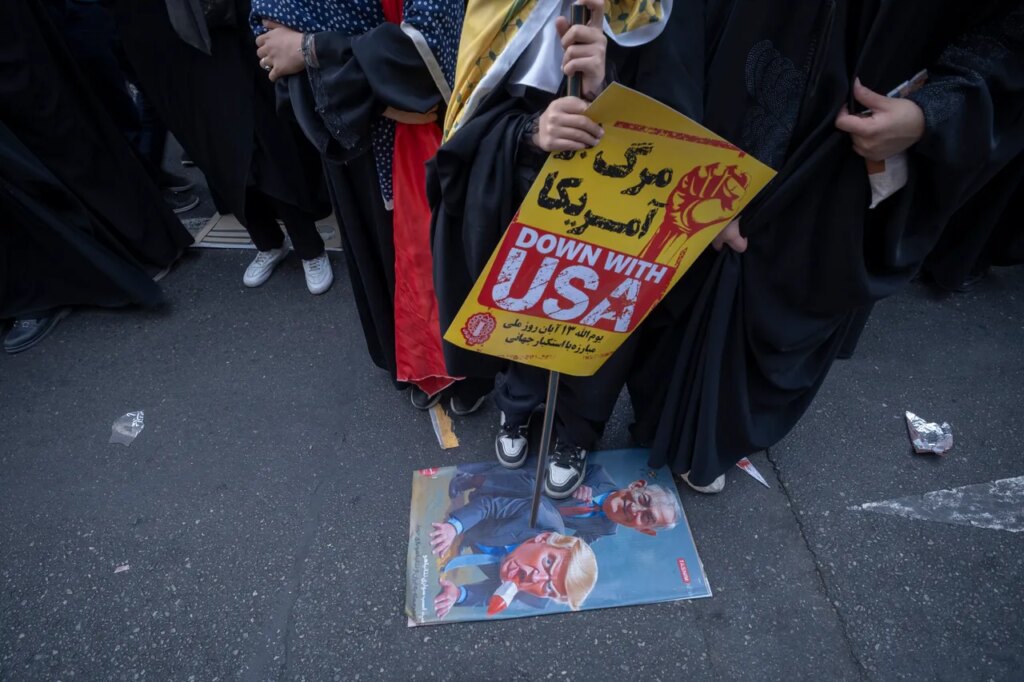
During his career as a real estate mogul, Donald Trump repeatedly bankrupted casinos. In his second term as president, Trump continues to indulge his love of high-stakes gambits—and the war-entirely-of-personal-choice he launched over the weekend with Iran might be the biggest gamble yet of his entire political career. The apparent death of Iran’s supreme leader in the opening hours of the war only heightens the danger for Trump, his war partner Israeli Prime Minister Benjamin Netanyahu, the entire region, and the world beyond.
On the one hand, the events of the weekend so far seem all-but foreordained. It was a war that almost everyone could see coming—the US military buildup has been underway for months and, in many ways, Trump’s been on this road since May 8, 2018, when he jettisoned the Iranian nuclear deal known as the JCPOA, the Joint Comprehensive Plan of Action, which had been carefully negotiated by the Obama administration to limit Iran’s path toward an atomic weapon. Similarly, the Iranian response to the war’s opening salvos—missiles and retaliatory strikes against other Gulf States, including Kuwait, Qatar, Bahrain, Israel, the United Arab Emirates, Saudi Arabia, and Jordan—had been widely foreseen and telegraphed.
But where the war goes from here—how long and how far-reaching—and the fate of Iran’s regime in the days, weeks, and months ahead stand as some of the biggest unknowns ever contemplated in a famously fraught and explosive region.
All of modern history tells us that upheaval in Iran is the proverbial butterfly flapping its wings, with the potential of enormous yet-to-be-understood consequences that could unfold for decades. After all, the US is still dealing with the downstream consequences of the last upheaval in Iran nearly a half-century ago, when the US-backed shah—originally put in power by a 1953 CIA coup—was ousted in 1979 by Ruhollah Musavi Khomeini and whose 86-year-old Ali Hosseini Khamenei successor led Iran until his death in the Israeli and American airstrikes this weekend.
In the run-up to the 2003 Iraq War—America’s first great folly in the Middle East of the 21st Century—then-Secretary of Defense Donald Rumsfeld spoke of the “known unknowns” and “unknown unknowns” of geopolitical events. Today, understanding some of the “known unknowns” of Donald Trump’s grand new adventure in Iran helps to make clear the stakes of what’s ahead.
1. It has already caused American deaths. Donald Trump has been clearly emboldened in his global rambunctiousness over the last year by two major tactical military successes—a bloodless-for-America airstrike campaign on Iranian nuclear facilities last year, carried out with stealth bombers and in conjunction with earlier Israeli airstrikes, as well as the stunningly audacious raid just weeks ago to seize Venezuelan leader Nicolás Maduro, which also was carried out without a single US death. History, though, is always a close-run thing—and earlier this week we received an unexpected window into an narrowly averted alternate history: At the State of the Union, Trump presented an Army special operations pilot, Chief Warrant Officer 5 Eric Slover, with the Medal of Honor for his brave and careful reaction after being wounded four times by machine-gun fire while piloting the lead MH-47 Chinook helicopter on the Maduro raid. It was on the one hand a wildly inappropriate made-for-TV moment—one rushed by the Pentagon to align with the president’s whim, bypassing a deliberate process that normally takes months or years—but what was even more interesting was how it revealed that, but for 45-year-old Slover’s bravery, dedication, and fortitude, the Maduro operation might have gone wildly sideways. The crash of the lead helicopter in the raid’s opening minutes might have tipped the whole operation from being seen as a smashing, daring success toward being remembered as a debacle like Jimmy Carter’s bungled attempt to rescue Iranian hostages, Operation Eagle Claw, which killed eight US servicemen and fatally injured Carter’s presidency.
There’s little reason to believe that the new Iranian operation, known by the muscularly Hegsethian moniker of “Operation Epic Fury”—a name seeming better suited for a retaliatory vendetta than an out-of-the-blue war-of-choice—will remain long-term as bloodless or costless to the US in materiel, personnel, or economic toll as Trump’s two other operations, Operation Midnight Hammer and Operation Absolute Resolve, both of which were effectively one-and-done strikes.
And, indeed, on Sunday morning, US Central Command put out a statement affirming that three US service members have already died, and five are injured, from the Iran operation.
Part of Donald Trump’s calculation in striking Iran now is that Iran, weaker than it has been in a generation, is unlikely to retaliate with much strength. Certainly Iran’s traditional retaliatory arsenal has been depleted in recent years from its peak of world-ranging proxy terror campaigns. Israel since October 7 has done much to dismantle Iranian proxy groups, including its own daring attack on Hezbollah using explosive pagers, and Donald Trump’s 2020 assassination of Iranian general Qasem Soleimani removed the longstanding mastermind of Iranian terror operations.
However, few strategists believe Iran’s capability to strike far afield of the Middle East is zero. And intelligence officials continue to warn that Iran is seeking to kill Trump officials involved in that Soleimani operation. (In one of Trump’s early moves of presidential pique against critics, he pulled the three security details that had guarded former secretary of state Mike Pompeo, Pompeo aide Brian Hook, and former national security advisor John Bolton, who had all been targeted by the Iranian regime.)
Iran has long been a substantial terror threat. As Trump himself outlined in his bizarre overnight video this weekend, Iranian-backed terror campaigns bombed a US Marine barracks in Beirut in the 1980s and, more recently, helped to kill and injure thousands of US servicemen and women in Iraq. (Trump also, oddly, seemed to insinuate that Iran played a role in the 2000 bombing of the USS Cole, a theory that is not backed up by the FBI and US government’s deep investigations of the al-Qaeda-orchestrated attack. He also posted misinformation about Iran interfering with US elections in 2020 and 2024.)
The US is at its best in the opening minutes of a military campaign, when its unparalleled intelligence capabilities and technologically sophisticated military can maximize those advantages. But what happens when Iran has time to muster a response? Trump himself seemed to anticipate this, saying in his speech, that “the lives of courageous American heroes may be lost.”
Which leads to:
2. What does Donald Trump think victory looks like? Trump rode to the Oval Office in part on a wave of national dissatisfaction with the Forever Wars in Iraq and Afghanistan.
It was a message he carried proudly on the campaign trail — no less than J.D. Vance proclaimed his support for Trump in the 2024 elections in an op-ed entitled, “Trump’s Best Foreign Policy? Not Starting Any Wars,” and saying that Donald Trump would be the exception to the rule of the 21st century presidency. “My entire adult lifetime,” Vance wrote, “has been shaped by presidents who threw America into unwise wars and failed to win them.”
“I’m not going to start wars, I’m going to stop wars,” Trump declared in his 2024 victory speech after being returned to the presidency, and he has spent much of his second term campaigning for the Nobel Peace Prize (settling, at one point, for the entirely-invented FIFA Peace Prize). Even at the beginning of the week, as part of his State of the Union, the White House trumpeted how he’s “End[ed] Wars and Foster[ed] Peace.”
And yet for the second time in as many months, Trump has now launched a decapitation strike against a US adversary with seemingly little plan—or even interest—in what comes next. Venezuela, in particular, has faded from the news almost as quickly as it appeared late last year. Huge uncertainty remains around what shape its national leadership and American involvement might take going forward.
In announcing Khamenei’s death, Trump posted on Truth Social, “This is the single greatest chance for the Iranian people to take back their Country. We are hearing that many of their IRGC, Military, and other Security and Police Forces, no longer want to fight, and are looking for Immunity from us…. Hopefully, the IRGC and Police will peacefully merge with the Iranian Patriots, and work together as a unit to bring back the Country to the Greatness it deserves.”
The bombing, Trump promised, “will continue, uninterrupted throughout the week or, as long as necessary to achieve our objective of PEACE THROUGHOUT THE MIDDLE EAST AND, INDEED, THE WORLD!”
If the Bush administration’s plan for what came after toppling Saddam Hussein once seemed thin and Dick Cheney’s pledge that “We will, in fact, be greeted as liberators” appears overly optimistic in hindsight, that pre- and post-war planning for invading Iraq looks Herculean compared to the lack of planning and strategic preparation that surrounded Trump’s solo push for war in Iran. He never even pretended to make a meaningful case to Congress for military action, and there’s no clear stated goal—or picture of victory—coming from the White House other than the amorphous “regime change” and, apparent hope that Iran was only ever a few well-placed JDAMs and Tomahawk missiles away from breaking out in democracy.
Trump, who has effectively pulled off high-profile, surgical, tactical military actions like the 2019 killing of ISIS leader Abu Bakr al-Baghdadi, might be betting that no one really cares about long-term planning. America, he proves news cycle after news cycle, has an attention span as short as his own. Perhaps he doesn’t even know what victory with Iran looks like. As John Bolton told me in the fall, “He doesn’t do grand strategy.”
“It is very hard for people to understand,” Bolton said. “It was very hard for me to understand, because you think in government that’s what it’s about—policy is what you do. That’s not what Donald Trump does. Therefore, when people talk about a Trump doctrine in international affairs, it’s a complete fantasy to think that there’s any coherence to it at all.”
Much hangs in the balance in Iran and across the Middle East in the days ahead as the world waits to discover whether Donald Trump either feels like he’s succeeded or else loses interest and moves on. Trump has thus far made clear that no US ground troops will be involved. As now-Vice President JD Vance told the Washington Post, “The idea that we’re going to be in a Middle Eastern war for years with no end in sight—there is no chance that will happen.” But just how far can the US press its military advantages and affect the Iranian regime from the air?
Which leads to another “known unknown”:
3. Who, exactly, is Trump serving? One of the giant unknowns now is that President Trump’s own business interests are coming under literal fire from Iran. In fact, while the Trump family’s finances are famously opaque, it’s likely that the bulk of his wealth is now tied to one Middle Eastern royal family or another. In the years since his first presidency, Trump and his family have become intertwined with numerous Gulf states—the Saudi crown prince invested some $2 billion in Jared Kushner’s investment fund, Trump has a branded golf course in Dubai, and a company backed by a UAE royal investor last year purchased 49 percent of Donald Trump’s family cryptocurrency company. Not to be out done, Qatar, for its part, once was labeled a “funder of terrorism” by President Trump in his first term, but in this second has been carefully currying favor by, among other things, donating a plane to be used as Air Force One. The president—shortly thereafter and surely totally coincidentally—offered an unprecedented presidential defense guarantee.
All of those countries—and their royal families—are now under fire or possible targets for Iranian missiles, drones, and terror strikes. It’s not a conspiratorial question to wonder: As Donald Trump weighs the potential paths ahead and when “enough is enough,” how will he be influenced by what’s best for the US vs. the geopolitical or financial pressures of his business partners? And what will these countries do as missiles hit civilian targets in their territories? Saturday night, the Dubai International Airport, which has grown into one of the world’s main travel hubs, was damaged by an Iranian strike. Trump has pledged, intermittently, to help Iranian protesters. But if it will hurt his business interests to continue to wage war against the existing regime, it’s hard to see him sticking to a plan.
Which leads to a fourth:
4. History is not on Trump’s side. As much as “modern American” memory begins with the disastrous long tail of the wars of Iraq and Afghanistan, Iran has been America’s most fraught Middle Eastern friend and enemy for far longer than either. In fact, there is no country, arguably, where more US presidents in the last eight decades have found geopolitical trouble and domestic political challenges at home than Iran—which was, many forget, once one of America’s most important economic and military partners.
Eisenhower, wary of protecting British oil interests, authorized the coup known as Operation Ajax that deposed Iran’s prime minister and set up the longtime reign of Mohammad Reza Pahlavi. Pahlavi, as shah, the powerful “King of Kings, Light of the Aryans, and Shadow of God on Earth” became a massive purchaser of American arms and an important anchor of stability for the US in the Middle East.
Later, though, darker notes appeared. Richard Nixon saw his presidency upended by oil crises carefully calculated by the shah; in seeking to break that “Oil Shock,” Gerald Ford set up a path that caused the collapse of the regime, and Jimmy Carter lost his presidency over his handling of the Iranian hostage crisis that followed the overthrow of the unpopular leader. Ronald Reagan rode into the White House on a wave of goodwill following the release of those hostages—partly, it turns out, because associates of his campaign might well have bargained with Iran to keep the hostages from being released earlier to maximize his own political benefit—but then spent much of the 1980s engaging in illegal arms trafficking with Iran, which blew up as the Iran-Contra scandal. His administration struggled, too, with the fallout of the Iran-Iraq War, including the tragic 1988 shootdown of Iran Air Flight 655 by the USS Vincennes, which killed 290 people—an incident better remembered in Tehran than in the US.
Indeed, most Americans today are too young to recall the years when Iran ranked behind perhaps only the Soviet Union as the country’s primary geopolitical foe. For nearly a decade in the 1980s, the US fought a serious and costly shadow war with Iran in and around the Persian Gulf; as David Crist outlines in his definitive history, The Twilight War, the US navy fought regular gun battles with Iranian mosquito boats. Iranian dhows covertly mined the Persian Gulf as spillover from the Iran-Iraq ultimately saw more than 500 ships attacked—a tonnage lost or damaged that was equal to roughly half the shipping lost to German U-Boats in the Battle of the Atlantic.
The battle on the water, though, was only one aspect of the US’s deadly confrontation with the post-revolution regime that still runs Iran today. In the 1980s and ’90s, Iran orchestrated the killings of at least 80 people around the world. US officials pointed to Iran, as well, as a culprit of the deadly bombing in 1996 of Khobar Towers in Saudi Arabia, which killed nineteen American servicemen. The case proved a political flashpoint for both the Clinton administration and the early months of George W. Bush’s presidency, when a young Justice Department prosecutor named Jim Comey helped lead the indictment of 14 individuals on the eve of the expiration of the statute of limitations.
In the years after, Iran helped supply the insurgency in Iraq with explosives that killed and maimed thousands of US military; in late 2006 and early 2007, US troops detained a dozen Iranian intelligence officers in Iraq, including Brigadier General Mohsen Chizari, the regime’s head of Iraq operations, and accused them with attacking US personnel.
More recently, Iran has been a regular adversary in cyberspace—and while it hasn’t demonstrated quite the acuity of Russia or China, Iran is “good at finding ways to maximize the impact of their capabilities,” says Jeff Greene, the former executive assistant director of cybersecurity at CISA. Iran, in particular, famously was responsible for a series of distributed-denial-of-service attacks on Wall Street institutions that worried financial markets, and its 2012 attack on Saudi Aramco and Qatar’s Rasgas marked some of the earliest destructive infrastructure cyberattacks.
Today, surely, Iran is weighing which of these tools, networks, and operatives it might press into a response—and where, exactly, that response might come. Given its history of terror campaigns and cyberattacks, there’s no reason to think that Iran’s retaliatory options are limited to missiles alone—or even to the Middle East at all.
Which leads to the biggest known unknown of all:
5. How does this end? There’s an apocryphal story about a 1970s conversation between Henry Kissinger and a Chinese leader—it’s told variously as either Mao-Tse Tung or Zhou Enlai. Asked about the legacy of the French revolution, the Chinese leader quipped, “Too soon to tell.” The story almost surely didn’t happen, but it’s useful in speaking to a larger truth particularly in societies as old as the 2,500-year-old Persian empire: History has a long tail.
As much as Trump (and the world) might hope that democracy breaks out in Iran this spring, the CIA’s official assessment in February was that if Khamenei was killed, he would be likely replaced with hardline figures from the Islamic Revolutionary Guard Corps. And indeed, the fact that Iran’s retaliatory strikes against other targets in the Middle East continued throughout Saturday, even after the death of many senior regime officials—including, purportedly, the defense minister—belied the hope that the government was close to collapse.
The post-World War II history of Iran has surely hinged on three moments and its intersections with American foreign policy—the 1953 CIA coup, the 1979 revolution that removed the shah, and now the 2026 US attacks that have killed its supreme leader. In his recent bestselling book King of Kings, on the fall of the shah, longtime foreign correspondent Scott Anderson writes of 1979, “If one were to make a list of that small handful of revolutions that spurred change on a truly global scale in the modern era, that caused a paradigm shift in the way the world works, to the American, French, and Russian Revolutions might be added the Iranian.”
It is hard not to think today that we are living through a moment equally important in ways that we cannot yet fathom or imagine—and that we should be especially wary of any premature celebration or declarations of success given just how far-reaching Iran’s past turmoils have been.
Defense Secretary Pete Hegseth has repeatedly bragged about how he sees the military and Trump administration’s foreign policy as sending a message to America’s adversaries: “F-A-F-O,” playing off the vulgar colloquialism. Now, though, it’s the US doing the “F-A” portion in the skies over Iran—and the long arc of Iran’s history tells us that we’re a long, long way from the “F-O” part where we understand the consequences.
Let us know what you think about this article. Submit a letter to the editor at [email protected].
The post The 5 Big ‘Known Unknowns’ of Donald Trump’s New War With Iran appeared first on Wired.