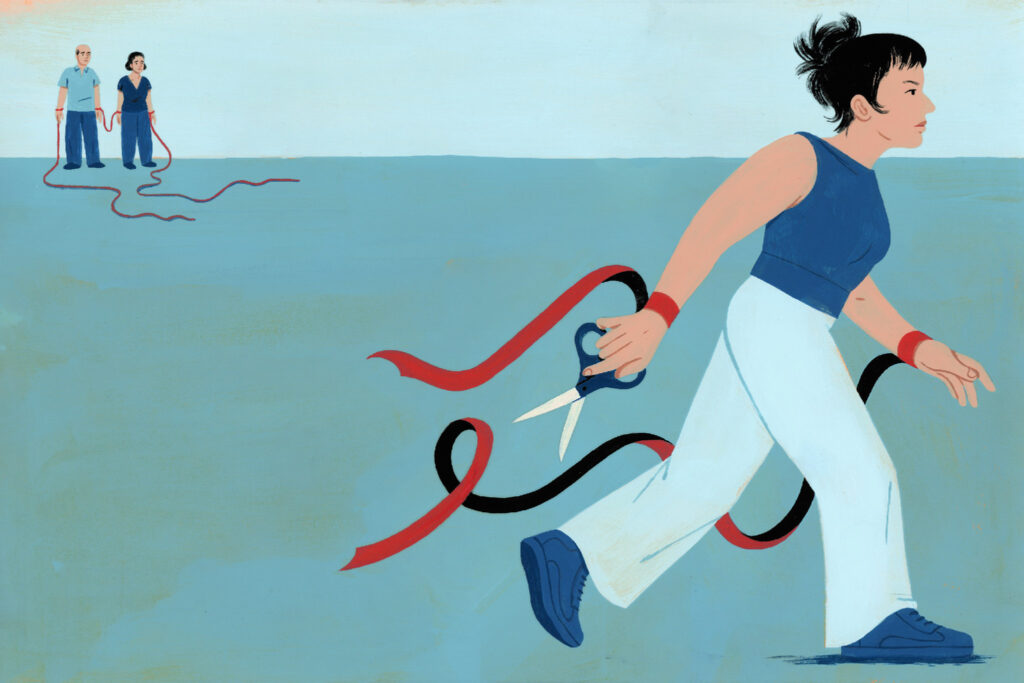
My 30-year-old son cut me off last year and says he never felt “emotionally safe” growing up. I find that hard to accept. I provided a stable home, paid for college and was involved in every part of his life. We were not an abusive family and my other kids have never complained about that.
He now claims I was “too intense” and that he had to manage my moods. Yes, I’m passionate and can get upset when people disappoint me, but that’s normal. He should’ve grown up with my parents! As I’ve told him, it was never my intention to upset him.
Now he says when he tries to explain, I get defensive and “turn it around on him.” I don’t see it that way — I just think conversations should include both perspectives. It feels unfair that I’m expected to validate a version of events or of myself I don’t agree with.
I’ve apologized for anything I may have done, but I refuse to apologize for being the kind of parent he’s implying I was.
I get letters every day from mothers and fathers with concerns similar to yours. It’s hard to apologize for things we don’t believe we did — or to accept a version of ourselves that feels so at odds with our own perceptions. Like most parents today, you probably never asked your parents to make amends or take responsibility for how they shaped you.
But we are living in a different era. Over the past half-century, family values have shifted from obligation and hierarchy toward emotional transparency and accountability. Parents who haven’t reckoned with that transformation are at greater risk of distance — or estrangement — than those who recognize and adapt to it.
Here are some realities I’ve found helpful for estranged parents:
- Nothing requires an adult child to have a relationship with a parent beyond their own desire for that relationship. While prior generations of parents could rely on cultural prescriptions around duty, obligation and loyalty to ensure contact, today’s youth are governed by a different set of operating instructions.
- The value of parent-adult child relationships is being reassessed within a culture that emphasizes personal development. As the historian Steven Mintz wrote, “No longer do the young long to grow up. Instead the goal is simply to grow.” In that sense, the norms shaping relationships between parents and their adult children now resemble those of romantic partnerships, where people stay or leave based on whether the relationship supports their ideals of happiness and personal growth.
- The threshold for what gets labeled as harm, abuse, trauma or neglect has changed in the past few decades. From that perspective, you and your son, like so many families, are talking past each other. When your son said he didn’t feel safe growing up, he’s saying that his experiences with you made him feel anxious, threatened or insecure. If he’s in therapy, that narrative has likely been dissected to explain other aspects of himself that he believes — rightly or wrongly — contributed to his problems or inhibitions as an adult.
- There are separate realities in every family. Our perspectives on our parents aren’t a perfect mirror of their intentions and efforts. In families we see one another not only through actions but through filters shaped by temperament, gender, birth order, social class, sibling dynamics, outside influences, generation and luck. This means that a parent could reasonably feel like they did a good job raising their child, and the child could reasonably feel like they didn’t. It also explains why your son experienced you as hurtful while his siblings may see you as devoted.
- Parents must lead reconciliation. It is hard to not defend, explain or complain when we feel mischaracterized. But you are unlikely to convince him that he’s wrong or misremembering. You’ve tried all of that and it made him feel like you weren’t listening or were making it about you.
- You don’t have to agree with his narrative to take responsibility for your impact. You are not required to label yourself abusive or selfish. But if reconciliation is your goal, you will need to take responsibility for how he experienced your behavior and the impact it had on him.
Given these principles, perhaps you could write him something like the following:
Dear son,
I’m writing to see if it’s possible to open up a dialogue with you. I know you wouldn’t have cut off contact unless you felt like it was the healthiest thing for you to do. In the past when you tried to talk to me about your experience of me as a parent, I responded out of defensiveness, which probably only confirmed your feeling that I always make it about me.
Looking back, I can see that I was often intense, reactive and easily hurt. I didn’t realize you felt you needed to manage my moods in order for things to feel more predictable for you at home. A child shouldn’t be responsible for stabilizing a parent’s emotions, and I’m sorry I put you in a position where it seemed like that was your job.
If you’d be open to telling me more about your experience, memories or feelings I promise to listen. Or if there are things that you’d like me to work on in my own therapy or that we could work on together, I would welcome that. I hope you let me know.
Love,
Mom
This approach doesn’t require you to disown your identity as a parent or to agree with every part of his narrative. It asks something harder: that you value the relationship more than being right. In today’s family culture, intention doesn’t cancel impact. Persuasion won’t get you to reconciliation. Accountability might.
The question isn’t whether you were a good parent by your standards or by your generation’s standards. The question is whether you’re willing to adapt to the expectations that now govern adult relationships — where emotional safety, however imperfectly defined, determines who stays and who leaves.
And in this era, staying is always a matter of choice.
Joshua Coleman, PhD, is a clinical psychologist in the Bay Area, keynote speaker, author and senior fellow with the Council on Contemporary Families. His newest book is “Rules of Estrangement: Why Adult Children Cut Ties and How to Heal the Conflict.” His Substack is Family Troubles.
If you have a question for a therapist about mental health, relationships, sleep, dating or any other topic, email it to [email protected], and we may feature it in a future column.
The post Six things to know if you are estranged from your adult child appeared first on Washington Post.