It started with an email.
Lindsay Alukonis, a diocesan archivist at the Diocese of Arlington, reached out to an anthropology professor at Catholic University for help in October 2022. A large, rectangular-shaped anomaly had appeared during a radar survey of a cemetery on land once owned by one of Virginia’s earliest families. Researchers were curious: was it from a chapel, or the foundation of a building?
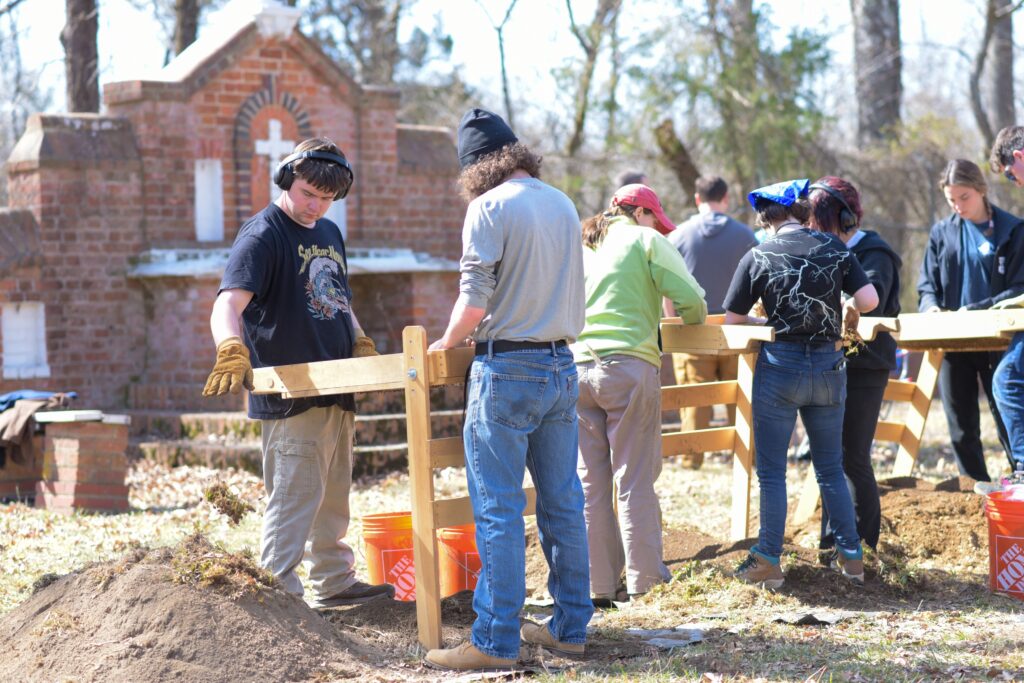
Last spring, assistant professor of anthropology Laura Masur led a team of 12 Catholic University students on a dig at the site in Aquia, Virginia, about 39 miles from the nation’s capital. As they combed for artifacts and other clues, they stumbled upon something unexpected: unmarked graves. A new mystery began.
The cemetery was once owned by the family of George Brent, an influential Catholic, lawyer and politician in the Virginia colony during the 17th century. He also was an enslaver: His will mentioned 25 people who were property of the Brent family.
Now, Masur and the diocese are trying to identify who is buried in the unmarked graves, including determining whether any were enslaved people, and learn about their lives. They also hope to find any living descendants to start a conversation on how to honor their ancestors.
“I wanted to ensure that, from the beginning, they [the diocese] were ready to engage with issues of reconciliation and engage with members of the descendant community,” Masur said in an interview.
Up to 88 burial sites
The earliest Brents arrived in Maryland from England in 1638, with some of the family then moving to Virginia. Margaret Brent — George Brent’s great-aunt — was the first woman in the new colonies to request the right to vote.
George Brent settled in Stafford County on property that would remain in the family’s possession until 1841. It is now owned by the Arlington diocese.
The location of the Brent residence was rediscovered in recent decades during an investigation by the Archaeological Society of Virginia. Alukonis said that when she learned of potential burials at the property, she reached out to a geophysicist who later used ground penetrating radar to examine the property. A report said the 2022 survey identified at least 60 and as many as 88 burial sites, many of them unmarked. Prior archaeological digs between 1995 and 2002 also identified unmarked graves inside a brick wall and on a slope that leads toward a swampy area.
The survey results prompted Alukonis to reach out to Masur, who in recent years also led a dig of property around Sacred Heart Chapel in Bowie, Maryland, that found graves of people enslaved by some of the priests and brothers who were building the Catholic church.
After completing the Maryland project, Masur visited the former Brent family property in Virginia about a year and a half ago, where she says she saw a few graves within a brick wall. There has been a history of vandalism at the site, she said, because of urban legends about the area, including a possible nearby witch’s pond.
When Masur returned to the property last spring with her students, she said the team had to be careful when digging next to burials. They got a permit from the state and followed special protocol, such as putting any bone found into a separate bag. (They did not find anything that looked like human bones). While on the site, the team found a wine bottle with the initials “GB” on it, indicating it could have belonged to George Brent, Masur said.
It was on the third or fourth day of the dig when her team realized that there was a depression in the ground associated with a grave marker — temporarily halting their work.
“You never quite know what you’re going to find,” Masur said. “We were expecting to find a structure, but as we got down deeper, we hit wood and debated whether this was wood from trees or old coffins.”
Masur said the team mapped the outline of the depression with GPS, and then removed other sediment in the area. She said they measured and recorded elevations from the unit to document how the depression was lower than the rest of the surrounding ground surface.
The team wasn’t able to dig deep enough to identify coffins, Masur said, but saw fieldstone grave markers and other depressions in the ground.
“Thankfully, our excavations showed that at least within the brick walls, the graves are all likely to be very deeply buried,” Masur said. “There was little risk of encountering anything sensitive, like a coffin or human remains.”
At the end of the dig, Masur and the team of students held a moment of silence. They’d done the same at the beginning of their work on the site.
“I think it’s important to have reverence for what we’re doing,” Masur said. “It’s important to remember the humanity of the people who are buried here, even if we don’t know who they are.”
Masur said evidence indicates that most burials on the property likely occurred between 1670 and 1775.
‘A better understanding of history’
Now the work has shifted to learning more about whose remains are at the site.
Alukonis said that she has made several trips to the Library of Virginia in Richmond to find more information on the Brent family and property. But she notes that many court records dating to the 17th century were destroyed during the Civil War.
Somehow, Masur said, a copy of George Brent’s will survived.
“One of the big obstacles when looking at Virginia is some of the counties are burned counties, and Stafford is one of those counties,” Masur said.
Alukonis, who was on-site during the dig, said it is not yet determined whether the graves belong to enslaved people.
Masur and the diocese are working to find records, family trees and oral histories that may help identify descendants of both the Brents and those that they enslaved.
“Opening up these conversations will help us have a better understanding of the history, and we can accurately represent and respect everybody who was there,” Alukonis said.
The diocese contributed “several thousand [dollars]” that Catholic University used for expenses related to the dig, such as an archaeological field technician, and for those working in Catholic University’s lab. According to the diocese, as they work with descendants of those who may be buried at the site, there may be further funding devoted to excavation and preservation efforts.
Bishop Michael Francis Burbidge said in a separate statement that he is grateful for the partnership with the university and hopes that descendants come forward so both sides can “more fully honor the lives and legacies of these first Virginians.”
“Every grave marks the final earthly resting place of a human person, known and loved by God, who came before us,” Burbidge said. “It is our great responsibility as a diocese to conserve, honor, and steward Brent Cemetery as sacred ground.”
Masur said that there had been no excavations of the graves yet. She doesn’t foresee that happening without unanimous support from descendants of the Brents and the people they enslaved. The site, meanwhile, will be monitored to ensure there is no risk of erosion for the graves.
Masur said she hopes residents come away from this Brent cemetery project with a fuller understanding of the past.
“We try to frame historical figures in one way or another,” she said. “These individuals are very complex and we can look at what they’ve achieved, but we also need to look at what enabled this to happen.”
The post Researchers probe unmarked graves at Virginia site where slaves once toiled appeared first on Washington Post.