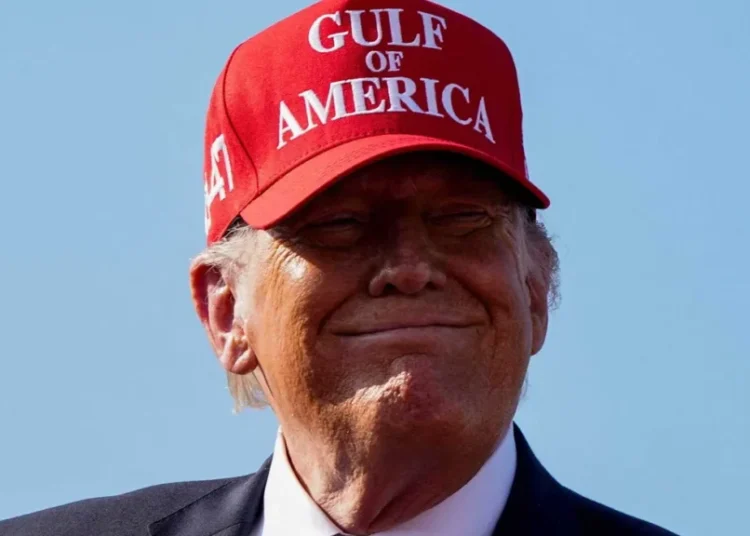
President Donald Trump launched Saturday’s wide-ranging attack on Iran after a weeks-long lobbying effort by an unusual pair of U.S. allies in the Middle East — Israel and Saudi Arabia — according to four people familiar with the matter, as Israeli and U.S. forces teamed to topple Iranian Supreme Leader Ali Khamenei after nearly four decades in power.
Saudi Crown Prince Mohammed bin Salman made multiple private phone calls to Trump over the past month advocating a U.S. attack, despite his public support for a diplomatic solution, the four people said. Israeli Prime Minister Benjamin Netanyahu, meanwhile, continued his long-running public campaign for U.S. strikes against what he views as an existential enemy of his country.
The combined effort helped lead Trump to order a massive aerial campaign against Iran’s leadership and military, which in its initial hour led to the death of Khamenei and several other senior Iranian officials.
The attack came despite U.S. intelligence assessments that Iran’s forces were unlikely to pose an immediate threat to the U.S. mainland within the next decade. Saturday’s attack on Iran was a break from decades of U.S. decision-making to hold back from a full-scale effort to depose the regime of a country of more than 90 million people. It also marked a stark shift from Trump’s own previous military forays, which until now have been far narrower in scope.
Now Trump will bear the risk of the bet he has placed: that a major military operation conducted from the air can achieve political goals on the ground.
“No president was willing to do what I am willing to do tonight,” Trump told Iranians in a video address posted as U.S. bombs rained down on targets across Iran. “Now you have a president who is giving you what you want, so let’s see how you respond.”
The Saudi push for an attack came as presidential envoy Steve Witkoff and Trump’s son-in-law Jared Kushner pursued negotiations with Iranian leaders over the country’s nuclear and missile programs.
As those talks proceeded, Riyadh issued a statement, following a phone call between the crown prince and Iranian President Masoud Pezeshkian, that Muhammed would not allow Saudi airspace or territory to be used in an attack on Iran.
In his discussions with U.S. officials, however, the Saudi leader warned that Iran would come away stronger and more dangerous if the United States did not strike now, after amassing the largest military presence in the Middle East since the 2003 invasion of Iraq, said the people, who, like others, spoke on the condition of anonymity to discuss the sensitive situation.
Mohammed’s position was reinforced by his brother, Saudi Defense Minister Khalid bin Salman, who held closed-door meetings with U.S. officials in Washington in January and warned about the downsides of not attacking, the people said.
The Saudi leader’s complicated position probably reflected his desire to avoid Iranian retaliation against his country’s vulnerable oil infrastructure, weighed against his view of Tehran as Riyadh’s ultimate foe in the region, said those familiar with his thinking. Iran, dominated by Shiite Muslims, and Saudi Arabia, led by Sunnis, have long had an intense rivalry that has generated proxy wars in the region.
Following the initial U.S. attack on Saturday, Iran did retaliate against Saudi Arabia. Riyadh issued a furious statement condemning the attack and calling on the international community to “take all necessary and decisive measures” to confront Iran.
The Saudi Embassy did not respond to a request for comment.
Witkoff and Kushner had their final contacts with Iranian officials in Geneva on Thursday, their third high-level encounter since early February. They walked away believing that Tehran was playing games with them about its need for nuclear enrichment, according to a senior Trump administration official.
“It was very clear that the intent for them was to preserve their ability to do enrichment so that, over time, they could use it for a nuclear bomb,” the official said.
By Friday afternoon, when Trump arrived in Corpus Christi, Texas, for a campaign rally ahead of Tuesday primaries there, the president’s frustration — and his rhetoric — was escalating. He repeatedly declared himself “not happy” with Iranian negotiators.
“I’ve got a lot of things going on now,” he told the crowd toward the end of a rambling speech ostensibly focused on energy policy. “We have a big decision to make, you know that. Not easy, not easy. We have a very big decision to make.”
Later, he flew to Palm Beach for the weekend, where he mingled with supporters at his Mar-a-Lago resort Friday evening, looking tired but otherwise in good sprits before exiting to his private quarters to record a speech he would give announcing the attack, according to one person who was there and interacted with him.
The decision to launch the attack was in some ways foretold by the massive buildup of U.S. forces over the past two months. But there was little in Trump’s record to suggest that he would embrace a war of choice in the Middle East with the goal of regime change.
In explaining his decision, Trump on Saturday reached all the way back to Iran’s 1979 revolution. He described the U.S. attacks as payback for decades of conflict with Iran. He cited the 52 Americans held hostage for more than a year after the 1979 takeover of the American Embassy in Tehran; the deaths of 241 U.S. service members in 1983 bombing of their barracks in Beirut by Iran-backed Hezbollah during a Lebanese civil war; and the 2000 attack on the USS Cole, a naval destroyer docked in a Yemen, which Trump said Iran “probably” was involved in, although the United States has long attributed the suicide bombing to al-Qaeda.
Earlier Saturday, Trump said that the United States had faced “imminent threats from the Iranian regime.” Tehran was continuing to work toward producing a nuclear weapon and development of “long-range missiles that … could soon reach the American homeland.”
Both of those assertions have been challenged. Trump himself has vehemently maintained that the U.S. “obliterated” Iran’s nuclear program with airstrikes this past summer. The International Atomic Energy Agency has said there is no evidence Iran has restarted its uranium enrichment program following those strikes or that it has an active bomb-building plan. In an assessment last year, the U.S. Defense Intelligence Agency cited no indication that Iran was embarking on development of an intercontinental ballistic missile. If it decided to do so, the DIA said, it would take a decade to produce.
Trump directed anti-government Iranians to “take over” their government, but his call included no details. He declared that those within Iran’s extensive military and security infrastructure would be given “complete immunity” but provided no explanation how or by whom that would be done.
During both his first and second terms, Trump has said consistently there would be no American boots on the ground in military operations that he launched. Since taking office again, while launching air and missile attacks on seven countries — Nigeria, Syria, Yemen, Somalia, Venezuela, Iraq and Iran — he largely has kept that promise.
But it remains unclear whether aircraft and missile strikes can achieve his ever-expanding goals — among them new, U.S.-friendly regimes in Iran and Venezuela; an end to Iran-backed militant operations in Yemen; and the defeat of Islamic terrorist operations in Nigeria and Somalia.
“History is not kind to efforts to fundamentally alter and restructure the internal politics of a country using the air power alone,” said Aaron David Miller, a former U.S. diplomat who worked on Middle East issues for both Republican and Democratic administrations.
“This is very much Trumpian, in the sense that he’s tried to split the difference between getting bogged down in an interminable conflict which will undermine the American economy and cost Americans their lives, on one hand, and yet bringing to bear the power of the American military in a sort of roll-the-dice operation,” Miller said.
Months of planning for the 2003 U.S. toppling of Iraqi leader Saddam Hussein included thousands of invading American forces that remained there for nearly a decade and a large cadre of civilian U.S. officials on the ground to organize a new government.
Top Trump officials — some of whom have been sharp critics of the Iraq effort and other U.S. forays into the Middle East — have insisted in recent days that this time will be different.
Vice President JD Vance on Thursday told The Washington Post that he still considers himself a “skeptic” of foreign military interventions — a description he said still applied to Trump, too. He said there was “no chance” any military operation by the U.S. in Iran would lead to a drawn-out war involving the Trump administration.
Vance on Saturday watched the military operation from the Situation Room at the White House, while dialed into a conference line that connected him to the president and his national security team, who were tracking Iran from Mar-a-Lago, according to a person with knowledge of the events. Vance was joined at the White House by Tulsi Gabbard, the director of national intelligence, who has long campaigned against war with Iran. Energy Secretary Chris Wright and Treasury Secretary Scott Bessent were in the Situation Room too, the person said.
Apart from Trump’s Saturday’s statements once the attack already started, the president has devoted little time to publicly justifying or explaining war with Iran, a break from previous practice of U.S. leaders.
Democrats on Saturday pushed Trump to explain his case to the American people.
“What was the imminent threat to America?” said Sen. Mark R. Warner (D-Virginia), the senior Democrat on the Senate Intelligence Committee, in an interview. “I don’t know the answer.”
Warner, who participated in a classified briefing on Tuesday with Secretary of State Marco Rubio and CIA Director John Ratcliffe, said that senior lawmakers were given a “fair description of options” the administration was considering, but that he saw no threat that “would literally be worthy of putting our troops in harm’s way.”
In the briefing on Tuesday for the Gang of Eight, which consists of the leaders of the House, the Senate and each chamber’s intelligence committees, Secretary of State Marco Rubio indicated to lawmakers that the mission’s timing and goals were shaped by the fact that Israel was going to attack with or without the United States, according to a person familiar with the administration’s outreach to lawmakers.
“So the only debate that seemed to be remaining was whether the U.S. would launch in concert with Israel or if the U.S. would wait until Iran retaliated on U.S. military targets in the region and then engage,” the person said.
Now the question is what comes next.
For now, Trump says that he hopes that in the face of the death of Khamenei, Iran’s security forces and police “will peacefully merge with the Iranian Patriots, and work together as a unit to bring back the Country to the Greatness it deserves.” In January, those security forces killed thousands of Iranian protesters.
He vowed that “the heavy and pinpoint bombing, however, will continue, uninterrupted throughout the week or, as long as necessary to achieve our objective of PEACE THROUGHOUT THE MIDDLE EAST AND, INDEED, THE WORLD!”
Souad Mekhennet, Ellen Nakashima, Natalie Allison and Noah Robertson in Washington; Matt Viser in Corpus Christi, Texas; and Greg Miller in London contributed to this report.
The post Push from Saudis, Israel helped move Trump to attack Iran appeared first on Washington Post.