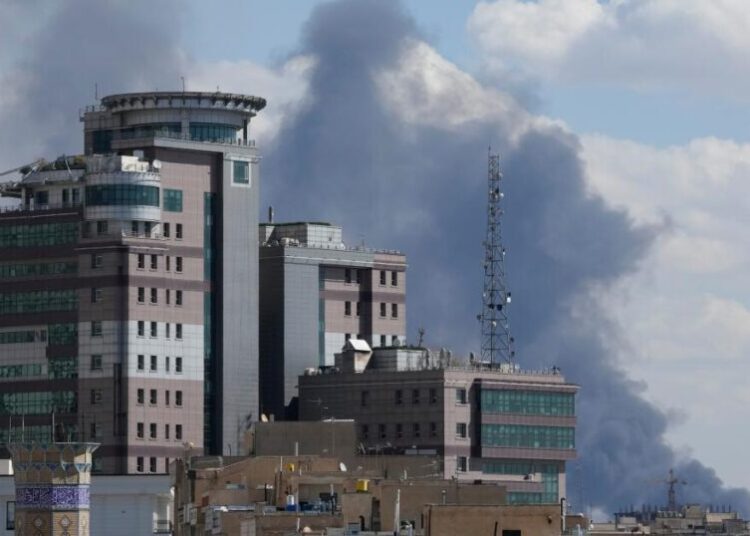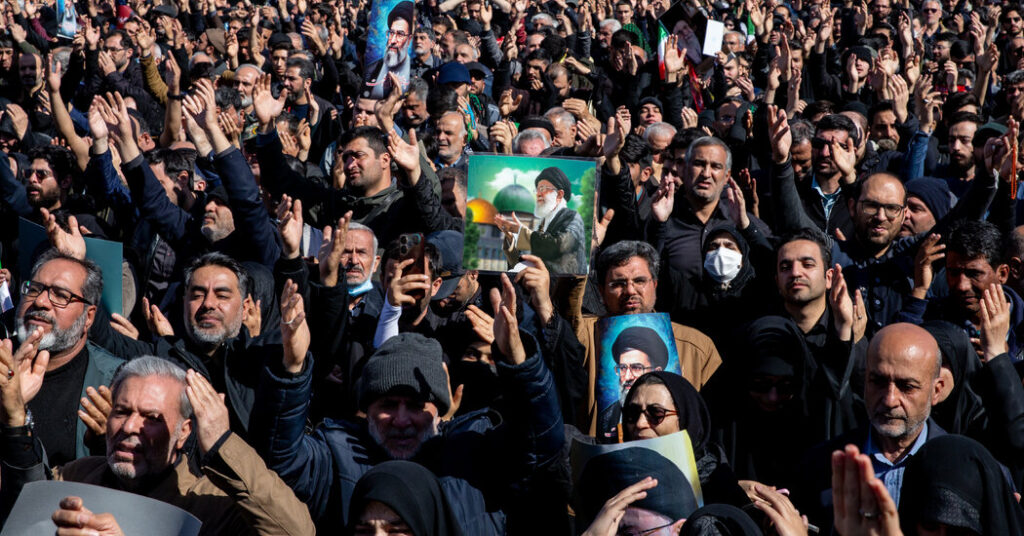
At least 22 people were killed in Pakistan on Sunday as thousands gathered across the country to denounce U.S. and Israeli airstrikes on Iran, including 10 who died as crowds tried to storm the U.S. Consulate in Karachi.
The airstrikes have already spurred fear, uncertainty and unrest in Iran’s eastern neighbors, Afghanistan and Pakistan — two countries with sizable Shiite minorities who have long been influenced by Iran’s Shiite leadership.
A broader regional conflict over Iran threatens Afghan and Pakistani communities that rely on cross-border trade and could embolden militant groups in a region that has been inflamed by the fiercest military standoff in years between Afghanistan and Pakistan.
At least 10 died and dozens were injured in Karachi, Pakistan’s largest city, according to Summaiya Syed Tariq, a police surgeon at the city’s main government hospital.
Two more died in Islamabad near the U.S. embassy, according to a hospital official, and 10 in the northern region of Gilgit-Baltistan, according to a provincial official. Both spoke on condition of anonymity because they were not allowed to discuss the turmoil publicly.
The protests around U.S. diplomatic missions across Pakistan marked the most serious crisis in U.S.-Pakistan relations since 2011, when U.S. forces killed Osama bin Laden, who was in hiding in Pakistan, said Adam Weinstein, the deputy director of the Middle East program at the Quincy Institute in Washington.
“Pakistan’s military can suppress the protests, but the political cost of bear hugging President Trump is rising fast,” said Mr. Weinstein.
Pakistan shares a volatile, 560-mile border with Iran, and an estimated 15 to 20 percent of its 240 million people are Shiite Muslims, one of the largest Shiite communities outside Iran.
Over the weekend, thousands gathered in Karachi, Pakistan’s largest city, and Islamabad, its capital, to express solidarity.
“When Iran is attacked, we feel our faith, our identity and our very existence are being targeted,” said Asghar Jaffer, a Shiite student activist who joined the demonstrations in Karachi.
Pakistan has long walked a diplomatic tightrope between Iran, Saudi Arabia and the United States.
On Saturday, Pakistan’s foreign ministry decried “unwarranted attacks against the Islamic Republic of Iran,” but did not name the United States or Israel. It also condemned Iran’s retaliation against Gulf countries.
A spokesman for the Taliban government, Abdul Qahar Balkhi, said Afghanistan expressed “deep regret” regarding U.S. and Israeli attacks and Iran’s response.
Under a defense pact signed between Pakistan and Saudi Arabia last year, any attack on one country would be considered an aggression on the other. Saudi Arabia intercepted Iranian missiles on Saturday.
Further instability could also have a major impact on much-needed remittances for people in both Pakistan and Afghanistan.
Pakistan’s economy relies heavily on Pakistanis who send about $20 billion in remittances from Gulf countries every year. A Pakistani citizen was killed by an Iranian airstrike in the United Arab Emirates on Saturday, according to the Pakistani foreign ministry. If countries in the Gulf continue to be targets of Iranian retaliation, Pakistani workers may be reluctant to go there.
Remittances sent by Afghans living in Iran have also been critical to millions of families. Iran expelled nearly two million Afghans last year, but a sizable diaspora still lives in the country.
Hussain Akhlaqi, a clothing shop owner in Herat, one of Afghanistan’s largest cities and home to a large Shiite population, said his business relied mostly on remittances sent by Iran-based Afghans to their families.
“If they don’t send money to their families from Iran, the families don’t buy clothes here,” Mr. Akhlaqi said.
Nearly all Afghan households that lost their Iranian remittances in the previous year were in debt, according to a study of more than 450 families by World Vision, humanitarian nonprofit group, and Samuel Hall, a research firm.
In Pakistan, security officials fear instability in Iran could create power vacuums along the two countries’ harsh and mountainous borderland, an area known for separatist militancy, jihadist networks and smuggling routes.
Pakistan has a long and often violent history of sectarian conflict, frequently inflamed by geopolitical shifts in the Muslim world and tensions between Iran and Saudi Arabia.
Last month, a suicide bombing carried out by the Sunni extremist group Islamic State on a Shiite mosque on the outskirts of Islamabad killed 31 people and injured 169.
The risks are acute in Pakistan’s southwestern province of Balochistan. The province has endured a decades-long separatist insurgency and shares deep ethnic and tribal ties with Iran’s neighboring provinces.
Families straddle the border, and rely on both legal and illegal trade to survive.
But a Pakistani official in Balochistan, Hamza Shafqaat, said in an interview last month that Pakistan was planning to abolish a decades-old border crossing policy with Iran that has allowed border communities to cross for family visits and small-scale trade. Mr. Shafqaat said a strict visa and passport policy would be enforced in an attempt to curb smuggling.
“Our livelihoods depend on stability in Iran,” said Khair Baksh, a trader involved in cross-border commerce in the Pakistani border town of Mand. “When conflict grows there, it directly threatens our survival here.”
Elian Peltier is The Times’s bureau chief for Pakistan and Afghanistan, based in Islamabad.
The post Protesters Try to Storm U.S. Consulate as Thousands in Pakistan Protest Iran Strikes appeared first on New York Times.