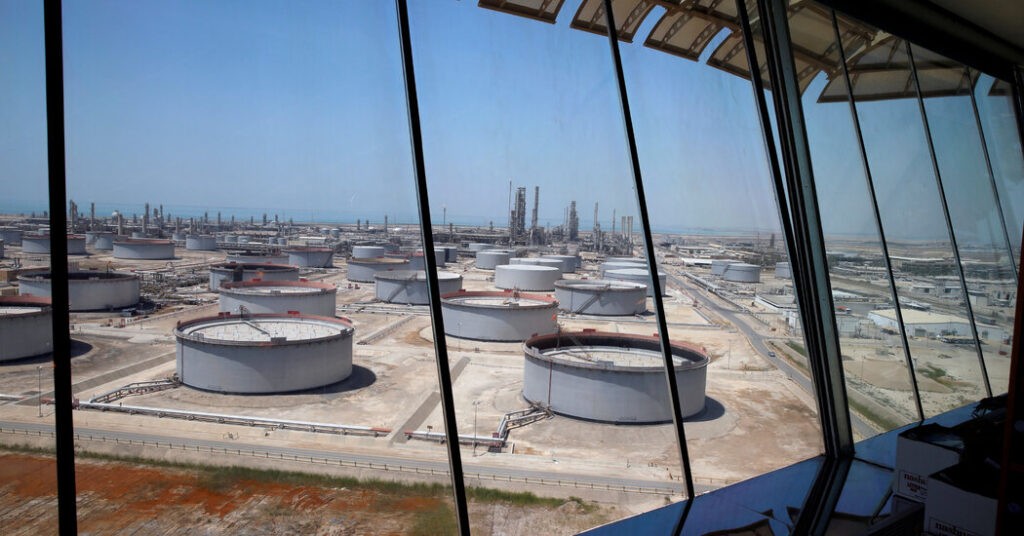
The eight oil-producing countries in the group known as OPEC Plus said on Sunday that they would increase oil production by 206,000 barrels a day in April, which could help mitigate the impact on oil prices of disrupted shipments in the Middle East.
The group’s members would “closely monitor and assess market conditions,” OPEC Plus said in a statement, and adopt a “cautious approach” to future moves. The group includes Saudi Arabia, Russia, Iraq, the United Arab Emirates, Kuwait, Kazakhstan, Algeria and Oman, which sell enormous volumes of oil to energy-hungry countries like China and India.
The production boost is a step up from the increases the group implemented toward the end of last year — about 137,000 barrels a day — but it is modest relative to global oil supplies of more than 100 million barrels a day.
Many analysts expect oil prices to jump when markets open for trading late Sunday night. Oil tankers have already begun steering clear of the Strait of Hormuz, a crucial waterway on Iran’s southern border that typically carries about one-fifth of the world’s oil. The Iranian military had warned ships to avoid the area, saying that passage through the strait was “unsafe.” Iraq, Kuwait and Qatar rely heavily on the waterway to ship their oil and gas.
On Sunday morning, Britain’s maritime security agency reported that a ship near the Strait of Hormuz was struck by an “unknown projectile” that caused a fire in the vessel’s engine room. The blaze has been brought under control.
Brent crude, the global benchmark for oil, was trading at around $73 per barrel when markets closed on Friday. It has risen about 20 percent this year.
Analysts at Eurasia Group said that oil prices were likely to rise between $5 and $10 a barrel when trading resumes. An analyst at Barclays said on Saturday that oil prices could rise much higher, exceeding $100 a barrel. Brent crude has not traded at that level since 2022, in the months after Russia’s full-scale invasion of Ukraine, which contributed to a surge in inflation across the world.
“How this ends is extremely uncertain at this point but in the meantime oil markets will have to face their worst fears,” Amarpreet Singh of Barclays wrote.
The production increase will follow several months when OPEC Plus kept output steady. The cartel had paused increases in the first months of the year, fearing that demand was not keeping up with supply and that oversupply would depress prices.
Eshe Nelson is a Times reporter based in London, covering economics and business news.
The post OPEC Plus to Boost Oil Production as Iran Strikes Threaten Price Spike appeared first on New York Times.