Making a Pavlova is a magic trick. Lifting the flat beater of her stand mixer to reveal the meringue’s famous soft peaks that appear midway through, the pastry chef and writer Tanya Bush described the process: “The transformation from a snotty egg white mess to a gorgeous, opalescent, fluffy meringue is so satisfying.”
It’s a description that could equally apply (with small changes) to the narrator of a new memoir: a down-on-her-luck 23-year-old in the midst of transforming into a self-actualized professional pastry chef, the editor of a beloved literary zine, and the author of a “narrative cookbook” — don’t call it a cookbook — recounting the whole experience.
In staking out the premise of this book, called “Will This Make You Happy,” Ms. Bush took a risky bet: The exact thing you said you didn’t want to wade through before reading a recipe online — the origin story, or the particular pleasures of a seasonal ingredient, or any obliquely related anecdote from the recipe writer’s life? You actually want more of that. And as someone who is primarily a dessert maker, Ms. Bush is an expert in knowing when people want more of something.
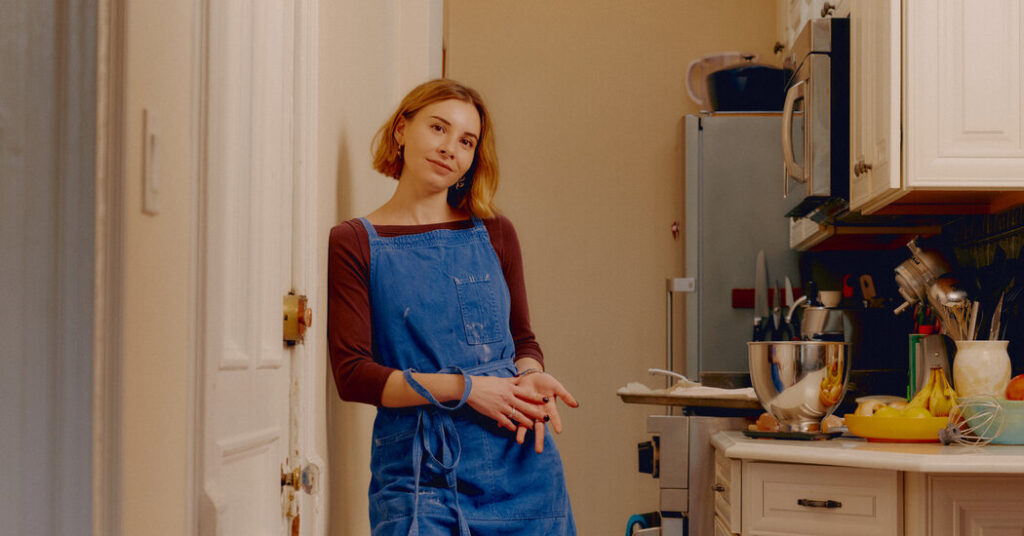
On a recent Thursday, I met Ms. Bush in her Brooklyn apartment to help her prepare — by watching her prepare — a famously finicky dessert. Ms. Bush, now 29, was sporting a shiny dark purple manicure, a denim apron and a ready gleam whenever there was an opportunity for a conspiratorial moment. For instance, her response to the frenetic efficiency of some other recipe-writing or cooking videos? “Slow down, babe.”
“All our attentional economies are so deformed, and we are so hungry to optimize at every turn,” Ms. Bush said. “It’s nice to be like, This is actually not about optimization. It’s about a pleasurable reading experience that hopefully then is moving me to action.” That action being preparing one of her recipes, maybe a fish sauce peanut brittle or a carrot cake with cream cheese mousse.
While the dessert was cooling, Ms. Bush doled out enticing descriptions of the Pavlova, as if making an advertisement of why it was worth waiting for: “billowy,” “cloudlike,” “whimsical,” “big and pearlescent,” “glossy,” made with strawberries three ways. (One of the ways: a shot of transfixing, unnaturally pink strawberry Nesquik.)
When she’s not baking as the pastry chef at Little Egg, a Prospect Heights breakfast spot, Ms. Bush, who is originally from Princeton, N.J., cooks in a galley kitchen with NPR playing from an actual radio. Her one-bedroom in Park Slope is filled with candles in the shape of cakes, novels intermixed with cookbooks and two blue-eyed cats (one, a regal queen; the other, her skittish court jester).
In her book, each batch of dessert recipes is preceded by moody, impatient, early-20s recollections from Ms. Bush’s 2021. (Even the book’s dimensions suggest a commitment to splitting the difference: just bigger than a typical hard-bound novel, just smaller than a typical cookbook.)
“I was very specific about this term, ‘narrative cookbook,’” Ms. Bush said. She understands some readers’ frustrations with what she called the “S.E.O. ploys of the food-blogging era,” when enterprising writers realized that they could get their words in front of readers if only those words appeared before a recipe for apple galette. “But I think there’s something so special about seeing what is outside of the finished product, this perfect recipe that I’m offering to you.”
Her book’s title is a riff on @will.this.make.me.happy, the handle of an Instagram account run by Ms. Bush whose “puckish immediacy” was recently praised in The New Yorker. Ms. Bush started the account a few months before the narrative arc inscribed in her book began, and its first post, in late November 2020, reads: “No. Buttermilk scones with lemon zest do not alleviate anxiety.”
The account began as a way to lampoon the idea “that baking could make me happy,” Ms. Bush said. “And then, obviously, I did actually like making things.”
About two years after that first post, she started working in Brooklyn bakeries. She developed the menu for Little Egg in the fall of 2022. It opened in 2023, the same year New York magazine named her cruller the city’s best pastry (“as crunchy as can be”). She founded the saucy, unexpected literary food publication Cake Zine with Aliza Abarbanel in 2022.
What TikTok and Instagram have done to the narrative arc of food is an essential part of Ms. Bush’s back story, something she both appreciates and resists. As a self-taught pastry chef, she said, she spent a good deal of time learning online — a place where she also developed her public voice. These experiences bolstered her enough to want to take herself out of that ecosystem.
Admiring the finished Neapolitan Pavlova, with fresh fudge sauce in addition to the strawberry layers, Ms. Bush described her growing aversion to “being online.”
“Online, sometimes recipes feel really deracinated, detached from the source,” she said. “It’s just so much more fulfilling, pleasurable, and honest to put food back in its narrative context. Food is inherently narrative. You’re making it for someone you love, you’re worrying over it. There are so many things that preceded that perfect recipe.”
This brings up another element that the narrative cookbook can really contain: the crumbly, burned, total flop.
“There’s a lot of failure and humiliation as a part of it, which is pretty rare in cookbooks,” Ms. Bush said. “I was always really interested in what was happening outside of the wings of the recipe.”
Failures on the way to success make for a true, and more attractive, narrative arc. So like any memoirist worth her salt, Ms. Bush collects the failures. It’s a part of the instructive ethos of her book: She insists on not discarding your mistakes. As she writes in the book: “The freezer is an archive.” And indeed, whenever she fouls up a recipe, she immediately puts it in the freezer.
This itself is proof of maturity for Ms. Bush. Balking at failure, she said, is very “young 20s.” “Over time, I’ve just learned from other amazing cooks and chefs how to salvage things.” That over-crisped cookie that went straight into the freezer? Down the road, it can be blitzed with butter in a food processor and used as a tart base.
The failures documented aren’t only culinary. Ms. Bush’s memoir recounts the humiliating job application (declaring “a passion for copy machines” in a cover letter); a collapsed olive oil cake; the sweet, supportive but stifling feeling of a college relationship waffling its new iteration. (The happy ending is in the wings here: The character of “The Boyfriend” in the memoir is now Ms. Bush’s “The Husband” after the couple married last year.)
Throughout her 20s, the failures got more exciting, and often involved “high-stakes pastries.” Take the Pavlova she had just prepared: Ms. Bush had previously made over 400 mini versions of it on Governors Island for a 2023 Outstanding in the Field dinner party, a lavish affair on a notoriously long single table. That night, it was “an inferno — it was wildly, unpleasantly, devastatingly humid and sweltering.” It was a heaving effort to keep the Pavlovas from melting, with lots of personal tumult, but instructive about checking the weather.
“I’m 29 now,” Ms. Bush said. “I have, hopefully, a more fortified, robust sense of self than I did at the beginning of my baking journey.”
There’s a script to the end of dinner, and it begins with everyone insisting they’re full. Most people deny they want a dessert, and then they do, and when it’s on the table, they eat the whole thing. It’s a whole ritual, so much that servers often have a little wiggle when they present the menu.
Even if you say you don’t want it at first, Ms. Bush knows if it’s good, you’ll have a bite and then some more.
The post Just Get to the Recipe? She Will When She’s Ready. appeared first on New York Times.