It was barely midday on Sunday, the start of the workweek and the second day of the conflict, and many Israelis were already exhausted.
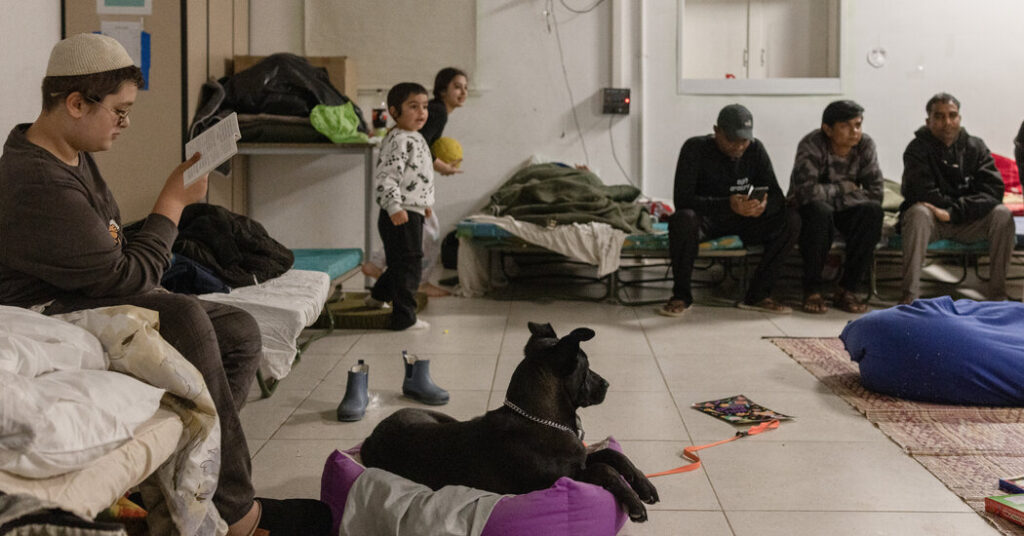
Shrill phone alerts and wailing sirens warning of incoming Iranian missiles and drones kept people across the country awake until about 2 a.m., and then started up again at 6 a.m. A series of barrages sent them running repeatedly to bomb shelters.
Still, many said they were heartened by the morning headlines.
The front page of Yedioth Ahronoth, a popular Hebrew daily, featured a large portrait of Ayatollah Ali Khamenei, Iran’s supreme leader, with a red X across his face and one word: “Eliminated.”
The news was confirmed by President Trump late Saturday: An Israeli strike had killed one of the country’s most implacable foes in the first minute of the attack on Iran, leaving some Israelis to feel the ordeal was worthwhile.
“I am happy Khamenei has been killed, but it’s stressful,” said Tanya Sachs, 42, a chemist from Jerusalem. “We are at war and it feels like war,” she added, describing how she ran up and down from her apartment to a bunker below the building with her four children, aged two to 13.
Most Israelis needed few justifications for attacking Iran, having lived for decades with their leaders warning that Iran’s nuclear program and ballistic missiles posed an existential threat to their country.
Ms. Sachs said that having Mr. Trump on board provided a one-time opportunity for Israel.
“It wouldn’t be happening without him,” she said. “We have a real desire to see a regime change in Iran. It’s critical for Israel’s security.”
Ms. Sachs was in a Jerusalem supermarket stocking up on snacks and other food, like dry pasta. Others were loading shopping carts with trays of eggs, bottles of mineral water and toilet paper for their shelters.
Schools were closed and nonessential businesses shuttered on the instructions of Israel’s home front command. Nobody knows how long the conflict will last, but the Israeli military says it will be for as long as it takes.
Iran has already fired dozens of missiles toward Israel. Many were intercepted by the country’s air defenses, but on Sunday a direct strike on a residential district in Beit Shemesh, an Israeli city about 18 miles west of Jerusalem, killed at least nine people and injured dozens. It was the highest number of casualties in a single strike in Israel in this conflict.
On Saturday night, a direct hit on a residential building in central Tel Aviv killed a Filipino caregiver in her 50s, according to the authorities. A hospital reported the death of another woman on Sunday morning after she suffered shortness of breath running to a bomb shelter.
Not all Israelis were convinced of a good outcome, even if they supported the offensive.
“History teaches us that taking out leaders rarely brings about a better reality,” said Gideon Lopez, 62, a Jerusalem resident who was sheltering in a bunker with his wife, Annie, and their daughter, Achinoam, 29.
Their two other children had been called up on Saturday for reserve duty. One is a tank commander in northern Israel, and another serves in a military search and rescue unit deployed in Tel Aviv.
“I’m too old to be naïve that something better might emerge” in Iran, Annie said. But the death of Ayatollah Khamenei, a “murderous leader,” might be “better for humanity,” she added.
Achinoam said she thought this was “a good war,” adding, “The younger generation prefers to suffer now and not have a worse situation to deal with later.”
Some Israelis drew a comparison between the death of Ayatollah Khamenei and the story of Purim, a Jewish holiday that falls this week. Set in ancient Persia, the tale celebrates the triumph of the Jews of the empire over an evil royal adviser who had persuaded the king, Ahasuerus, to allow them to be killed.
“I feel great, like from 2,500 years ago!” said Doron Binyamin, a grocer. “It feels like good things are happening, and that finally we are dealing with our problems.”
His father, Zeev Binyamin, said he hoped this would be the war to end Israel’s wars.
“I hope it will bring peace and quiet for a hundred years,” he said.
Isabel Kershner, a senior correspondent for The Times in Jerusalem, has been reporting on Israeli and Palestinian affairs since 1990.
The post Israelis Are Tense but Relieved That Iran’s Supreme Leader Is Dead appeared first on New York Times.