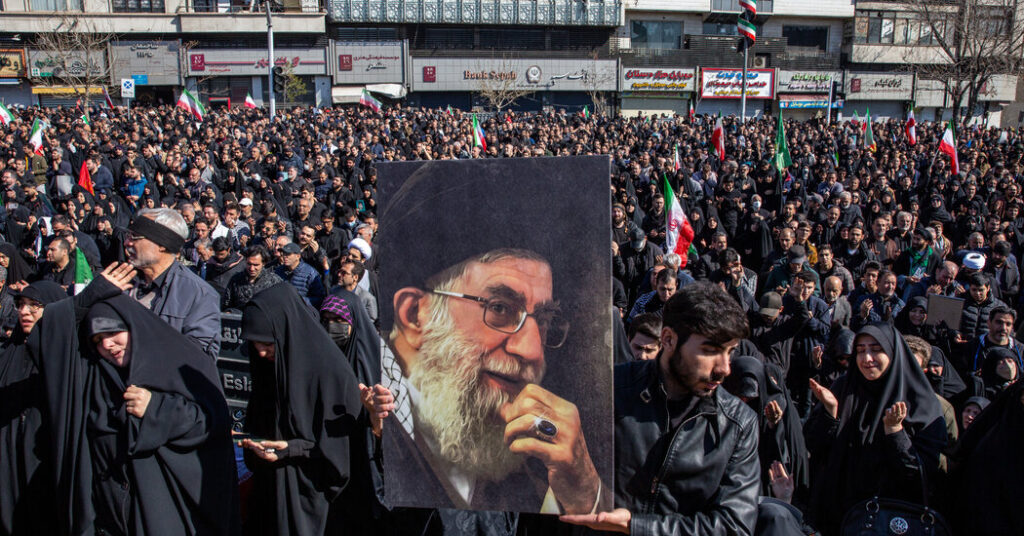
Iran’s supreme leader may be dead, but there will be another. Its slain military commanders will be replaced. A governing system created over 47 years will not easily disintegrate under air power alone. Iran retains the capacity to strike back against American and Israeli airstrikes, and the war’s trajectory is unclear.
But the Islamic Republic, already weakened and unpopular, is now further diminished, its power at home and in the region at one of its lowest ebbs since its leaders took power during the revolution that overthrew Iran’s American-backed shah in 1978-79.
Even if the regime does not fall, which remains the stated aim of President Trump, this massive attack is likely to have strategic consequences in the Middle East comparable to the collapse of the Soviet Union.
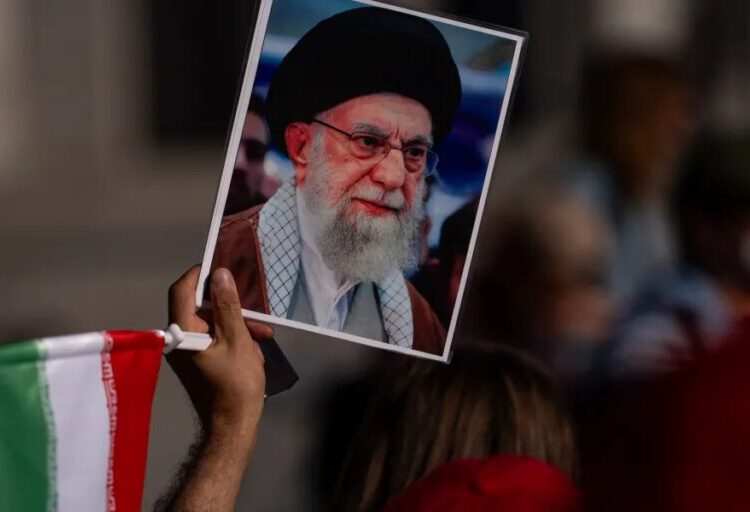
Ayatollah Ali Khamenei, the supreme leader killed on Saturday morning, maintained a visceral antagonism toward Israel and the United States, which he consistently called “the Great Satan.” He built a regional set of proxy militias that surrounded Israel and which shared his hatred and were financed to damage it. Hezbollah in Lebanon, Hamas and Islamic Jihad in Gaza and the West Bank, the Houthis in Yemen — all served both to attack Israeli interests and protect Iran itself.
Iran built up its missile program and enriched uranium to nearly bomb grade, even as it denied ever wanting a bomb. It became a regional power so strong that Sunni leaders in Saudi Arabia, Egypt and the Gulf sought to keep good ties with a Shia Islamic regime that also threatened them.
Iran’s decline began two years ago, with Israel’s tough and sustained response to an invasion by Hamas from Gaza. It accelerated when Israel eroded Iran’s air defenses, defeated Hezbollah and profited from the Syrian revolution that overthrew Bashar al-Assad, another ally of Tehran.
But now, with the ayatollah’s death and intense destruction from the air, Iran’s regional sway has ebbed further, with uncertain consequences that will play out over months and even years.
“The Islamic Republic as we know it will not survive this,” said Sanam Vakil, director of the Middle East and North Africa Program at Chatham House, a London-based research group.
“The Mideast won’t be the same again,” she said. “For 47 years the Mideast has been living with a hostile regime and a destabilizing force that it has tried to first isolate and then manage.”
Now, she said, the regime might be dismantled and something new and different might emerge. That leadership may turn out to be even less friendly to Washington, particularly if dominated by the Islamic Revolutionary Guards Corps under another, more pliant supreme leader.
Whoever takes charge, Iran will be badly weakened in the medium term, more inward-looking, and focused on political competition, internal security and economic chaos, Ms. Vakil said.
In the coming days, however, Iran may spread more short-term chaos as its current leadership tries to bring an end to the war while saving the regime.
Iran will try to rapidly increase the cost for Israel, the United States and its Gulf allies “to force them to back down before this succeeds in destabilizing the regime,” said Ellie Geranmayeh, deputy head of the Middle East and North Africa program at the European Council on Foreign Relations.
Increasing its attacks on Arab countries in the gulf is risky but may be Iran’s best chance to shorten the war — since it could prompt the Arab world to pressure the U.S. and Israel to end their campaign.
“Iran’s aim now is to absorb U.S. and Israeli attacks, hold its position and signal expansion of war, and wait for worried regional actors to mediate a cease-fire,” said Vali Nasr, an Iran expert at the Johns Hopkins School of Advanced International Studies in Washington, on social media. “They expect that if Trump does not get a quick win then he will look for an exit, and negotiations afterwards will be different.”
Iran’s proxies across the Mideast could also come to Iran’s defense, increasing the price of an extended war, according to Ali Vaez, Iran project director for the International Crisis Group, a research institution.
“If Hezbollah fully engages from Lebanon, if militias strike U.S. bases in Iraq and Syria, or if the Houthis escalate in the Red Sea, this stops being a bilateral conflict and becomes a regionwide war stretching across the Middle East,” Mr. Vaez said. A wider war would have considerable longer-term impact on oil prices and inflation, especially if Iran can shut the Strait of Hormuz, a key international shipping route.
But in the longer term, an Iran that is wrapped up in its own domestic problems — trying to avoid elite fragmentation and consolidate a new leadership or even move toward a more consultative one, with less clerical influence and more power sharing — will not have the energy or the resources to meddle in the region. That could open up new opportunities for Lebanon and the Palestinians, as it has already done for the Syrians.
It leaves Israel ascendant, making it even more of an ineradicable fact in the region that the Sunni nations must accommodate. A new and more moderate government could take office in Israel after elections later this year. With Iran defanged, it may feel it has the mandate to build on the cease-fire in Gaza and negotiate seriously with the Palestinians, under pressure from Washington and the Saudis.
Israel itself would prefer regime change, as Mr. Netanyahu has made clear, but would be content, analysts say, with a divided, broken and chaotic Iran wrapped up in its own problems, like Syria is now.
Presuming there is no revolution, a reconstituted Iranian government must still grapple with a powerful Israel and a United States it cannot trust. The current regime has made nuclear enrichment a key element in its efforts to cement regional power and deterrence. And it has refused to change course, even as that display of persistence seems to have brought it closer to destruction than any other policy, whether that be supporting terrorism abroad or massive repression at home.
It is unclear if even a more moderate government would make new concessions over its nuclear program under the pressure of war. It is also unclear if any Iranian leader would feel able to trust President Trump, who tore up President Obama’s nuclear deal in 2018, and now has bombed Iran twice in the middle of ongoing negotiations. Would Tehran deem it necessary to give in on the nuclear issue to survive? Or if a hard-line, more security-dominated government emerges, will it try to race toward a nuclear weapon, more convinced than ever of its need?
Despite the fierce crackdown on Iranian protesters in January that left many thousands dead, President Trump continues to encourage the Iranian people to rise up to overthrow the regime.
“Bombs will be dropping everywhere,” he said. “When we are finished, take over your government. It will be yours to take.”
But it may not go that easily or cleanly, noted Ivo H. Daalder, a former American ambassador to NATO.
In February 1991, during the first gulf war, President George H.W. Bush issued a similar call to the Iraqi people to rise up and oust Saddam Hussein.
“They did,” Mr. Daalder noted, “and the U.S. stood by as Saddam’s security forces slaughtered them in huge numbers.”
Steven Erlanger is the chief diplomatic correspondent in Europe and is based in Berlin. He has reported from over 120 countries, including Thailand, France, Israel, Germany and the former Soviet Union.
The post Iran’s Regime May Survive, but the Middle East Will Be Changed appeared first on New York Times.