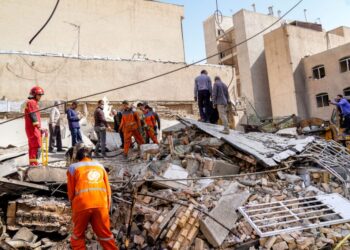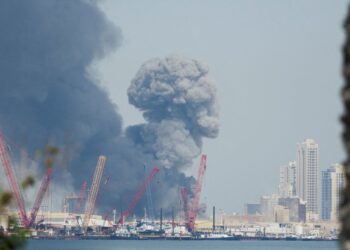
It was Friday night in Los Angeles when Sam Yebri’s phone started to light up with texts from friends and family. Explosions in Tehran, which is 11 ½ hours ahead of Los Angeles. Israeli ministers warning of Iran’s possible retaliation for U.S. and Israeli military strikes.
As the night wore on, a few messages became hundreds. By daybreak, they had become a blizzard, as the largest community of Iranians outside Iran absorbed the news that the government they had once fled was being attacked by their adopted country — and that Iran’s longtime leader, Ayatollah Ali Khamenei, had been killed.
“This is just a day that every Iranian has hoped and prayed for,” said Mr. Yebri, now a 44-year-old lawyer who was about one year old when his Jewish family fled persecution in their homeland. “It’s the beginning of the end of a 47-year hellish nightmare for the people of Iran.”
Some 150,000 Iranian-born Americans have settled in the Los Angeles area, according to census figures. One community in West Los Angeles, near the University of California, Los Angeles, has attracted so many Iranian exiles that it is colloquially known as “Tehrangeles.”
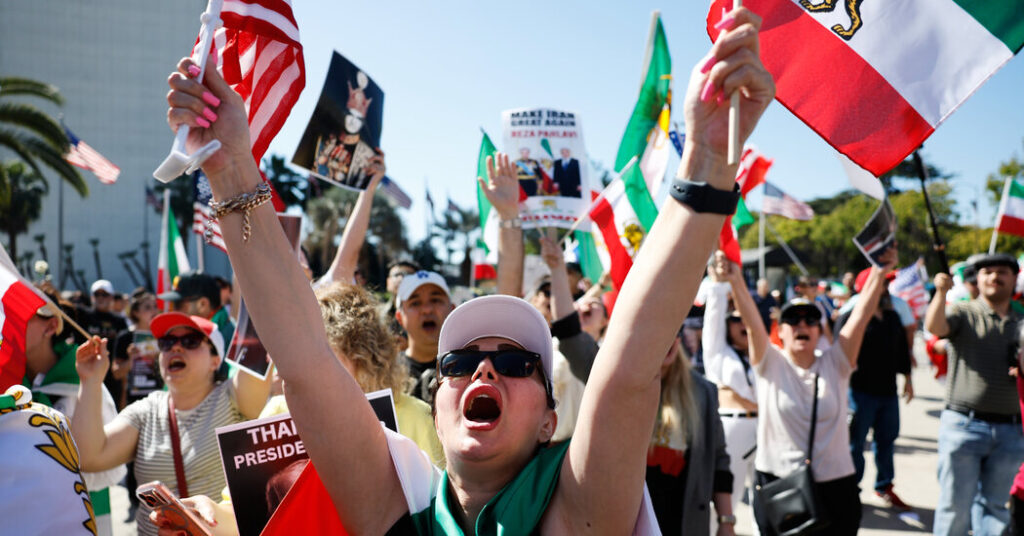
By noon on Saturday, Iranian-American demonstrators had gathered outside the federal building in West Los Angeles, blasting Iranian music and cheering. Green, white and red Iranian flags waved from the crowd and lined nearby sidewalks. As the rally swelled, hundreds of people marched through Westwood. Cars honked. People danced.
More than a half-million residents of the United States are at least partially of Iranian descent, according to census data. Many of them were members of oppressed minorities in Iran — Jews, Assyrians, Baha’i, Christians. Some fled after the overthrow in 1979 of the last shah of Iran, Mohammad Reza Pahlavi. Some were born in exile and have never set foot in Iran.
On Saturday, the news about the military strikes was felt acutely in Southern California. Many Iranian Americans said they had been texting since before dawn with Iranian-born relatives in other parts of the country or around the world, including in Israel, where loved ones huddled in shelters, braced for Iranian missiles.
“This is a global moment,” said Sharon S. Nazarian, 58, a political scientist at U.C.L.A. and local philanthropist whose Jewish family fled Iran when she was 10 amid death threats. “There’s a lot of fear, a lot of mixed emotion, but also a lot of hope. Our hearts are all shivering.”
Although Iranian Americans in Los Angeles have held frequent protests calling for the overthrow of the oppressive, religious government that runs Iran, some said on Saturday that they were worried about ordinary Iranians caught up in the bombing.
“There’s no question that you want this regime out, but at what human cost?” asked Adrin Nazarian, a Los Angeles city councilman whose Christian Armenian family fled Iran in 1981 and spent years moving from country to country before finally settling in the San Fernando Valley.
Mr. Nazarian said he was glad to see the Iranian government go, but horrified at the attack and worried about who might now take charge of the country. Years of sanctions had already weakened the regime nearly to the point of implosion, he said, and the military action by the United States and Israel seemed likely to create ambivalence among Iranians, who might now resent the outside meddling and the collateral damage.
“The citizens of Iran have already endured so much human loss and suffering,” he said. “And now, on top of that, the U.S. is bombing? We’re soon going find out about the losses from this attack as well.”
At Los Angeles synagogues, worshipers prayed on Saturday not only for the safety of Iranians and Israelis but also for American service members. Rabbi David Wolpe, the rabbi emeritus of Sinai Temple, a West Los Angeles synagogue where Iranian Jews make up about two-thirds of the congregation, said that many in the community were apprehensive but have long felt that “if it was at all possible to change the regime, that would be a blessing for the world.”
“They feel that this is what Iranians would want if they had the ability to do it,” he said. For two months, protesters in Iran have held large demonstrations against their government, and human rights advocates say that thousands of people have been killed.
Mayor Karen Bass of Los Angeles said that law enforcement agencies were closely monitoring for potential threats to public safety and that Los Angeles police had stepped up patrols near places of worship, community spaces and other areas of the city. She encouraged demonstrators to remain peaceful.
Democratic leaders in California expressed support for Iranian Americans, but condemned the assault and the Trump administration.
“At a time when millions of hardworking families face higher costs of living and skyrocketing health care to pay for tax breaks for billionaires, Donald Trump is now pushing the country toward a war that risks American lives without presenting a clear justification to the American people or any plan to prevent escalation and chaos in the region,” Senator Alex Padilla, who grew up in Los Angeles, said in a statement.
Gov. Gavin Newsom said on X that while “the leadership of Iran must go,” President Trump was “engaging in an illegal, dangerous war.”
For some Iranian Americans, however, the moment was less about domestic politics than the possible end of a painful era.
“There is the feeling that you have not been breathing for 47 years,” said Ms. Nazarian, the political scientist. “And now you can breathe.”
Carmel Lastra, 42, who does digital marketing for real estate companies in Southern California, said that she had grown up listening to her Iranian-born grandmother “curse the regime” that had sent her and Ms. Lastra’s parents into exile. But she noted that her grandmother also told tales of Iran’s beauty and yearned to return someday.
Now, Ms. Lastra said, she might be able to go see what her grandmother so loved about her home country.
“I have her memories in my head,” she said. “I’ve always wanted to go to Iran.”
Shawn Hubler is The Times’s Los Angeles bureau chief, reporting on the news, trends and personalities of Southern California.
The post Iranian Americans in L.A. Find Hope in U.S.-Israeli Strikes on Iran appeared first on New York Times.