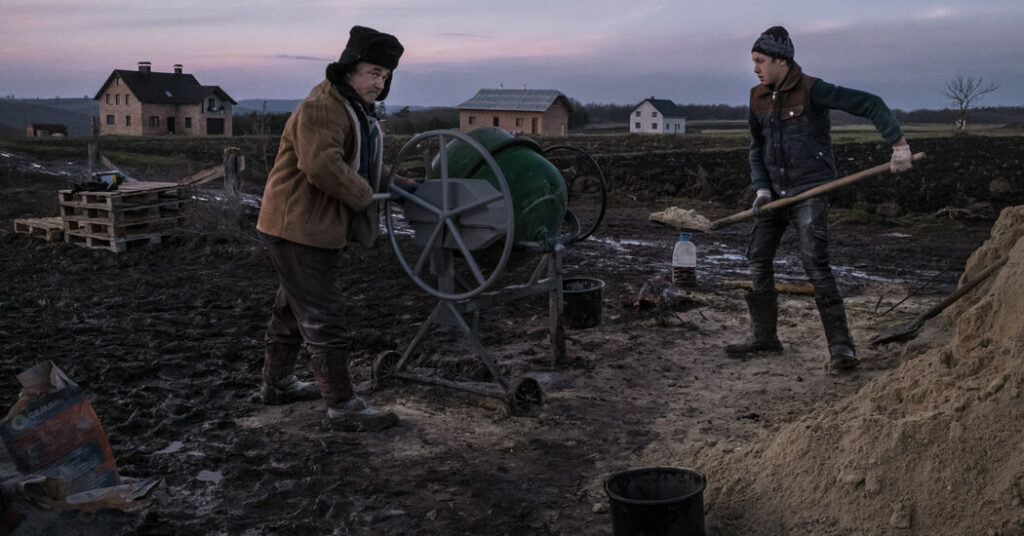
On the outskirts of Kosmyryn, a village in western Ukraine, several men poured the foundation for a house. They used hand tools — shovels, wheelbarrows, a manual cement mixer. No engines, no electric cables.
They let themselves be photographed, which is rare. Most members of their Christian community shun images of any kind. Their homes contain no pictures or icons. They believe that creating images of people, or of God, violates the Second Commandment and distracts from the true faith.
They call themselves simple believers — viruiuchi prostaky, in Ukrainian — or just believers. They strive to live by biblical law and remain apart from the modern world. Its members’ houses have no electricity, and instead of cars they use horses and wagons.
The group focuses on faith, prayer and a strict adherence to Scripture, said Vasyl Rashydov, 60, one of its informal leaders. Some innovations, however, have taken root. Their homes now glow with lamps powered by solar panels, not kerosene, and they use old flip phones “because they’re only for words,” Mr. Rashydov said.
Members of the community, which is estimated to number about 2,000, are known in their villages as kashketnyky, a reference to the flat caps many of the men wear. Some villagers mistakenly call them Amish. The women are recognizable by their head scarves; married women tie them in the back, often over a neatly coiled bun. Unmarried women may also tie them in front, but they always leave one corner loose.
Gender roles are clearly defined. Men work, build homes for their large families and provide for them. Married women rarely work outside the household. Once married, many give birth almost every year, devoting themselves entirely to children and the home. Women take part in communal prayer alongside men and some say they view their responsibilities as an essential part of the community’s way of life rather than as an imposed burden.
Volodymyr Moroz, a scholar who has studied the movement, said it emerged in the mid-1970s among Ukrainian Pentecostals. Its founder was a Kosmyryn man, Ivan Derkach, whose followers regard him as a prophet. He preached the rejection of electricity, machinery and urban culture as obstacles to spiritual purity, and he taught that women should bear children “as the earth bears fruit.” Mr. Derkach fathered 16 children, an example that is held up as a model.
There are practical benefits to big families. One of them, currently, is that fathers of three or more children under 18 are exempted from Ukraine’s mandatory military service. But an abundance of children can also bring challenges. In Kosmyryn and the nearby village of Stinka, schools are severely overcrowded.
“The situation in Kosmyryn is critical: The school was built for 180 students, but now more than 420 are enrolled,” said Ulyana Demyanchuk, the acting head of the Zolotyi Potik municipality, which includes four villages where members of the group live.
Local officials say the school, which does not have a dining room, needs more than $5 million for renovations and expansion, but Zolotyi Potik’s annual budget is only about $900,000. The national government is unlikely to provide the money, since its priority is the war.
For children, education usually ends after the ninth grade. Celebrations, concerts and participation in extracurricular school events are considered worldly distractions, incompatible with the community’s beliefs.
The believers live mostly in seven villages across the Ternopil and Ivano-Frankivsk regions of western Ukraine. In Kosmyryn and Stinka, they make up more than 70 percent of the population and set the rhythms of local life.
There are no churches, only prayer houses, which are ordinary buildings. “We gather for prayer on Sundays, and whenever there’s a need,” said Mykola Siyanchuk, 44, from the village of Snovydiv. In village cemeteries, graves are not marked by crosses or stones; they are mounds of earth, gradually covered by grass.
Mr. Siyanchuk and his wife, Olha, 34, married five years ago. Together, they are slowly restoring an old house and raising three children. They expect another child in the spring. For pregnancies, and for significant medical issues, members of the community consult doctors who use modern technology.
Raising multiple children, often with pregnancies close together, can be physically demanding. “God created woman and gave her the gift of bearing children, so I feel happy fulfilling this role,” Ms. Siyanchuk said.
On their one-acre plot, they maintain 20 beehives and grow fruit trees, corn, potatoes, grapes and watermelon. They produce almost everything they eat. The chickens that roam freely provide eggs and meat.
Like most men in the community, Mr. Siyanchuk works in construction.
When dusk falls over the village, Mr. Siyanchuk lights a lamp powered by a small solar panel, and the house fills with a soft, flickering glow. In the evening, the family gathers around the table to pray and share supper. Time here is measured less by clocks than by the rhythm of days, the blooming of fruit trees, the season of honey.
Yet even here, the war is never far away. All seven of the believers’ settlements lie along the Dniester Canyon. Russia uses the river valley to launch air attacks, sending its missiles and Shahed drones low over the water to evade Ukraine’s air defenses. Fragments of intercepted weapons sometimes fall in nearby villages.
On the night of Oct. 5, during the largest assault on the city of Lviv since the war began, there was an explosion so close that the windows of the Siyanchuks’ house rattled.
“At 7:30 in the morning, when I went out to the garden, I saw a Russian Shahed for the first time,” Mr. Siyanchuk said. “It was flying right over our village. That day we gathered in the prayer house to pray for Ukraine.”
The post In Ukraine, a Community of ‘Simple Believers’ Shuns the Modern World appeared first on New York Times.