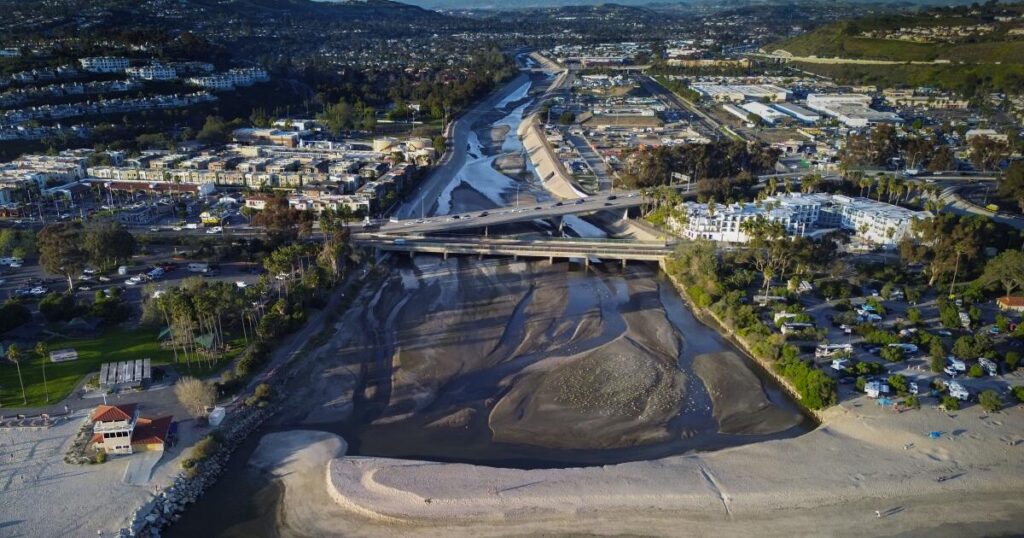
Residents concerned about the possible poisoning of Orange County waterways with herbicides have been making their voices heard on Instagram and pressured the county into holding a meeting on the issue Monday night.
Their effort has exposed tensions between people who see the waterways as natural creeks and county officials who see them as flood channels.
Brent Linas, a 41-year-old tech sales director in San Juan Capistrano, launched the Creek Team OC Instagram account after seeing changes on his runs along San Juan and Trabuco creeks. Lush green reeds in the channel had suddenly turned brown and lifeless, and birds had disappeared.
Linas said when county officials ignored and brushed aside his complaints, he and others turned to social media.
“We want an end to the use of herbicides in our creeks,” Linas said. “This idea that we’re just going to spray, hose down these creeks and leave them dead is unacceptable.”
The account has gained more than 4,600 followers in three weeks. Linas and other residents have filed requests for records detailing the chemicals the county uses to control vegetation in the waterways, such as glyphosate, triclopyr and imazapyr.
They have posted images of workers spraying chemicals and used artificial intelligence to make illustrations resembling movie posters and old-fashioned magazine ads, some with surfers under the slogan “Endless Herbicides.”
San Juan Creek meets the ocean beside the popular surf break at Doheny State Beach. Linas, who often takes his two kids there, said surfers are angry about the spraying and are helping make fliers.
Orange County Public Works officials defend their practices.
“Vegetation management in flood control channels is conducted to maintain flood protection capacity and protect public safety,” Dave Ahern, a spokesperson for the agency, said in an email. “When chemical treatments are used, they are applied in a limited and targeted manner, consistent with applicable regulations.”
The county will hold a town hall in Dana Point on Monday night to provide information and hear from the public.
County Supervisor Katrina Foley said she generally opposes using herbicides in waterways. Her district includes San Juan Capistrano, Dana Point and the flood control channels of San Juan Creek and Trabuco Creek.
“I would like us to use the least toxic alternative possible, wherever possible,” Foley said in an interview. At the same time, she said, the county must keep channels clear of vegetation and at full capacity to protect neighborhoods against flooding.
The county uses only herbicides approved by state water regulators and the federal Environmental Protection Agency, and crews do not spray during bird nesting season or when endangered Southern California steelhead trout may be swimming upstream to spawn, the supervisor said.
Documents obtained by the Creek Team detail chemicals used in 2024 to “eradicate nuisance weeds” in flood control channels, or “washes,” as many Southern Californians know them. They also show the county plans to spray herbicides on more than 2,000 acres in dozens of channels and basins this year, among them the Santa Ana River and Aliso Creek.
The State Water Resources Control Board regulates herbicide use on aquatic plants and grants permits with requirements for using these chemicals.
State records show that in 2024 the county violated rules by submitting data that was “incomplete, inaccurate, or inconsistent.” Orange County Public Works wrote that it was “conducting a thorough review” to ensure compliance.
The state water board allows glyphosate, the key ingredient in the herbicide Roundup, to be used on plants in waterways.
The weedkiller has come under increasing scrutiny as Bayer, Roundup’s maker, has faced thousands of lawsuits alleging it failed to warn people it could cause cancer. (In February, the company announced a proposed $7.25-billion settlement to resolve thousands of suits by cancer patients. President Trump’s recent order to increase domestic production of glyphosate has angered activists who previously supported him.)
Supervisor Foley said she learned the county used Roundup in San Juan Creek about a year ago and made a complaint. She said the county has not used that chemical since January 2025 in the San Juan and Trabuco flood channels.
A record obtained by residents shows that in July, workers sprayed different herbicides in San Juan Creek, including triclopyr and imazapyr. Totaling the gallons listed, Linas calculated they sprayed 8 tons — a figure he has repeatedly used in the campaign with the demand “Stop the Ecocide!”
Foley said it was actually 34 pounds of herbicide “diluted with 8 tons of water,” and that officials are trying to use the “least amount” possible. She is pushing the county to consider alternatives, including perhaps hand weeding or even grazing goats.
“My goal is to try to find every possible way that we can avoid using chemicals,” she said.
However, she doesn’t see the washes as natural creeks.
“The purpose of the channel is not to hold habitat,” she said. “The purpose of the channel is to accommodate water during a flood.”
Linas disagrees. He previously lived for years in San Diego County, where he ran along waterways teeming with birds among reeds, willows and sycamores.
In a post that garnered more than 17,000 likes, Linas asked: “Why do Orange County’s rivers look like this when San Diego’s rivers look like this?” He showed a barren creekbed filled with cobbles, then a green wetland filled with ducks.
San Diego County “lets rivers be rivers and ecosystems manage themselves,” Linas said. (A spokesperson confirmed that San Diego County Public Works manages vegetation in waterways by hand or using equipment.)
Linas said the spraying is “destroying these vital ecosystems” and posing health threats for people who live nearby. At a minimum, he said, the county needs to notify the public when workers are going to spray.
The post Fear that herbicides are poisoning Orange County creeks blows up on social media appeared first on Los Angeles Times.