One of Jeffrey Epstein’s most secretive and least scrutinized former properties is not an island. But it might as well be.
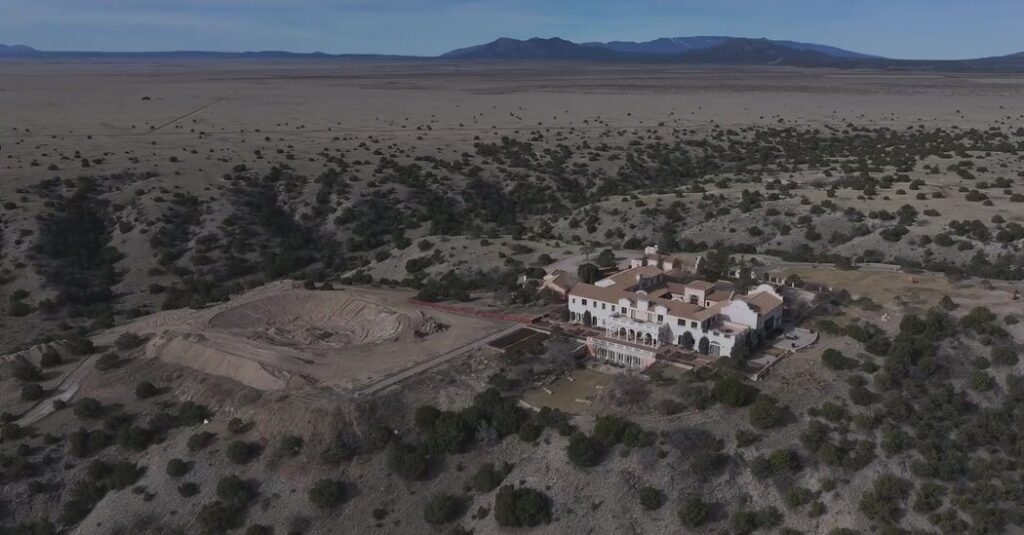
His palatial 30,000-square-foot New Mexico mansion sits on a ridge overlooking thousands of acres of southwestern land he named Zorro Ranch. A sea of tufted grass, prickly cholla cactus and cracked arroyos, the sparsely populated high desert south of Santa Fe is a land where the nearest neighbors are miles away and most everyone minds their own business.
Some of the financier’s victims have said they were trafficked there, famous figures visited, and Mr. Epstein mused about turning Zorro into a headquarters for outlandish genetic engineering experiments.
And yet, New Mexico leaders say there has never been a thorough investigation of the criminal activity that may have occurred at the ranch during the 26 years the convicted sex offender owned it. A state-led inquiry into Mr. Epstein’s actions was taken over by federal prosecutors in 2019, and then apparently fizzled, according to New Mexico officials and recently unsealed records.
“Not only has it been overshadowed, it’s been completely ignored,” said Eddy Aragon, an Albuquerque radio D.J. who has spent years researching Mr. Epstein’s activities.
He checked off the other corners of Mr. Epstein’s empire that have been scoured, such as Little St. James, the notorious private island hide-out in the Caribbean. “Everyone was paying attention to Paris, Little St. James, New York and Miami, but they didn’t pay attention to Zorro Ranch.”
Last month, lawmakers in New Mexico, spurred by the Justice Department’s latest release of Epstein documents, voted unanimously to change that, impaneling a bipartisan four-member “truth commission” in the State Legislature, equipped with subpoena power, to probe the sordid history of Zorro Ranch. The state’s attorney general also announced he would reopen an investigation his office had closed shortly before Mr. Epstein’s death in 2019.
“We need to find out how he was able to operate without any accountability,” said Andrea Romero, a New Mexico state representative from Santa Fe who is leading the truth commission. “We have to understand what allowed this to happen.”
That won’t be easy. Since Mr. Epstein’s death, the property has changed hands, potentially complicating the state’s investigation. The new owner, a Dallas real estate magnate and former state senator named Don Huffines, is running for comptroller of Texas, an inopportune moment for investigators, though he has said he would cooperate with law enforcement.
But the unverified claims in the documents have proved impossible to ignore. An anonymous tip from someone who claimed to have worked at the ranch said Mr. Epstein concealed the deaths of two abused girls by ordering them to be buried in the hills outside the ranch. It is unclear whether the F.B.I. ever looked into the tip.
The files also included correspondence between Mr. Epstein’s lawyers and federal prosecutors indicating that investigators had not searched the ranch as of December 2019.
The F.B.I. declined to comment on the tip or to say whether the New Mexico property had been searched.
The year of Mr. Epstein’s death, 2019, was also the year the trail went cold in the high desert. As the criminal case against Mr. Epstein gained momentum, the New Mexico attorney general’s office was interviewing witnesses about his possible wrongdoing locally.
But federal prosecutors in the Southern District of New York asked the state authorities to stop their work and share all they had found with federal officials, according to Hector Balderas, a former New Mexico attorney general, and recently released emails. The prosecutors believed their case would be stronger if they led the investigation, Mr. Balderas recalled.
But a year later, he decided federal authorities were not being aggressive enough, and his office sent a letter urging them to seize Mr. Epstein’s New Mexico assets.
“We believe that this ranch was used by Epstein and others to facilitate the commission and prolonged concealment of his trafficking of children,” the letter read.
Mr. Balderas did not receive a reply. The Southern District of New York directed a request for comment to the Justice Department, which did not respond.
“There should have been more convictions that were tied to conduct in New Mexico,” Mr. Balderas said.
The tip about buried bodies was originally sent in 2019 to Mr. Aragon, who said he alerted local authorities. He never heard back.
But the Land of Enchantment, as New Mexico calls itself, has long held its secrets close.
In the 1940s, the U.S. Army Corps of Engineers chose a mesa called Los Alamos for its covert Manhattan Project. Researchers detonated the first-ever atomic bomb on a missile range outside the city of Alamogordo and concealed it for weeks.
In recent decades, the rich and famous have flocked there to purchase vast tracts of remote land surrounded by stunning scenery and few other people. Asked how Zorro Ranch could have avoided scrutiny for so long, several residents replied, “It’s New Mexico.”
Mr. Epstein purchased the ranch near the town of Stanley in 1993 from the family of a three-time New Mexico governor, Bruce King, linking himself with the state’s political elite as he did elsewhere. With small living quarters and little else to work with, Mr. Epstein started major construction projects.
Jim Sloan, an artist and longtime resident of the area, turned down work on Zorro Ranch in the 1990s rather than sign a nondisclosure agreement.
“It just seemed fishy to me,” said Mr. Sloan, 90, who lives in Galisteo, about 10 miles north of the ranch.
The sprawling compound would eventually include a private runway, a helicopter pad, an airplane hangar for his personal jet and a mansion believed to be the largest in the state. Barbed-wire fencing lined the outskirts, and hidden cameras recorded comings and goings.
Residents of the rural towns nearby saw the mansion’s glaring lights at night and the frequent air traffic, but most did not know who lived there or what was going on inside.
“New Mexicans, we pretty much leave people alone,” said Mike Anaya, 62, a former county commissioner who was born and raised in Galisteo. “That’s why movie stars like to come to Santa Fe. Nobody bothers them.”
Mr. Anaya and his partner, Kevan Saunders, can see Mr. Epstein’s former home from their small horse ranch, an unsettling scar on the magnificent vista.
“Here we were, so close, and we knew nothing,” Ms. Saunders, 59, said. “It’s creepy.”
Today, New Mexico officials say Mr. Epstein appeared drawn to their state for several reasons.
Along with the King family, Mr. Epstein’s powerful connections included Bill Richardson, another former governor of New Mexico, United Nations ambassador and energy secretary, who died in 2023. New Mexico also has more lenient sex offender registry laws, which allowed Mr. Epstein to avoid registration after pleading guilty to felony sex crimes in Florida.
Then, there was geography. In addition to Zorro Ranch, Mr. Epstein leased about 1,200 acres of public land adjacent to it, ostensibly for grazing. Instead, he used it to further buffer illicit activity, said Stephanie Garcia Richard, New Mexico’s public lands commissioner, who canceled the contracts in 2019.
“I feel like New Mexico was chosen specifically because of its obscurity,” Ms. Garcia Richard said.
Ms. Romero, the state representative, is concerned that potential evidence may have been lost since Mr. Epstein’s death and the property’s sale in 2023.
Mr. Huffines, the new owner, said recently that he was planning to turn the property into a Christian retreat. Law enforcement had not contacted him about getting access to the premises, he said, but he would comply if they did.
Mr. Huffines has renamed the place San Rafael Ranch, after the patron saint of healing. He is building a new front gate, and when it is complete, he said, the stone arch above the entrance will read: “Blessed are those who come in the name of the Lord.”
Reis Thebault is a Phoenix-based reporter for The Times, covering the American Southwest.
The post Epstein’s New Mexico Ranch Gets Scrutiny at Last. It May Be Too Late. appeared first on New York Times.