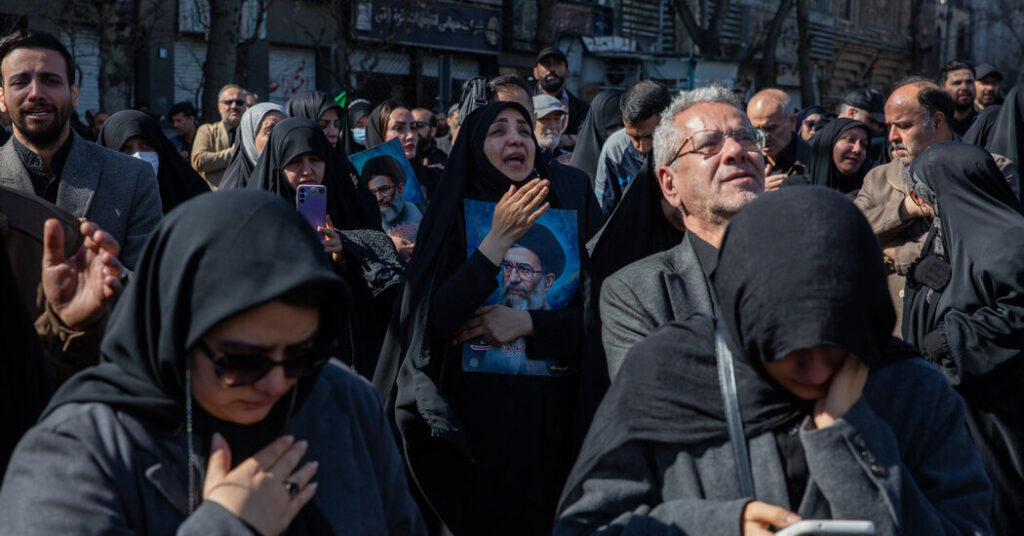
The death of Iran’s supreme leader, Ayatollah Ali Khamenei, is a watershed moment in the 47-year existence of the Islamic Republic. The scenes that followed — throngs of Iranians taking to the streets to celebrate, others turning out to grieve — signal the deep uncertainty about what comes next.
There are now three key questions: How will protesters respond to President Trump’s call to take over the government? Can Iran’s authoritarian system survive? And could the attack unleash a chaotic battle for power?
Mr. Trump and Israel’s prime minister, Benjamin Netanyahu, have made public appeals to Iran’s people, arguing that they have offered them a historic opportunity to topple their brutal authoritarian government. How they envision an unarmed population facing down a heavily armed, ideologically driven security force is less clear.
Though it has been only two days of strikes, some regional experts are skeptical that an aerial campaign alone could weaken Iran’s government enough that Iranians could bring it down with protests.
Nonetheless, Iran is headed toward a transformative moment, said Farzan Sabet, an analyst on Iran and Middle East politics at the Geneva Graduate Institute in Switzerland.
“Some kind of change will happen in the system,” he said. “But in which direction? We don’t know.”
Could Iranian protesters topple their government?
In some ways, Iranians are ever more defiant after facing a brutal crackdown on nationwide antigovernment protests in January, in which security forces killed thousands. As the violent repression subsided, the risks were still high even before the bombardment began. Yet students still protested and held sit-ins, and the families of slain protesters used their memorial services to voice dissent.
After the authorities confirmed Ayatollah Khamenei’s death in the attack, many Iranians dared to celebrate publicly — but not to the point of risking bloodshed.
Arian, a resident of a suburb near Tehran, described seeing people “honking in the streets, shouting chants from windows.” Like all people interviewed inside the country, he asked to withhold his full name for fear of retaliation.
On Sunday morning, Arian said, he saw people dancing and singing in the streets — until they noticed the arrival of armed members of Iran’s Basij, the volunteer militia force aligned with Iran’s Revolutionary Guards. “When the Basij showed up, everyone got scared and quickly scattered,” he said.
Even under aerial bombardment, Iran’s domestic security apparatus was still making a show of force. Basij forces, estimated to be around one million strong around the country, have already been mobilized around the capital.
“The brutal killing of protesters in January suggests domestic unrest will be met with an iron fist,” said Ellie Geranmayeh, deputy head of the Middle East and North Africa program at the European Council on Foreign Relations. “This time under far harsher wartime conditions.”
Some airstrikes have begun to target Basij and intelligence headquarters, but experts are divided as to whether airstrikes can inflict enough damage to weaken a deeply entrenched and complex network of security forces across such a large country.
“The problem is these are very multilayered targets,” said Abdolrasool Divsallar, an Iran expert at the Catholic University of Milan. “You hit one, but there are so many others. I am not sure how long it can be sustained, munitions wise.”
Could Iran’s current regime survive?
Even as strikes wiped out several of Iran’s top political and military leaders, official statements went to great lengths to show the system was prepared for the shock and still functioning.
After Ayatollah Khamenei’s death, Iranian officials announced that the government would follow the constitutional framework for selecting the country’s next leader, and that a temporary leadership council would be formed.
Ali Larijani, the head of Iran’s Supreme National Security Council who is seen as the de facto leader behind the scenes, stressed that idea in televised comments urging unity after the ayatollah’s death.
“Throughout history, the Iranian nation has faced even greater challenges; even the Mongols plowed through the entire country, yet the people stood firm and defended their land,” he said. “Such martyrdoms make people resistant and steadfast.”
But the system could undergo a transformation from within. Mr. Larijani, seen as a pragmatist, is the type of figure observers say could potentially strike a deal with Washington now that Iran’s more ideologically driven supreme leader is gone.
Some ordinary Iranians said that such a deal, if accompanied by an easing of international sanctions on Iran, may be palatable to many residents who have suffered through so many months of instability and a collapsing economy.
“Most people aren’t chasing deep meaning,” said Payman, 45, a businessman in Tehran. “They just want a normal life: family, work, small goals. If that becomes possible, a lot of people might stop pushing for bigger change.”
But there is also the possibility Iran’s new leaders would turn the state in the opposite direction — making it even more radical. “The risk is that the more hard-line figures emerge,” Mr. Divsallar said.
The fact that the leadership change was brought about by American and Israeli attacks increases that possibility, he said. “That works completely against what people wished for,” he said.
Experts point to several appointments that could tip a transition in this direction.
Two of the members of Iran’s interim leadership council are hard-liners. One of them, Ayatollah Alireza Arafi, is from Iran’s Council of Guardians, a powerful group of jurists. The other is Gholam-Hossein Mohseni-Eje’i, the head of the judiciary. The third member, President Masoud Pezeshkian, is a moderate, but had been largely sidelined before the war.
Another bellwether is the reported appointment of Gen. Ahmad Vahidi to lead the Revolutionary Guards.
“He’s an incredibly brutal person. So I think they’re not going to hesitate to use extreme violence,” said Mr. Sabet, of the Geneva Graduate Institute.
Could Iran descend into chaos?
Beyond toppling or transforming Iran’s current system is the possibility that the war unleashes chaos in a country of 90 million people that borders seven countries.
There are many potential opponents who could use violence to challenge a weakened state. Some ethnic minorities, like the Kurds and the Baluchis, already have armed opposition groups.
Mustafa Hijri, the leader of the Kurdistan Democratic Party in Iran, said that his organization was part of an alliance of groups from Iran’s ethnic minorities, and that among them were parties that “when necessary, may engage in armed resistance as part of their struggle.”
Officials from two Kurdish groups in exile, who asked not to be identified, said they were planning on trying to restart operations inside the country, aiming to encourage an uprising in Iran’s Kurdish region.
Even before the war started, many Iranians were bemoaning the increasingly polarized state of the country in the wake of the brutal crackdowns on the protests.
The government retains an ideological and religious support base that, in the current war, would be highly motivated to fight back against perceived threats. That raises the possibility of internal fragmentation and violence that spills beyond Iran’s borders.
On Sunday, Ayatollah Naser Makarem Shirazi, an influential cleric in Iran, called for jihad against Israel and the United States, according to remarks published in the semiofficial Mehr news agency.
All of these factors create a growing risk of a dangerous insurgency should the state collapse, similar to the insurgency that broke out in Iraq after U.S. forces invaded it in 2003, said Ms. Geranmayeh, the analyst.
“This is a holy war for them — and they seem willing to burn down the country and region before surrendering,” she said. “If this air campaign succeeds in toppling Iran’s leadership, years of chaos probably lie ahead for the country and its people.”
Leily Nikounazar and Falih Hassan Hassan contributed reporting.
The post Big Change Seems Certain in Iran. What Kind Is the Question. appeared first on New York Times.