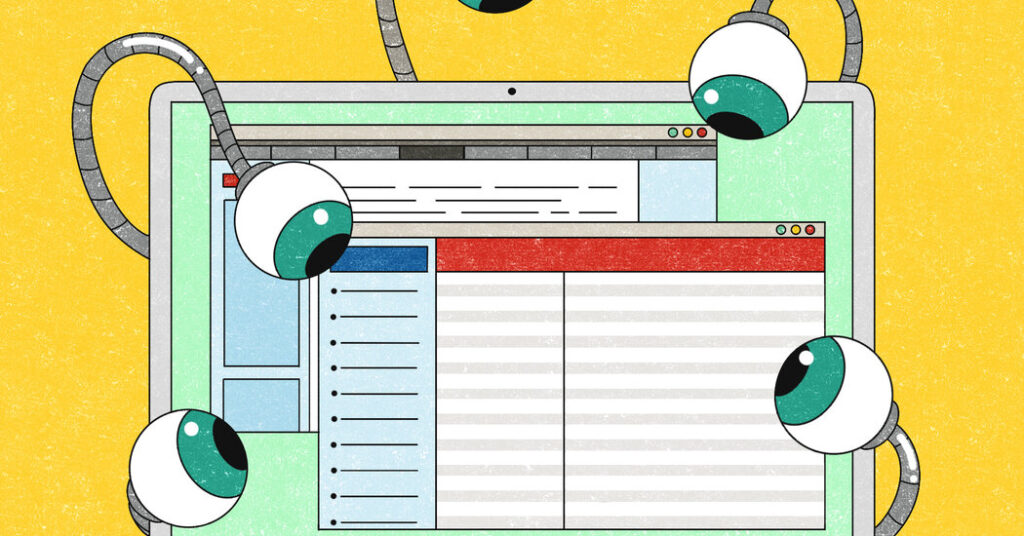
While many workers worry that artificial intelligence will one day take their jobs, another use of A.I. and technology may already be quietly reshaping and degrading workplace conditions: “bossware.”
“Bossware” refers to the technology some managers use to supervise and surveil employees in the workplace. The term was popularized by a 2020 report from the Electronic Frontier Foundation, a digital privacy nonprofit, and has since come up in nonprofit reports and news coverage.
“Workplace surveillance has been going on since we’ve had work,” said Karen Levy, a professor at Cornell and the author of “Data Driven: Truckers, Technology, and the New Workplace Surveillance.” Managers have always sought to keep an eye on employees to make operations more efficient. But the rise of A.I., she said, has allowed employers to monitor workers in “more predictive or granular ways.”
How it’s pronounced
/bäs-wer/
In the world of trucking, for example, A.I.-augmented video tools can trigger real-time alerts if a driver looks fatigued or is looking away from the road. In other fields —including in some white-collar desk jobs — employers are using algorithmic and biometric tools to track habits and output. Some of the tools, including A.I.-driven ones, are packaged with enterprise software suites.
The use of work-surveillance technology took off during the pandemic. As many people started working remotely, more employers began surveilling their teams in new ways: tracking keyboard strokes, taking screenshots and monitoring pauses. By 2022, eight of the 10 biggest private employers in the United States were tracking the productivity metrics of individual workers, The New York Times reported.
Over the past few years, “A.I. has helped to create a greater opportunity for omnipresent surveillance of workers,” said Rob Reich, a professor of political science at Stanford and a co-author of “System Error: Where Big Tech Went Wrong and How We Can Reboot.” Sophisticated A.I. tools are now available more cheaply, he said, which means they can be applied more broadly. Surveillance tools are now used in factories and in corporate offices; they monitor customer service agents, therapists and even chaplains.
The goal of these tools is to get more out of workers. But some metrics — like how much an employee is typing — may not translate cleanly to how much work someone is actually getting done. And workers, Dr. Reich argues, deserve periods of slack and “moments of downtime outside of the gaze of the surveillance tools that are meant to drive productivity gains.” Such respites are good for workplace culture, he said, and they enable better workplace relationships.
Beyond the psychological toll, “bossware” tools that push people to work faster and harder present “serious health and safety risks for workers,” including potential physical injury, said Laura Padin, a lawyer and director at the National Employment Law Project, a workers’ rights nonprofit. She added that clear guardrails on worker surveillance and laws requiring companies to disclose how they use such technology would be “good policy interventions.”
The tools, Dr. Levy said, are unpopular because they impinge on workers’ well-being — and, in the case of truckers, her research has found, they don’t necessarily improve safety.
“Giving workers more autonomy in the workplace can help with retention and their capacity to do more creative work,” Dr. Levy said, adding that getting worker buy-in around which technologies would actually be useful to them could help workplaces achieve a better balance.
Still, Dr. Reich thinks that even well-intentioned monitoring tools should be viewed cautiously because they may help advance a culture of surveillance. “It’s obvious that the introduction of ‘bossware’ further tilts the power imbalance between supervisors and workers in favor of those with already considerably more power,” he said.
The post Are ‘Bossware’ Tools Tracking You? appeared first on New York Times.