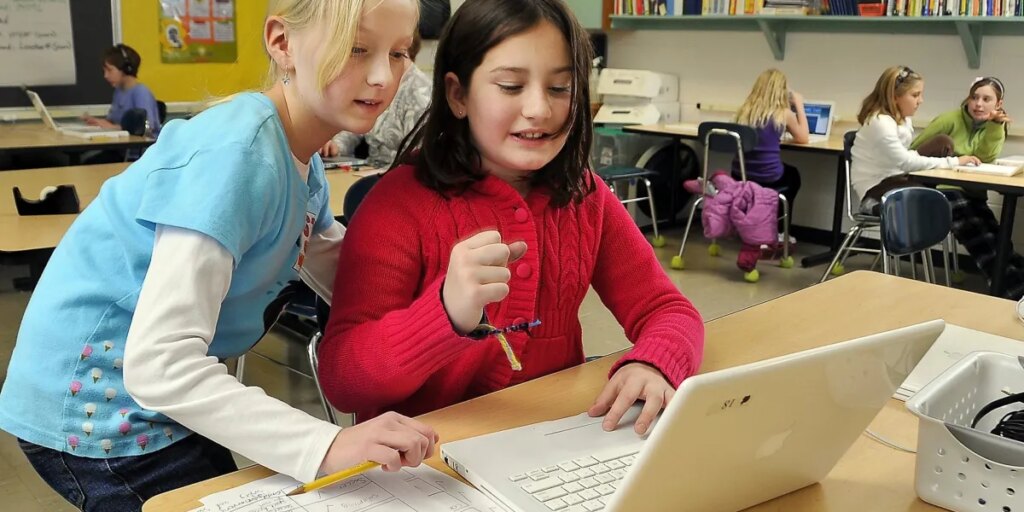
For more than a decade, a trend has emerged in standardized testing data for students in Utah. After years of increasing reading and math scores, results from the state’s National Assessment of Educational Progress testing for 4th and 8th graders have shown a steady and continuing downturn.
Neuroscientist and former teacher Jared Cooney Horvath noticed the inflection point of this data coincided with the implementation of Student Assessment of Growth and Excellence (SAGE), the state’s first computer-adaptive test.
“Before 2014, computers were in schools, they were just peripheral,” Horvath told Fortune. “After 2014, every school had to have digital infrastructure in order to take the state assessment.”
According to Horvath, author of the 2025 book “The Digital Delusion: How Classroom Technology Harms Our Kids’ Learning—And How To Help Them Thrive Again,” Utah’s test score data isn’t a fluke; it’s part of a global trend of plummeting test scores that have coincided with the rise of easy access to computers and tablets in the classroom.
Earlier this year, Horvath testified before the U.S. Senate Committee on Commerce, Science, and Transportation, arguing the technology’s impact on more than just test scores, but on the cognitive capabilities they are intended to measure. He said that for the first time in modern history, today’s generation has failed to outperform their parents on standardized assessments. In other words, Gen Z is the first generation to be less cognitively capable than their predecessors.
Citing data from the Program for International Student Assessment taken from 15-year-olds around the world, Horvath revealed it’s not just a dip in test scores, but also a correlation between these slumping scores and how much time students spend on computers, such that more time in front of screens was associated with worse scores.
Technology was put in schools in a bid to help them learn. Instead, Horvath said, they had an adverse impact on learning.
Horvath blames educational technology (EdTech) for these atrophying skillsets, arguing that at the turn of the 21th century and through its first decade and a half, tech companies and advocates pushed a false narrative that the education system was broken, but computers could fix it. Instead, Horvath said, the plan backfired.
“This is not a debate about rejecting technology,” Horvath said in his testimony. “It is a question of aligning educational tools with how human learning actually works. Evidence indicates that indiscriminate digital expansion has weakened learning environments rather than strengthened them.”
The rise of EdTech
EdTech found its roots in U.S. schools in 2002, when Maine became the first state to implement a statewide laptop program in some elementary and middle schools. In its first year, the Maine Learning Technology Initiative distributed 17,000 Apple laptops to seventh graders across 243 schools. By 2016, 66,000 Maine students had laptops and tablets.
By 2024, the U.S. had spent more than $30 billion putting screens in classrooms, with school districts making deals to buy tech at a discounted rate. A Florida state appropriations report from 2003 noted a four-year, $37.2 million lease from Henrico County, Virginia, for 23,000 Apple computers for high school students. Oklahoma City Public Schools minted a $25 million contract with Dell for 10,000 laptops and wireless carts.
According to Horvath, these deals helped some tech giants find footing after shaky product launches, in particular Google. After the shaky rollout of its Chromebook, the low-cost computers with free Google apps found their way into schools and by 2017, accounted for more than half of digital devices sent to schools. Horvath claimed Google sold these laptops to schools to help it recoup costs on the product. Google did not respond to Fortune’s request for comment.
The snowballing of EdTech in classrooms was associated with an emerging narrative on how tech impacts learning, Horvath said. Education was broken, and computers could provide adaptability to students’ differing learning needs and with knowledge at their fingertips, students could be empowered to learn all by themselves.
To Horvath, these pushes toward screens in classrooms was an attempt to solve a problem that did not exist. At the turn of the century, achievement gaps across race and gender were closing and test scores were rising, he said.
“Everything was looking good,” Horvath said. “So by what argument were they saying education was broken? There was no argument. They were just making it up to try and get people fomented to say, ‘I guess we need a new tool in there.’”
The transfer problem
A close look at the history of EdTech reveals criticisms of the pedagogy that go back nearly 100 years.
In the 1950s, legendary behaviorist B.F. Skinner debuted his version of a “teaching machine,” based on the 1924 invention of Ohio State University psychology professor Sidney Pressey. The contraption was loaded with a piece of paper with questions, and students pressed keys indicating the correct answer, at which point, another question would appear. Both Pressley and Skinner ran into similar problems, though, failing to implement the technology in schools. Educators weren’t convinced of the machine’s benefit, which prioritized individually paced learning not conducive to students of the same age moving through a grade level at the same time.
Later, in a letter to Skinner, Pressey would concede there was a massive pedagogical limitation to the device: Students learned how to master the machine, but not the subject matter.
“The reason they all quit was the transfer problem,” Horvath said. “They found that kids would be very good so long as they were using the tool, but as soon as they went off the tool, they couldn’t do it anymore.”
EdTech’s AI revolution
The results seem to follow, no matter what decade the technology is found in. Today’s teaching machines have taken the form of AI, and educators are once again concerned the technology will encourage students to master the use of bots at the expense of their own critical thinking and synthesis skills.
A Pew Research Center survey published this week found more than half of U.S. teens use AI for their schoolwork. A Brookings Institute report from January suggested students were abusing the technology, using it to cheat as opposed to really learning.
“Students can’t reason. They can’t think. They can’t solve problems,” said one teacher interviewed for the study.
Horvath was inclined to agree. He said the best learning happens where there is friction, or when a student needs to grapple with a problem and work through it. AI is most effective when experts use it, he argued. Someone with mastery of a skill knows how to deploy a certain AI tool and then fact check its output. A student, however, doesn’t have mastery and looks to AI only for shortcuts.
“The tools experts use to make their lives easier are not the tools children should use to learn how to become experts,” Horvath said. “When you use offloading tools that experts use to make their lives easier as a novice, as a student. You don’t learn the skill. You simply learn dependency.”
As schools begin to introduce AI literacy courses for their students, Horvath said there are ways for learners to develop a balanced relationship with the emerging technology. EdTech advocates have confused curriculum with pedagogy, he suggested. While curriculum refers to what is taught, pedagogy is how that material is taught. Instead of teaching students about computers—where technology would be in the curriculum—EdTech has become about teaching a subject matter through computers, a pedagogy that has shown it’s not effective.
“If you really want kids to be good at AI, continue to teach them stuff. Teach them math, teach them literacy, teach them numeracy, give them a general education,” Horvath said. “So when they’re older and experts, they can bring meaning to that machine and now use it to make their lives easier, as opposed to trying to help them figure out how the world works.”
The post American schools weren’t broken until Silicon Valley used a lie to convince them they were—now reading and math scores are plummeting appeared first on Fortune.