Times Insider explains who we are and what we do and delivers behind-the-scenes insights into how our journalism comes together.
Word traveled fast, from one hilltop to another.
El Mencho, Mexico’s most-wanted drug lord, had been killed in a military raid in a quiet wooded area of Tapalpa, in the coastal state of Jalisco. Jack Nicas, the Mexico City bureau chief for The New York Times, was on a hike when a source texted him the news. And 20 minutes later, he was in front of his computer, working on a story.
Covering a ruthless organization that publicly displays corpses and has assassinated Mexican officials isn’t for the faint of heart.
To better understand that work, I asked Jack and two other reporters who cover cartels — Maria Abi-Habib and Paulina Villegas — to share how they approached this news moment and the retaliatory violence that erupted across Mexico on Sunday. Lauren Katzenberg, an editor of the coverage, joined the conversation, which has been edited and condensed.
Let’s start with the moment you learned that Nemesio Oseguera Cervantes, known as El Mencho, the leader of the Jalisco New Generation Cartel, had been killed by Mexican forces.
JACK NICAS: A government official texted me with the simple message: “Mencho killed in defense operation.” I immediately started running down that mountain I was hiking (fortunately, it was a small one) and called Paulina on the way so she could get the story going until I got to a computer. We all knew this was huge news, and we locked in.
PAULINA VILLEGAS: I got a text from Jack: “Call me please asap” and then “Mencho is dead.” I stared at my phone, heart racing. I couldn’t believe that the ruthless leader who had caused so much death and devastation in my country was, in fact, dead.
I immediately started writing a few paragraphs based on what we knew, calling sources such as government officials and security analysts. When news this big breaks, it’s a scramble. You have to move fast, but you also have to get it right.
LAUREN KATZENBERG: It was a huge deal, given that the Jalisco New Generation Cartel is the biggest, most powerful cartel in Mexico. I handed off my baby to my husband and sat down at my computer — and didn’t get up again for about nine hours.
MARIA ABI-HABIB: I was making Sunday morning pancakes for my kids when my phone started pinging nonstop. The entire bureau was exchanging messages that El Mencho had been killed. Lauren called me, and we discussed analysis pieces I could write while Paulina and Jack covered the breaking news developments.
Now walk me through the first big step you each took.
KATZENBERG: Well, Step 1 is confirming the news and getting a story up quickly, even if it’s just two paragraphs. Then once we get through the initial blitz of reporting and publishing, I have to take a step back and decide how we’re going to divide and conquer this story from several angles.
NICAS: I created a group chat where we began communicating about the news coming out from Jalisco. At the start of a big breaking story like this, the first step is verifying the facts, so we’re looking for official statements and calling sources. At the same time, I began writing the story with the appropriate sweep to capture how big of a moment this was, putting it into context for readers.
VILLEGAS: We quickly started seeing images of violence on social media that showed masked men hijacking cars and torching stores, banks and other buildings. This was happening not only in the state of Jalisco but across the country.
I remember thinking that in all the years I have covered cartel violence, I had never seen such a swift, coordinated and widespread retaliation from the cartel, not even when other high-profile kingpins were captured.
NICAS: Right. The ferocity and scope of the cartel’s reaction became a big part of the story fast, so then we went about trying to gather and verify information about the damage. We were in a shared document dropping in reports of mayhem, including road blockades and burning banks, and our colleagues on Visual Investigations joined in to vet videos on social media to determine if they were real. Some of the stuff going viral turned out to be fabricated, but none of it made it into our report. (The Times did a separate investigation into the fake imagery and disinformation that caused undue panic around the country.)
VILLEGAS: It quickly became clear to me that one of us needed to be on the ground in Jalisco, the cartel’s stronghold and the epicenter of the unrest. I wanted to see for myself what was happening and how people were reacting, so I told Lauren that I wanted to go.
KATZENBERG: Paulina and I were on the phone and quickly decided she would go to Jalisco state. So Paulina had to both prepare for that trip, reporting-wise and security-wise, by working with our security team to make sure her plans on the ground were well-planned and safe. She and Jack would also stick with the story and keep reporting on Sunday afternoon and evening.
Then I called Maria and we talked about what this would mean for Mexico and for the cartel. Based on her deep reporting inside the cartels over the years, I knew she was the right person to put together that analysis for readers.
Next, I spoke to our colleagues on the Visual Investigations team. How could we help readers visualize the violence that seemed to be breaking out all over the country? Very quickly, they were pulling videos and working with graphics to map out where these retaliatory attacks were taking place.
ABI-HABIB: Once my colleagues had confirmed El Mencho’s death, I started thinking about what it would mean for the cartel. I used to cover terror groups in the Middle East, and although they are very, very different from cartels, their structure tends to be similar.
My first thought was: El Mencho’s death isn’t the end of the Jalisco Cartel. Cartels are sophisticated organizations that are run more like conglomerates. There is simply too much money at stake for the entire cartel to pack up and go home.
The Mexican military’s operation killing El Mencho set off a wave of violence. Locals were terrified; tourists were trapped. Describe the scene from where you were reporting, or from what you were seeing and hearing from people in the streets.
VILLEGAS: When I arrived in Guadalajara on Monday, just a day after the chaos, I was stunned to see the city — one of the biggest and nicest in the country, which I had visited dozens of times — had turned into a ghost town. The streets were completely empty. Businesses, offices, even small convenience stores were shuttered; some had been burned. Schools had canceled classes. Across the city, we found remnants of the violence.
Scenes around the city gave me flashbacks of a similar episode of violence that I had covered for The Times in 2019. Back then, cartel henchmen had laid siege to the city of Culiacán, in Sinaloa state, the stronghold of the Sinaloa Cartel. Scores of sicarios — hired assassins for the cartels — wreaked havoc and terrorized the city after Mexican forces had captured one of the sons of the infamous drug lord known as El Chapo.
Once I got to Guadalajara, I spoke to dozens of people about what they had experienced 24 hours before, which they described as a day of “horror.” Some were still processing what had happened. Others said they were still in shock. But, surprisingly, most people said they did not believe the death of El Mencho, this man known for his ruthlessness and use of extreme violence to co-opt and gain control of territory, would mean the end of his powerful criminal organization.
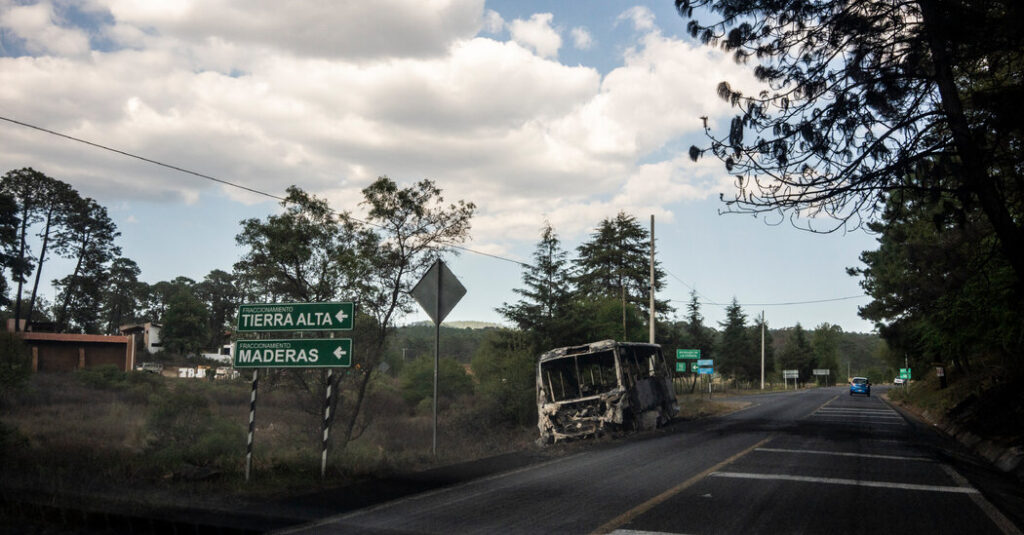
I also traveled to Tapalpa, the quiet mountain town where El Mencho had been located and killed, with my colleague César Rodríguez, a photographer. Along the way, the contrast really struck me: expansive blue agave fields and lush green hills interrupted by the blackened skeletons of trucks, buses and cars left along the highway from Guadalajara. At moments, it resembled images I had seen on TV and films from war zones, only this time it was my own country. And yet the landscape remained undeniably beautiful.
ABI-HABIB: A flood of images hit the internet — some fake, some real — of the violence. But those images and videos I determined were real told a story: This cartel can flex in multiple states at the same time.
While the Jalisco Cartel may not ring any bells for those outside of Mexico, its name here strikes absolute fear and panic. And for good reason: They were able to wreak havoc and mayhem in nearly a third of Mexico’s 31 states, from coast to coast, setting alight banks and storefronts and shutting down roads and highways.
NICAS: I remained in Mexico City to help steer coverage from here and meet with some key sources to understand what was behind the government’s calculus to take out El Mencho, what role did the United States play and what was Mexico’s strategy going forward.
Let’s step back to better understand reporting on the cartels. How does one cultivate sources deep within the cartel?
VILLEGAS: Covering security issues in Mexico for many years has meant that the work of finding and cultivating truly knowledgeable, reliable sources — particularly to report on cartel violence — is never-ending. The fact that I’ve done this for a long time has allowed me to build a roster of contacts, from law enforcement officials and local government authorities to security experts, crime reporters and others with direct, verifiable knowledge of how these groups operate. I must emphasize it has taken a long time to find and gain access to some of these sources, given the risk it implies talking to the press and being a crime reporter in Mexico.
Getting access to active cartel operatives and drug lords has, of course, been far more difficult. It has required significant time, energy and persistence, including dozens of trips to Sinaloa, the cartel’s stronghold, working with trusted local contacts and journalists and investing time in building trust by demonstrating that we are serious about hearing their side of the story.
Do you worry that someone talking to us from inside the cartel could be killed or harmed? Or try to use us to leak information that puts a target on someone else’s back? What happens if or when they get spooked?
KATZENBERG: The reporters go to extensive lengths to protect their sources’ identities. At the same time, we also have to exhaustively vet these sources, particularly if we are not naming them, to make sure what they are saying is true. We may choose not to identify a source if naming them puts them in danger, if they are a government official and aren’t authorized to speak to us, if the source is afraid of some kind of retaliation against them or their loved ones. This also goes for cartel members. They would obviously be in a lot of danger for speaking to a reporter, so we may grant anonymity, but we take a lot of steps to verify their accounts.
ABI-HABIB: What Lauren said. I have to run sources by top editors so they can verify whether they are real people.
VILLEGAS: I would be lying, and irresponsible, if I said I didn’t worry about the safety or consequences for someone who talks to me. That concern is always there. I balance it by taking every possible step to protect people who may be in danger, including ordinary citizens, and avoiding any details like their specific location, physical description or personal details about their background.
I also respect the conditions under which they agree to speak. The worry never fully disappears, but I accept it as part of the job, one that I believe is important and worth doing.
When a source tells you something, what steps go into verifying that information?
KATZENBERG: Without revealing identities, we take their accounts to security analysts and government officials to make sure they align with what the experts are seeing and what the government has documented. We look at reports issued by government agencies like the U.S. Bureau of Alcohol, Tobacco, Firearms and Explosives, and the Department of Homeland Security. We compare the answers that our sources give to the same questions to make sure their responses generally line up.
We think about why a source is speaking to us and what motivations they might have. We’ll talk through the interaction with the source in detail, how we found them, what we know about them, how they behaved and how they can prove who they say they are. It’s not just one conversation, it’s many. We push and ask questions until we’re confident that their identities and the information we’re putting in a story is factual.
VILLEGAS: Stories that involve interviews with cartel operatives require extensive additional reporting. We verify and fact-check their accounts with a wide range of other sources, including court documents, interviews with current and past law enforcement both in Mexico and the United States, government officials and experts who have covered and investigated this particular criminal group. There is also a long editing process that can take weeks or months.
NICAS: We also triangulate information to assess its veracity. When Paulina and I were in Sinaloa recently and spoke to multiple cartel members, we asked similar, neutral questions of each. When they all align on an answer, we feel a greater degree of confidence that it reflects reality.
What about the Mexican authorities, who announced recently that they had begun a new offensive against drug cartels?
NICAS: This is a key part of our work, and we talk to as many government officials as we can. But similarly, we also don’t take everything as truth. We ask how they know something, consider their motives and ask for proof or more details, and we corroborate it the same way, checking their accounts against documents, interviews with others and additional sources to see if what they tell us is true.
How do you stay safe when you’re out reporting?
KATZENBERG: Before any reporting trip, the first question is: What’s the risk? The second: Is the reporter comfortable with it? The Times does not — and will not — require anyone to take an assignment they feel is too dangerous.
Once we decide if the reporter is going, then they must put together a detailed plan of where they are going, who they are going with, what photographer is assigned to the story, where they are staying and what security precautions they are taking. If they have a driver or a car rental, who is that person and what’s the car make, model and license plate? Who are their emergency points of contact in the area they are going to? Then once the trip starts, we maintain groups chats where reporters check in with all of their movements and share their location as needed.
Our head of international security is a part of all of this and closely monitors the reporters’ movements. If a reporter is going somewhere risky, we have conversations about it to assess the risk versus the reward, make contingency plans and stay in constant contact.
ABI-HABIB: Lauren and our security team always have our backs and we are so lucky to have so much support. It is a costly endeavor, keeping reporters safe, and sadly a lot of media outlets don’t do this type of reporting anymore.
VILLEGAS: Totally agree. It makes a huge difference knowing you’re being looked after, that there’s a professional security team tracking our movements, helping us think through decisions on the spot and assessing risk in real time and guiding us through sticky situations.
Still, I have found myself in plenty of dicey situations that come with the territory. But, just like many other colleagues covering high-risk areas and in war zones, you accept the risk and the fear, even learn to get comfortable with it, and try to manage it the most responsible and smart way you can.
NICAS: One of the benefits we have is that sometimes it’s just us and a notebook. That allows us to be more agile and inconspicuous than, say, a TV crew. We also don’t spend more time in a dangerous place than we need to. We travel during the day when we can. We seek out locals to invite us into dangerous neighborhoods or situations. And we trust our gut if something feels off.
The Times includes bylines on stories about the cartel. Some news organizations do not. Why do we?
KATZENBERG: Sometimes The Times may not include a specific reporter’s byline if putting their name on a story puts them in danger. There are certainly times when as an institution The Times has had to make that decision, such as when we were reporting in Myanmar or from parts of Afghanistan where the Taliban could easily go after the local reporter. We take that decision very seriously, since building trust with our readers includes telling them who the reporter is and where they are reporting from, but we’ll never do that at the expense of someone’s safety.
VILLEGAS: I actually think that, somewhat ironically, having my name on cartel stories has been more useful than risky. The operatives I interview can and often do later read what I wrote and see that I didn’t distort their words or manipulate the facts — and that I kept my promise to protect their anonymity.
It also helps that they can look me up beforehand. Many of them do their own vetting before agreeing to speak, reading my previous work to understand who I am.
ABI-HABIB: I will explain to our security team or Lauren and other editors why it is worth taking certain risks. I hate it when reporters act like adrenaline junkies. It brings out the worst type of reporting and is not my thing whatsoever. I want to come home with a story but most importantly, alive, and definitely want anyone who is reporting with me to, as well.
I always worry the most for the local reporters we work with. It is one thing being an American reporter here in Mexico — the cartels don’t want that heat from the U.S. government, which may feel pressure to respond if we are kidnapped or killed. But cartels do go after local reporters. And they tend to be my biggest concern.
Cartels foster an environment of “machismo.” Paulina and Maria, does this ever get in the way of your reporting and if so, how do you circumnavigate that?
VILLEGAS: I think machismo runs deep in Mexico and across the region. It’s not confined to the underworld; it’s cultural, structural, sometimes so normalized it barely registers. I’ve felt it in interviews with cartel operatives, yes, but also with government officials and businessmen. The condescension, the offhand sexist remark, the subtle assumption that you’re less informed or less capable because you’re a woman. Sometimes it’s overt. More often it’s more subtle.
It has, at times, complicated my reporting. You walk into a room and have to manage not just the story, but the atmosphere. You learn to keep your composure, not burn energy reacting to every slight. Patience becomes key.
But sometimes you can turn this round. In the crime world especially, some cartel members, I believe, feel less threatened by a woman. The same bias that assumes you’re harmless can lower their guard just enough to make them more inclined to talk.
ABI-HABIB: I have to say I’ve been surprised by the machismo in Latin America as opposed to the Middle East. It has sometimes gotten in my way when I’m embedded with security forces here, like Mexican police or militaries in South America. But I just tell them I lived in Afghanistan and covered wars from Iraq to Libya and beyond, and they then tend to take me more seriously.
Maria, take us inside your previous work on sudden leadership changes like this?
ABI-HABIB: I’ve reported on power transitions within rebel and terror groups in the Middle East, which can be very similar in structure to cartels. But I have not covered cartel leadership changes until now. The story tends to be the same for both sets of groups, despite geographical and cultural differences. But one is driven by ideology, and the other by profit.
If there is a next of kin to take over, that tends to be the cleanest and clearest leadership change. That type of leadership change tends to go uncontested.
However, if no one was anointed by the group’s leader to carry the mantle, and there is no next of kin, then that is a much more messy power struggle. The commanders that had once surrounded the deceased or captured leader often go to war with one another for who gets to be the next boss. It is cannibalism from within; it could spell the end of the cartel. Or, one contestant may emerge victorious and, with blood-soaked hands, will lead the cartel, probably in a more vicious and bloodthirsty way than the previous boss did. Because internal power struggles bring out the most ruthless qualities in people.
The latter is how El Mencho got his start as the head of the Jalisco Cartel. He had been a member of the Milenio Cartel, which suffered from a spate of arrests and killings of its top bosses in 2008 and 2009. The cartel fractured, the remaining commanders going to war with one another. El Mencho was brutal in that war, and won out.
How could this death reverberate through Mexico, the drug trade and the United States?
KATZENBERG: I think the entire world is wondering what is going to happen next.
ABI-HABIB: The only thing that is seems clear is that El Mencho’s death is not the end of the Jalisco Cartel. Is there a successor? If so, why hasn’t he or she been named?
If there is no clear successor anointed by El Mencho, then maybe his commanders will agree among themselves to appoint one of them. Or they may launch a bloody internal struggle to claim the mantle, which may kill the cartel from within. Perhaps one commander emerges victorious and leads the cartel into a more bloody chapter.
Paulina Villegas is a reporter for The Times based in Mexico City, where she covers criminal organizations, the drug trade and other issues affecting the region.
The post ‘You Accept the Risk and the Fear’: What It Takes to Report on the Mexican Cartels appeared first on New York Times.