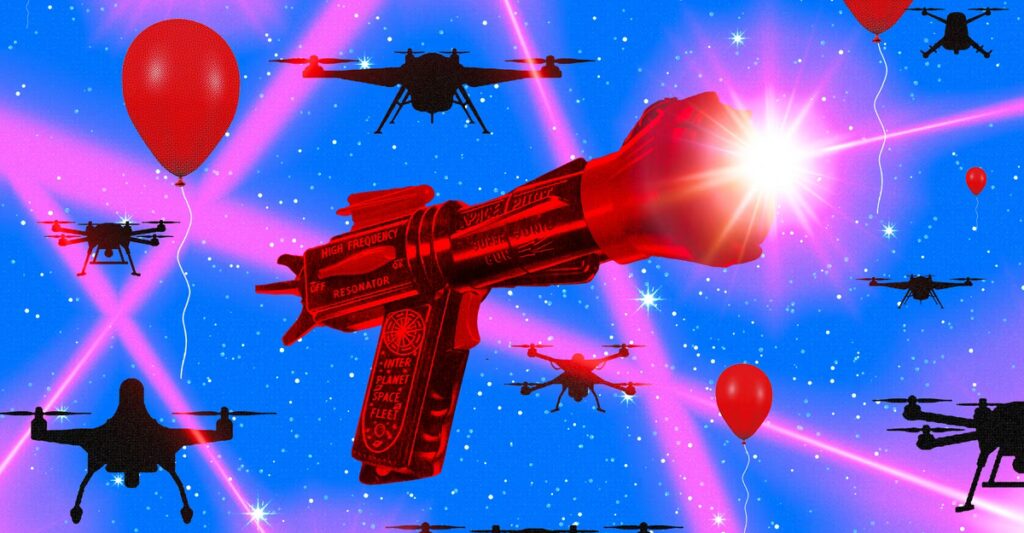
The headlines lately have verged on science fiction. A few weeks ago, my colleague Simon Shuster reported that the Ukrainian military had unveiled a new anti-drone laser weapon called the Sunray. On the very same day, American aviation officials abruptly shut down the airspace above El Paso, Texas, after Border Patrol agents in the area fired a laser of their own. Then, on Thursday, the U.S. military used a laser to take out a drone further down the Texas-Mexico border.
Much can be said about all of this: about the implications for the Ukrainian war effort, about the potential consequences for U.S. border policy, about the internecine conflict between the FAA and the Pentagon, and what that indicates about the distribution of power within the Trump administration. But focus too much on matters of geopolitics, and you can lose sight of something arguably even more profound: Laser guns are real now. Actual militaries are deploying actual lasers in actual combat. “This is a technology that has been under development for decades,” Iain Boyd, an aerospace engineer and the director of the University of Colorado Boulder Center for National Security Initiatives, told me. “And it’s only really now just really starting to enter the public view.”
Lasers have been a staple of sci-fi and children’s entertainment for well over a century. In H. G. Wells’s 1898 novel The War of the Worlds, the Martian invaders deploy heat rays. The crew of the starship Enterprise has been firing phaser guns since the 1960s, and the plot of the first Star Wars movie (several Star Wars movies, actually) centers on the race to destroy a planet-annihilating superlaser. When Buzz Lightyear crash-lands in Andy’s room at the beginning of Toy Story, the other toys are captivated by his (fake) laser gun. “It’s not a laser,” Woody says dismissively. “It’s a—it’s a little light bulb that blinks.”
[Simon Shuster: The new laser that can take down aircraft]
And what’s the difference? Laser is an acronym for Light Amplification by Stimulated Emission of Radiation. Light is shot into some material—it can be a solid, liquid, or gas, depending on the laser—in a way that causes the material to emit photons. A set of mirrors reflects the photons back at the material, which then emits more photons, which themselves reflect off the mirrors, and so on and so forth until that exponential cloning process creates a photon beam strong enough to pass through one of the mirrors. Put more simply, but also mysteriously, lasers exploit the quantum properties of atoms to amplify and streamline energy.
Whereas regular old light sources scatter light at all different wavelengths in all different directions, laser beams move at a single wavelength in a single direction. This property has been leveraged in mundane ways for decades. We entertain our pets with laser pointers. We use lasers to scan barcodes and survey landscapes. We drive cars assembled from laser-cut hunks of steel and aluminum, and the radios in those cars bombard us with advertisements for laser hair removal and laser eye surgery and laser skin resurfacing.
The difference between a harmless laser pointer and a deadly laser weapon is largely one of magnitude, not kind. In theory, if you combined a few hundred thousand laser pointers, you could create a weapon powerful enough to kill a person. In practice, though, the challenges of designing lasers powerful enough to do real damage has vexed engineers for the better part of a century. As early as the 1930s, the genius engineer Nikola Tesla was reported to have invented a “death ray” that could shoot down airplanes from 250 miles away. This “all-penetrating” weapon, he claimed, would fire 100 billion watts of energy at a point just one-hundred-millionth of a square centimeter in size. It would harness laws of physics that “no one has ever dreamed about.” It was preposterous—but this was Nikola Tesla. You couldn’t just dismiss him. And so during the early years of the Cold War, the United States launched a secret operation to complete Tesla’s unfinished work. Which failed. Later, the Reagan administration poured billions into its “Star Wars” program, with the goal of deploying space-based lasers to shoot incoming nukes. Which also failed. Beginning in 1996, the U.S. military spent $5 billion trying to equip 747s with missile-destroying lasers, but that project—formally known as Airborne Laser and colloquially known as the “Flying Lightsaber”—failed too.
Not until the 2000s did laser-weapons engineers start making serious progress. Earlier prototypes, Boyd said, had used massive tanks of toxic chemicals, which could generate huge amounts of power but were unwieldy for military purposes. Over time, as scientists devised ways to draw roughly commensurate amounts of power out of solid crystals, they were able to make the weapons small enough to ride aboard a truck or plane. But not so small as to allow for Star Wars–style handheld laser guns, Phillip Sprangle, a University of Maryland professor and former head of beam physics at the Naval Research Laboratory, told me. Those, he said, are still impossible given the size of the power source and cooling system you’d have to lug around.
By 2014, the technology had developed to the degree that the Navy could equip the USS Ponce with a laser weapon. But that weapon was never deployed in battle. In the years since, the laser fleet has grown, the Army has outfitted trucks with anti-drone lasers, and the Air Force has added ground-based lasers to its arsenal. Russia, China, and the United Kingdom are all developing—and in some cases already deploying—laser weapons, and last year, Israel became the first country to use a laser in combat to destroy a drone. In November, the U.S. military identified lasers as one of its six technological priorities.
Which brings us to the rollout of the Ukrainian Sunray laser and the two border incidents. In El Paso, Border Patrol officials fired their own anti-drone laser without giving the FAA sufficient notice—despite a top aviation official having warned the Pentagon that this would create “a grave risk of fatalities.” The supposed drug-cartel drone that Border Patrol shot down turned out to be a party balloon. And the “seemingly threatening” drone that the military shot down on Thursday turned out to belong to … Border Patrol.
The very real lasers now being deployed on battlefields around the world have some notable differences from most of their science-fictional forbears. They’re silent, for one thing—no pew pew sound effects—and the beam they produce is invisible. (Wells, to his credit, actually got this right in 1898.) This is why the drone in the demonstration that Shuster observed seemed to spontaneously combust, “as if struck by invisible lightning.”
[Ken Harbaugh: Ukraine’s most lethal soldiers]
Real lasers have a number of other advantages. For one thing, laser beams move at the speed of light, which is more than 200,000 times faster than the fastest bullets. The moment you fire one, it hits the target. (Impact is instantaneous, but the effects are not: Current anti-drone lasers must beam a target for a few seconds in order to destroy it.) Unlike conventional weapons, which eventually run out of ammunition, lasers are said to have an infinite magazine because all they need is a power source. This isn’t strictly true—we don’t say that electric cars have infinite batteries, after all—and although they don’t need to reload, Boyd told me, lasers give off so much heat that they regularly need to be cooled down. Still, $13 a shot is pretty good compared with the Navy’s standard missile interceptors, which cost $2 million apiece.
Another advantage of lasers is that they just keep going. Last year, Chinese scientists successfully beamed a precision non-weapon laser all the way to the moon. But infinite range is also a drawback. If a laser missed a drone, Boyd said, the beam could continue for hundreds of miles and hit, say, a commercial airliner. Hence the El Paso kerfuffle. Even if a laser beam did hit its target, Boyd said, its light could still scatter and cause all manner of collateral damage. Hit the wrong drone in the wrong place at the wrong angle, and you could end up blinding an unwitting bystander.
Novelists and filmmakers and their fictional creations never had to deal with concerns like these. Indeed, one wonders what H. G. Wells would make of laser-gun technology if he could see it now. Maybe he would be thrilled to see his vision finally realized. Or maybe he would be dismayed to find that humans had themselves created the weapons of destruction he had imagined being deployed by extraterrestrial invaders. Either way, he would surely be surprised to find them being used to shoot down balloons.
The post Wait—Laser Guns Are Real Now? appeared first on The Atlantic.