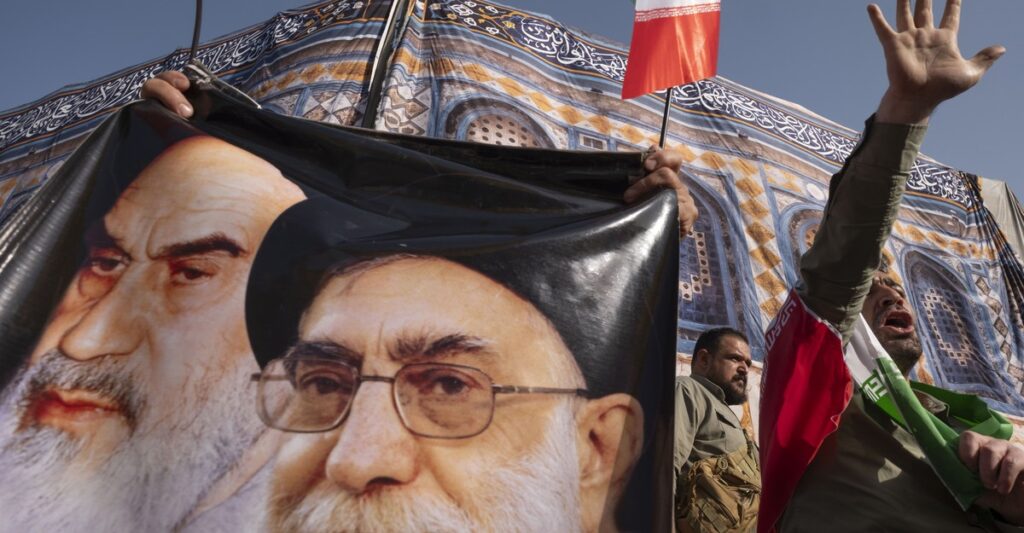
The United States has gone to war against Iran. America has only one ally – Israel – in this operation (the Arab states of the Gulf, who fear the Iranian regime, are targets of Iran, but so far are not participating in the attack), and both Washington and Jerusalem are making claims about “imminent” threats that require “preemptive” strikes. But we should dispense with such statements: Iran is not presenting immediate danger to the United States or Israel. Even President Trump, in a recorded address, didn’t bother overly much with such excuses; instead he presented a farrago of charges and accusations going back a half-century that included everything from killing American troops in Iraq to terrorism. These indictments are all grounded in truth, but none present a rationale for immediate attack. Trump ended by calling on Iranians to rise up and overthrow their government.
This is not a preemptive war. It is a war of choice, a discretionary war. It is a war for regime change. Many of Iran’s 92 million people want the regime removed. But it is far from certain that this will be the outcome.
To think about the possible courses of this war, we should start by clearly understanding three realities: First, Iran is a terrible regime that deserves to fall. The regime recently murdered thousands of its own citizens who were seeking freedom from their oppressive rule, and no one should be shedding tears for the mullahs hiding in their bunkers.
Second, “success” is not impossible – if by “success” we mean the fall of the ayatollahs and the rise of a better, more humane, pro-Western government that does not seek to destabilize the Middle East, dominate Lebanon, Iraq and Yemen, and eradicate Israel. But the path to that success is exceedingly narrow and mined with significant hazards. Destroying the regime’s capabilities is relatively easy, but nothing permanent – as Americans learned in Vietnam, Iraq, and Afghanistan – is achieved by bouncing rubble and piling up bodies. Destroying the regime itself is a far trickier business; dictatorships have a high pain tolerance, especially when the hapless citizens, not the leaders, bear the brunt of that pain.
Third, the president has not offered a strategy, or identified any conditions that would signal that U.S. goals have been achieved. Yes, he has vowed to prevent Iran from gaining nuclear weapons, but beyond that, he seems to be arguing for just inflicting military damage on the regime, on the assumption that enough ordinance on enough targets will weaken the grip of the ayatollahs. Once the theocrats are on the ropes, the thinking seems to go, the people of Iran will finish the job of regime change for us.
Americans have tried this before. In 1991, after stripping Saddam Hussein of much of his military power, George H.W. Bush called on the people of Iraq to rise up. That call led to disaster, as Saddam attempted to commit genocide against the Kurds in the north and and the the rebelling Marsh Arabs in the south, campaigns that would have been even more murderous without U.S. and British air power patrolling those regions.
Later, in 2003, we succeeded in taking down the Iraqi regime, and then bumbled our way through the ensuing chaos. Charmed by stories that Jeffersonian democrats were lining up to run the country, we disbanded the Iraqi military and exiled all the Ba’ath Party members from their jobs. These were disastrous choices, but they were undertaken with far more preparation and forethought than Trump has apparently given to a war against a much larger nation; worse, he seems resistant to any concerns among even his military advisers.
Years later, the U.S. and its allies conducted a similar operation against Libya. With the approval of the UN Security Council, and with a vow not to put boots on the ground, U.S. and NATO aircraft stripped Moammar Qaddafi of his military and security assets, effectively leaving him vulnerable to the armed rebels that were heading into the cities. These groups got their hands on Qaddafi and almost tore him to pieces. We then washed our hands of the whole business.
[Read: An Iranian network is ready to act]
America twice had its hands full in Iraq, a nation of 37 million, even with the assistance of several nations. The U.S., France and Britain managed to subdue tiny Libya, a nation of seven and a half million, and left its dictator to be raped and beaten in the streets. This time, conditions are different and more challenging: The target is two and a half times the size of Iraq; America has exactly one openly declared ally in this enterprise; no serious armed rebel force exists in Iran;and no coalition of nations is assembling to march into Tehran.
Trump has boldly told the regime to lay down its weapons and surrender—but to whom? Interestingly, the president in his speech did not rule out American boots on the ground. Does he envision a conquering American general accepting the pistols and swords of the IRGC in some sort of ceremony?
Here’s one way, however, all of this can go right: The air campaign is so well-designed, so precise, and so thorough that it strips the regime of its major military formations and its security police. Some of the top leaders are killed in at least a partial decapitation, and other forces begin to defect to the side of the people en masse. Rebel groups form quickly and efficiently to seize weapons and set up alternative ruling councils across the country. They cooperate with each other, rather than bicker or actually fight. Outside powers in the region stay away, and let the Iranian people sort out their destiny. Peace, of a sort, comes to Iran.
Unfortunately, ways that all this can go wrong are more numerous and more likely. Perhaps the Americans, for example, take unexpected casualties, and Trump – who seems to be counting on an easy victory – pulls back (Trump has spent years decrying American presidents who cost the lives of America’s soldiers; it seems unlikely that he will blithely accept American casualties.) The regime rallies, kills even more of its own people, and survives to fight another day. Or the current regime falls, and is replaced by a junta or military regime even more brutal than the one that’s just been destroyed. Or, what happens if Iranian retaliation turns out to be more effective than the Americans or Israelis expect, and the region becomes embroiled in repeating cycles of murder and reprisals that leave Americans and Israelis and others dead, but the regime intact?
Another possibility is that the bombing goes well, but America demurs from doing much more, and the rebellion is abandoned. People who believed they were going to be rescued by the American cavalry find themselves, like the people of Afghanistan, abandoned and left to be cut to pieces by a regime we’ve grown tired of fighting. And of course, Iran can cause havoc with shipping lanes and try to bait the U.S. and Israel into a larger commitment – or a larger war – than they planned.
When the 2003 war with Iraq ended, U.S. Ambassador Barbara Bodine said that when American diplomats embarked on reconstruction, they ruefully joked that “there were 500 ways to do it wrong and two or three ways to do it right. And what we didn’t understand is that we were going to go through all 500.”
[Listen: What the Pentagon fears in Iran]
Trump, who has not consulted Congress, has done little to explain the war to the American public, and has made no effort to build a coalition of allies, does not have that luxury. The president, a former casino boss, is taking a huge gamble. He has drawn his cards; the chips are now on the table. He has exactly one shot at getting this right. As Tom Warrick, a former Department of Homeland Security official, posted on X, Trump is trying to draw an inside straight.
Every so often, that pays off; Inside straights do exist and occasionally a player manages to put one together. But any gambler will tell you: It’s not usually the way to bet.
The post Trump’s Enormous Gamble on Regime Change in Iran appeared first on The Atlantic.