“On the eve of each war at least one of the nations miscalculated its bargaining power,” wrote the historian Geoffrey Blainey in his book The Causes of War. “In that sense every war comes from a misunderstanding. And in that sense every war is an accident.”
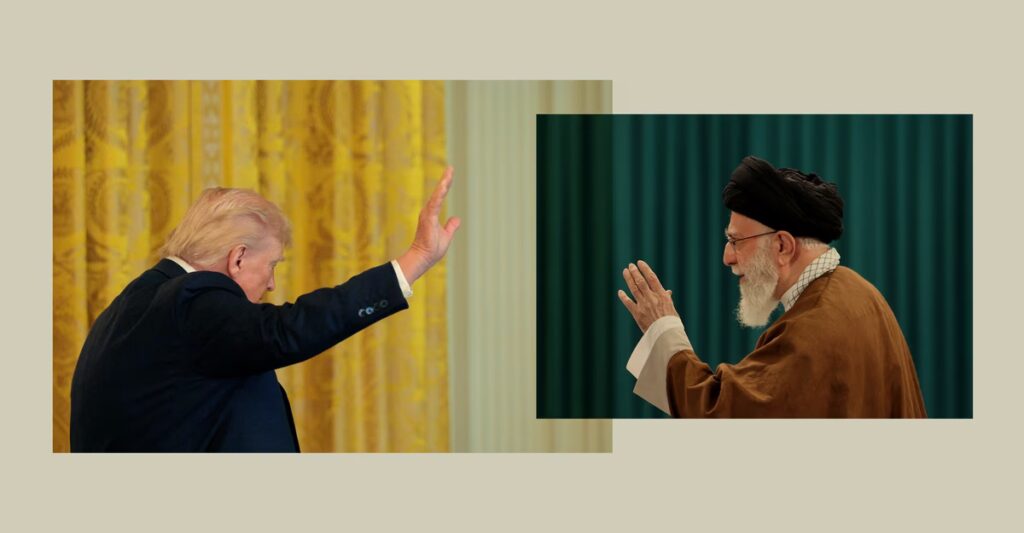
The U.S.-Iran war—or, to be accurate, its latest, and most dramatic iteration—grew from a high-stakes exchange of miscalculations between two men. Donald Trump and Ali Khamenei have little in common except for a vainglorious hubris that has distorted their strategic choices. For Trump, the conflict is a high-risk, high-reward gambit—the ultimate deal, with the Middle East as the table. For Khamenei, whose official compound was targeted by air strikes, it is something simpler and older: a fight for survival.
Trump’s hubris is a matter of performative strength. He has based his brand on being the ultimate dealmaker, making military action more palatable to him than even the appearance of having been out-negotiated. Khamenei’s hubris is a matter of ideological rigidity. He sees his theocracy as divinely mandated and has just presided over a historic mass murder to secure his rule. His focus is not on appearances, but on the cold mechanics of survival.
Trump has long approached high-stakes geopolitics with an amateur’s certainty. According to a 2016 account in The New Yorker, as far back as 1990, Trump offered a U.S. nuclear negotiator unsolicited advice on how to handle the Soviets: Arrive late, stand over the counterpart, stick a finger in his chest, and say, “Fuck you!”
[Karim Sadjadpour: The Iranian hedgehog vs. the American fox]
He saw the complexities of enriched uranium and ballistic missiles as secondary to the theater of dominance. And in that arena, he believes he has the upper hand against Iran—a view reinforced by his experience, including his 2018 withdrawal from President Obama’s nuclear deal, his 2020 killing of Iran’s top general, and his 2025 bombing of Iran’s nuclear sites, all gambits that cost him little.
The apparent ease with which the Trump administration replaced Nicolás Maduro in Venezuela in January likely reinforced this impression. As General David Petraeus recently cautioned, just as the swift fall of the Taliban in 2001 fueled unrealistic expectations for regime change in Iraq, the lightning capture of Maduro—and the seemingly seamless transition to Delcy Rodríguez—may have led Trump to believe that such a scenario is easily replicable in Iran.
If Trump’s hubris has been fortified by experience, Khamenei’s has persisted in spite of it. Long after Iran’s regional proxies and nuclear program had been significantly degraded by Israel and the United States, Khamenei continued to speak as one assured that God was on his side and that the present crisis could simply be endured. He dismissed the United States as a “corrupt, repressive, illogical,” and “crumbling empire,” citing Jeffrey Epstein’s “evil island” as the sinister culmination of 300 years of Western civilization. Washington, Khamenei said, lacks the “staying power” for a true confrontation with Iran. More dangerous than any American warship, he recently taunted Trump, “is the weapon that can send that warship to the bottom of the sea.”
The historian Barbara Tuchman once described four kinds of misgovernment that stem from a leader’s hubris: tyranny, excessive ambition, incompetence, and “folly”—the pursuit of policies contrary to the nation’s interests. Khamenei’s Islamic Republic has checked every box. In the face of decades of evidence of his worldview’s failure, his belief in its righteousness has remained unshaken; he has appeared more prepared to die a martyr than to capitulate, his endgame reduced to the simple clarity of living to fight another day against America.
Trump, in contrast, exhibits the hubris of excessive ambition, if not for a specific outcome, for his own ability to bring about an epoch-making consequence. Yet the range of options he debated during the negotiations—from a broad diplomatic deal to a military operation with the goal of toppling the regime—suggested a man with an uncertain sense of his own appetite, torn between ordering the side salad or a 32-ounce tomahawk steak. His choice of representatives—his son-in-law Jared Kushner and the special envoy to the Middle East, Steve Witkoff—seemed better suited to a part-time real-estate negotiation, conducted between rounds of golf and business deals. Even Trump’s address to Iranian forces on the night of the strikes sounded like a closing argument across a negotiating table: “Lay down your weapons and have complete immunity. Or, in the alternative, face certain death.”
For the Islamic Republic, the standoff is an all-consuming ideological war for both personal and regime survival. These are two fundamentally different distortions of reality: One leader views the world as a transactional playground where everything is for sale, while the other views his own survival as a world-historic necessity, regardless of the ruin it brings to his people.
America’s military superiority is overwhelming, but in this contest, it is not necessarily decisive. The two sides are playing for different stakes: Washington seeks a transformative victory, while Tehran seeks only to survive. As Henry Kissinger once noted of guerrilla warfare, the insurgent wins by not losing, while the conventional power loses by not winning.
[Arash Azizi: The ‘existential anxiety’ of the Islamic Republic]
In very few theaters do American values and interests converge as seamlessly as they do in Iran. A tolerant, representative Iranian state would both transform the lives of its citizens and fundamentally reorder the geopolitics of the Middle East toward stability and prosperity. But Washington has lately wavered in its commitment to those values and in doing so stripped itself of its most potent tools of influence. Hard power alone can depose a regime, but it is notoriously incapable of cultivating a better successor. Trump’s simple admonition to the Iranian people on the night of the strikes reflected this gap between destructive capacity and strategic vision. “When we are finished,” he told them, “take over your government. It will be yours to take.”
The immediate trigger for this crisis was the massacre of tens of thousands of Iranians whom Trump incited, and then abandoned, and now has called upon to rise up. He has chosen military action with an unclear endgame, relegating the U.S. military, regional partners, and 92 million Iranians to serve as anxious participants in an unscripted geopolitical drama. That is the ultimate hubris: a president more focused on the spectacle of power than its consequences, facing off against a martyrdom-obsessed theocrat who is more prepared to see his nation burn than his own power extinguished.
The post Trump and Khamenei’s War of Choice appeared first on The Atlantic.