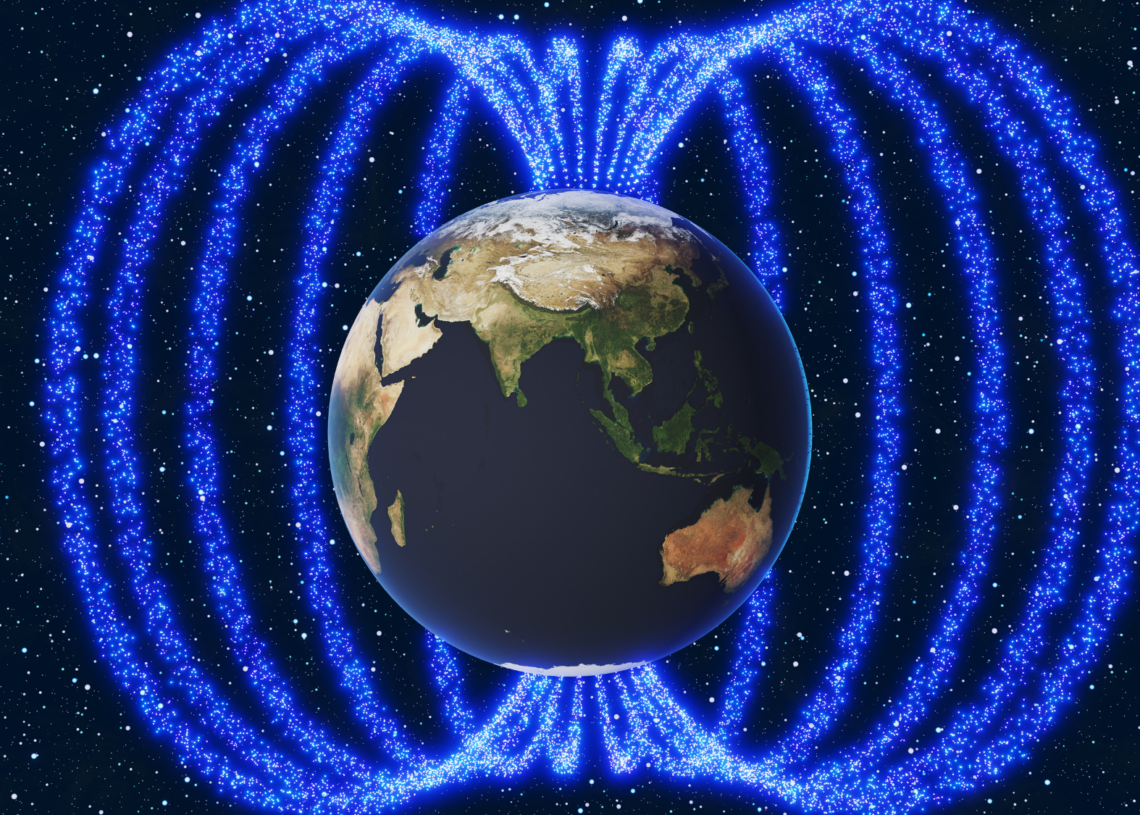
Earth’s magnetic poles have flipped dozens of times since the planet formed, with north and south changing places after they get tired of the old scenery.
These geomagnetic switcheroos aren’t scheduled events. They started happening roughly every 100,000 years. More recently, they’ve slowed to about half that rate. And during some stretches, they seemed to vanish almost entirely.
Now, according to research conducted by Kyushu University in Japan, which published its work in the journal Geophysical Research Letters, scientists argue we may have missed several reversals, especially in those long, silent stretches.
Zebra Stripes on the Seafloor
We know reversals have occurred because they leave physical evidence in the form of iron-rich lava that locks into place as it cools while pointed in the direction of the Earth’s magnetic field. Cooled lava literally creates an arrow telling us which way is up. Along mid-ocean ridges, this creates alternating magnetic “zebra stripes” on the seafloor. Unfortunately, the further back you go, the patchy are the record becomes. Oceanic crust starts to get recycled and destroyed or buried, erasing all record of pole flips.
Three years ago, a research team led by Dr. Yutaka Yoshimura at Kyushu University found evidence of overlooked reversals in 30-million-year-old Ethiopian volcanic rocks. If relatively recent flips were missed, older ones may be hiding too.
Using a statistical method called adaptive bandwidth kernel density estimation, Yoshimura and colleagues reanalyzed reversal timelines. They focused on the period after the Cretaceous Normal Superchron, a 37-million-year stretch when dinosaurs ruled, and pole reversals seemingly stopped altogether.
Is There a Rhythm or Not?
The new research identifies four intervals, about 14 million years apart, where reversals also happened rarely, or at least seemingly so. If those probable flips are factored in, the reversal timeline smooths out and makes the system look more or less as it should, with pole flips happening with some degree of regularity.
Understanding their rhythm could shed some light on why they happen at all, something the scientific community hasn’t fully grappled with yet. One leading theory suggests that maybe they have something to do with the heat flow changes at the boundary between the Earth’s core and mantle. But ultimately, no one really knows why they flip, nor do we have any direct evidence of the missing flips yet. But they’re out there, evidence buried in stone.
The post How Many Times Have Earth’s Magnetic Poles Flipped? appeared first on VICE.